

It’s just a faint, distant memory now, but way back in the halcyon days of 2016, a billion seemed like a lot. A decade later, we now have more than a dozen publicly traded trillion dollar companies (with a few more likely headed down the pipe later this summer), one of which just officially minted history’s first trillionaire in Elon Musk (you might have heard of him). There’s no doubt something to be said here about the Cantillon effect and the inexorable erosion of fiat currency driving headline figures that become increasingly unfathomable (O/U first quadrillionaire by 2040?), but there’s also much to be said about what the rise of SpaceX represents, not just for the American spirit but also as an illustration of the unrivaled depth of American capital markets and the kinds of innovations they can be marshaled to enable. That degree of capital formation is, for now, still the exclusive purview of the American empire (don’t look now, but CQQQ is red YTD and on a 5-year lookback), and SpaceX’s rise and legitimately impressive set of technical accomplishments testify to the fact that that deep liquidity can still fund bleeding-edge physical projects that truly push the frontier of human capability rather than just the nth delivery app or prediction market.
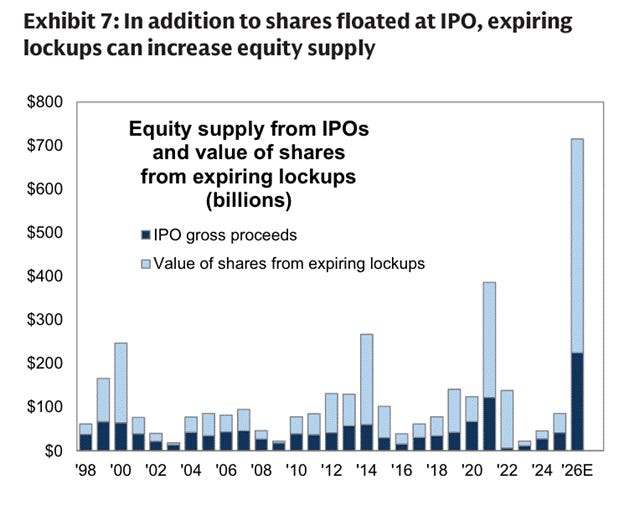
None of this is to say that SpaceX is necessarily a buy here (mind the lockup expiration schedule), nor is it to suggest that America’s rivals aren’t quickly making meaningful strides of their own. But if the current administration, or whatever faction of the Deep State is presently operating the controls, is truly determined to use every trick in the book to win back the critical physical supply chains that have left the US uncomfortably dependent on foreign counterparties, then SpaceX is a meaningful indicator that the old dog can still hunt. That “giant sucking sound” you hear is a half-century of foreign trade surpluses reversing, of dollar rails ceasing to be a public good subsidized by the beneficence of the taxpayer, and of industrial policy starting to gain real momentum. To be sure, history suggests that this will bring federal backstops, government grants, fiscal largesse, expanding deficits, and (in some form) money printing, so we continue to think it wise to consider how that flood of liquidity may flow to certain highly scarce assets over time (particularly assets where Americans already have a favorably skewed ownership share vs the world at large).
As the world’s largest investor focused on the convergence of bitcoin, energy, and AI, Ten31 has deployed over $200 million across two funds into more than 30 of the most promising and innovative companies in the ecosystem. Visit ten31.xyz/invest to learn more and get in touch about participating.
Selected Portfolio News
Giga Energy launched a new Power Systems Market Data Tool to give site operators stronger transparency into key pricing and market metrics:


Media
AnchorWatch’s Co-Founding team of Rob Hamilton and Becca Rubenfeld joined the Blockspace show to discuss prediction markets, bitcoin, and more.
Market Updates
After years of anticipation and more than a few side quests along the way, SpaceX finally went public on Friday in the largest initial public offering of all time, making Elon Musk history’s first trillionaire.
It’s not clear if the liquidity drag ostensibly created by this mega-offering will abate as the stock enters regular way trading, but with OpenAI adding its own confidential S1 filing to the mix this week, we think we may have to wait a little longer to get any clarity there.
What’s equally unclear is whether the two-sided kayfabe between the White House and the IRGC is ever going to advance any further, as President Trump this week responded to Iran’s unilateral termination of talks with a promise that the US will soon seize Kharg Island and the country’s oil infrastructure…followed by a claim that the war is basically over subject to dotting some i’s and crossing some t’s, comments that pushed oil to its lowest level since early March.
For what seems like the fifteenth time, though, the two sides appear to have very different ideas of what they’re actually signing, even as Iran’s foreign minister says a deal has never been closer.
Perhaps most notably, Treasury Secretary Scott Bessent ramped up rhetoric about using seized Iranian assets to fund the reconstruction of America’s Persian Gulf allies battered by Iranian strikes, the latest escalation of dollar weaponization we would only expect to ramp further from here.
That weaponization has certainly stimulated various attempts at throwing off the dollar yoke, but the South China Morning Post ran a noteworthy piece this week on the practical limits of the de-dollarization process for China and Russia, including a variety of unavoidable frictions and bottlenecks exacerbated by secondary US sanctions.
Elsewhere in US gambits for shoring up global hegemony, the Trump administration is reportedly seeking to purchase the Chagos Islands from Mauritius in an attempt to gain permanent control over Diego Garcia air force base, a key strategic asset in the Indian Ocean whose status has been thrown into question by the UK’s decision to give up its claim on the territory.
On the same thread, the Wall Street Journal published a piece on the growing US-China tug of war for access to and control over critical minerals production in Brazil, which boasts the world’s second-largest rare earths reserves but essentially no active production.
Meanwhile, right on schedule, President Trump said he’s “not looking to renew” the USMCA governing North American trade given that “we don’t need anything Canada has.” While the disgruntled, oil-rich citizens of Alberta may disagree, the move comes as an unsurprising escalation in the US’s attempt to rewrite trade rules with its northern neighbor.
Domestically, the latest inflation numbers came in firm this week, with headline CPI breaking 4% for the first time in three years, driven largely by energy as expected (though for what it’s worth, the M/M moves have been trending down since the start of the Iran war). The core (ex-energy) index hit 2.9%, with both numbers matching consensus.
Headline PPI was hotter than expected, with producer prices rising 6.5% Y/Y for the highest level since November 2022, though Core PPI was a bit below expectations.
Despite the energy-driven pressure, a few key dynamics appear to be keeping the upward impulse in check to some degree. Most notably, oil analysts suggest (as we’ve highlighted in previous issues) that China has dramatically curbed its imports and has likely been opting for material SPR drains over domestic demand destruction, limiting upward pressure on prices for now.
Of course, an historic US SPR drain is also doing a good deal of the legwork here, with American reserves set to drop to their lowest level since 1983. However, US Energy Secretary Chris Wright suggested traffic through the Strait of Hormuz has been “rising very meaningfully”; maybe the 15th time’s the charm.
Following months of breathless tech bro fanfiction and sci-fi guerrilla marketing, Anthropic finally publicly released its latest model Fable 5, which the company says is a version of Mythos with certain cybersecurity and ethical guardrails. Despite the shackling, the model appears to outperform basically everything.
At the same time, prominent OpenAI researcher Noam Brown published a thought-provoking piece arguing that we don’t actually know the capability limits of the current frontier models because it’s effectively too expensive to measure properly over sufficiently long time horizons, suggesting the ceiling on scaling laws may remain very far out.
Alongside the Fable release, Anthropic CEO Dario Amodei – who has deep ties to the Effective Altruism movement, which readers may recall was made famous by none other than Sam Bankman-Fried – published a new essay arguing for various EA-tinged social interventions to offset the assumed impact of AI, including extensive unemployment and underemployment insurance, as well as long-term economic support programs.
Right or wrong, this strain of proposal appears to have gained significant steam in many prominent circles, which longtime readers may recognize as the sound of the dormant printer trying to rev back up.
These kinds of proposals will need to confront the stark reality of the US’s existing base of liabilities, which was highlighted again this week by the Social Security administration’s announcement that it will now hit a shortfall by 2032, one year earlier than previously expected (intrepid observers may note that this estimated date gets one year closer with each passing year, which doesn’t paint a great picture for 2029).
Either way, Anthropic pulled access to the models just a few days later following a request from the Commerce Department on the back of reports that some users had been able to jailbreak Mythos. We’ll let readers decide how much of this is legitimate concern vs. a ploy to pave the way for stricter control of frontier models to limit distillation and build leverage (as another prominent Effective Altruist once said: if you’re good at something, never do it for free).

After another massive puke last week, bitcoin remained rangebound in the low $60,000 range all week as ETFs have continued to see consistent outflows, bringing cumulative ETF net flows to July 2025 levels.
That said, BlackRock filed an 8A form for its upcoming bitcoin income ETF, pointing to a likely launch within the next week.
Regulatory Update
US Senator and longtime bitcoin advocate Cynthia Lummis – who will not seek re-election this fall – reiterated her support for a strategic bitcoin reserve, noting that the US should be accumulating bitcoin “loudly, by law.”
Noteworthy
Bitcoin startup Second launched Bark, its implementation of the Ark protocol, on mainnet this week, potentially adding another pathway for improving self-custodial bitcoin payments UX. The implementation quickly saw its first major potential application in the form of a simple proof of reserves scheme for Cashu ecash mints.
FTX Founder Sam Bankman-Fried, currently serving a 25 year sentence for fraud and Various Ponzi Activities, officially applied for a pardon from the Trump Administration. Tinfoil hat enthusiasts may want to keep tabs on this one.