

We unfortunately need to start this week on a somber note, as any bitcoin users in the audience should be aware of a critical security vulnerability affecting many models of the popular Coldcard hardware wallet. In short, most seed phrases generated on Coldcard firmware released after ~2021 can no longer be treated as secure, and we recommend near-term action for any Coldcard users. Much more detail on which setups and scenarios are most affected can be found here and here, but for the moment we recommend treating all wallets that depend on any Coldcard model (including multi-signature wallets that depend on a quorum of Coldcards) as potentially insecure and taking action to move funds as soon as practical. We’d stress that proceeding calmly is paramount at a time like this, and in many cases the best next move may simply be to transfer funds temporarily to a reliable exchange like Strike, Fold, or River. Collaborative custody providers like Unchained and AnchorWatch can also provide products and guidance to assist users with an orderly migration. There are many, many takeaways from this incident that will be hashed out over the coming weeks, but for purposes of this newsletter’s usual focus we’d just note that the discovery of the vulnerability (as well as its diagnosis and solutions) appear to have been materially aided by the latest open source AI models. We therefore strongly suspect that, while this situation is isolated to a subsegment of bitcoin, it is the harbinger of a much broader cybersecurity arms race that will have an expanding blast radius for traditional systems going forward.
The rest of the week also had its share of bleak points, including a resurgence of hostilities around the Persian Gulf (which even bled into Ukraine this time around), benchmark long-end yields breaking out to noteworthy new highs, and a cascading liquidation selloff in tech that threatened to push the Nasdaq into correction territory before San Francisco’s AI Golden Boy was summarily shown the door by New York’s Finest Market Maker (Leopold, we hardly knew ye). In our view, these headlines and more continue to point to a sclerotic system lurching toward a phase change that will feature some combination of monetary repression (though what exact shape that takes remains to be seen), an increasingly tight relationship between the state and private industry, and fracturing global trade relationships, all of which make an ongoing strong case for bitcoin’s role in the evolving order even in the midst of an extremely tough week for many individual bitcoiners.
Media
AnchorWatch Co-Founder and CEO Rob Hamilton – who has been instrumental in helping to diagnose the Coldcard vulnerability and helping users keep funds safe – joined Natalie Brunnell to discuss the evolving situation.
Strike Founder and CEO Jack Mallers also appeared on Natalie’s show and What Bitcoin Did to dig into his decision to step away from Twenty One Capital and what’s next for Strike.
Ten31 Managing Partner Matt Odell joined What Bitcoin Did as well to discuss the bitcoin bear market, bitcoin treasury companies, and more.
Market Updates
Like Lucy and Charlie Brown, the US and Iran once again gave the market some false hope to kick off this week, with the two sides declaring yet another peacefire as they looked to reopen negotiations.
Shortly thereafter, Iran decided you can’t have a good peacefire without a little surprise attack to keep things interesting, firing missiles at US bases late Tuesday night. President Trump responded as you might expect, scuttling any hopes for another artful deal near term.
In a potentially concerning development for anyone not interested in World War III, the conflicts in Ukraine and Iran briefly collided this week, as the embattled European country attacked an Iranian shipping vessel in the Caspian Sea, prompting IRGC threats of retaliation.
Amid the ongoing exchange of missiles and drone strikes, Axios (which is either a US-aligned propaganda outlet or a tool of IRGC subversion, depending on the day) reported intelligence suggesting that Iran is “more afraid of Treasury than the War Department” as recent Treasury sanctions have pressured domestic banks and made it more difficult to pay IRGC operatives.
To that point of financial warfare, President Trump said this week that frozen Iranian assets will be used to pay for repairs to any tankers and cargo ships damaged by recent strikes in the Gulf.
Extending the theme further, the Senate overwhelmingly voted to advance the “Lindsey Graham Sanctioning Russian Act”, which would give the President broad new powers to impose secondary sanctions on customers of Russian oil, including tariffs of up to 100% on all exports from Russia’s top customers.
It was also Fed Week once again, and as always there were no shortage of takes going into and coming out of the FOMC meeting. The President offered his own view early in the week, noting that new Fed Chair Kevin Warsh “wants to do the right thing” (pundits everywhere were mystified as to what Trump might have had in mind) but that he was being hamstrung by a Board that is “too political.”
As expected by most, the central bank held its benchmark rate steady at the meeting, though three members voted for a hike due to growing fears of inflation (this group predictably included Neel “Infinite Cash”kari, who couldn’t be bothered to worry about inflation while pinning rates at zero and sending the Fed’s balance sheet vertical for years under a prior administration).
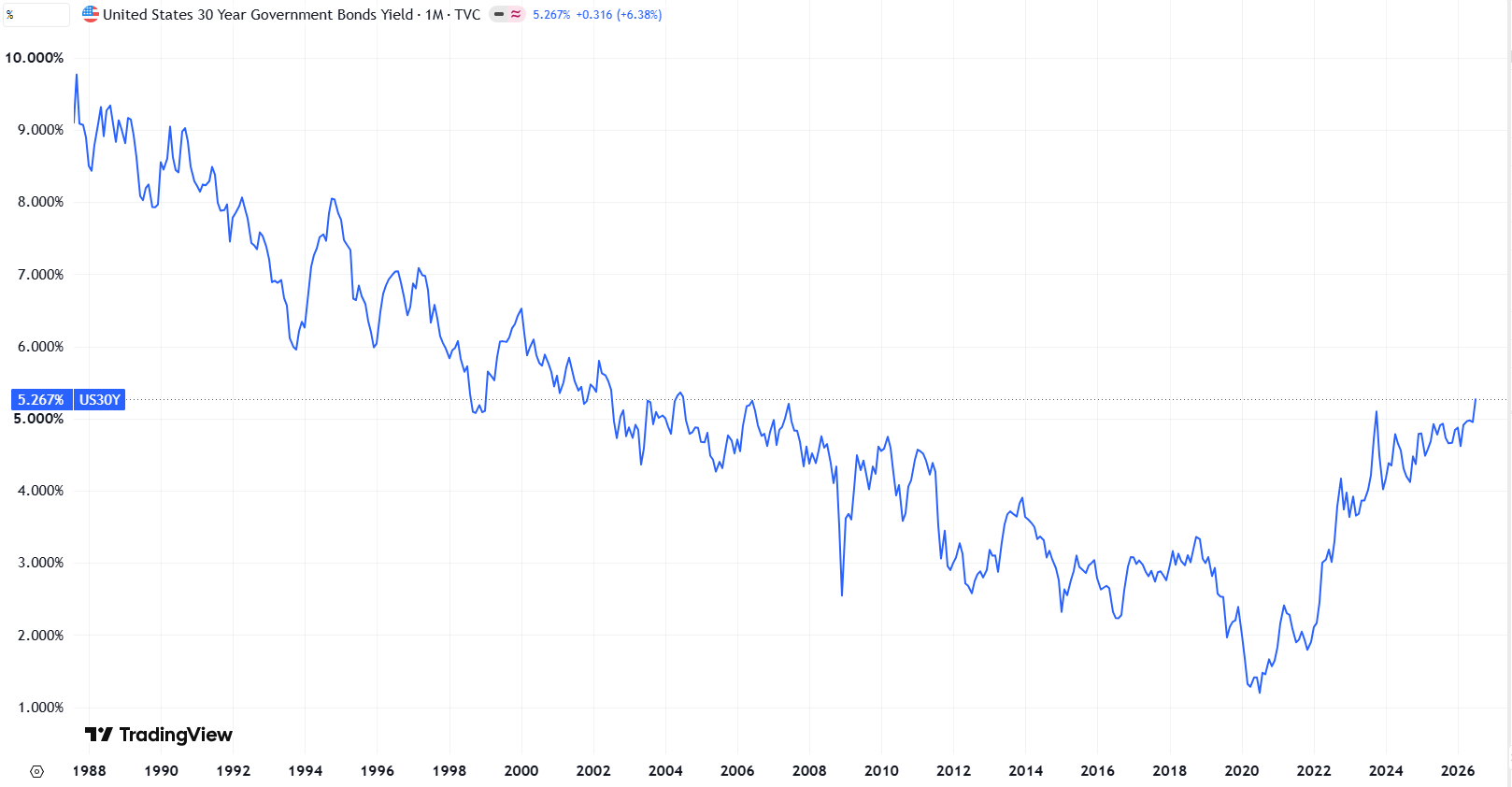
The long end was not happy with the decision (or Warsh’s relatively obscure comments at the press conference), as the 30-year Treasury ripped back to new highs from 2007 and the 10-year broke the 4.75% level for a ~2 year high.
Incidentally, with rates moving higher and putting pressure on an already strained federal interest line item, Elizabeth Warren reiterated comments from last year that she’s finally found a point on which she and Donald Trump can agree: abolishing the debt ceiling.
Philips Curve enjoyers (an increasingly endangered species) got more data to back their inflation fears this week, as the latest US Manufacturing PMI came in at 53.8, down slightly M/M but still clearly in expansion territory and marking a full year with readings north of 50.
Meanwhile, GDP growth for Q2 came in at an optically soft 1.5%, but that headline was largely an artifact of higher net imports, as consumer spending rose more than 3% and business equipment spending ramped by over 15%.
That business investment lever continued to see more (questionably sustainable) momentum from its key driver this week, as AI accelerator giant Nvidia is reportedly in talks with OpenAI to backstop a $250 billion financing deal for a massive 10GW Ohio facility that would be the single largest data center ever built.
We’d note some meaningful nuances to this headline figure to put it into perspective, and we’d also flag that the financing for the power buildout is coming from Japan in exchange for lower tariff rates, with Commerce Secretary Howard Lutnick reportedly “involved in deciding who will get power,” elements that both seem to fall cleanly into the administration’s aggressive shift toward extracting more concessions from trading partners and ramping up industrial policy.
Of course, the market understandably is not so sure about all this backstop business, as Nvidia credit default swap spreads jumped to their highest levels on record (on an admittedly very, very short time horizon).
Our frenemies on the other side of the Pacific are not slowing down either, as Chinese memory giant CXMT went public and immediately ripped 5x on its first day of trading.
At the same time, The Information reported that China has started producing its own DUV (note: not EUV) machines at “high volume” (though it’s not entirely clear what that means), which spooked markets given that it suggests progress on lithography, a key Western advantage in the semiconductor supply chain. While we would never underrate the inventiveness of the Chinese, for perspective we’d note that this development represents roughly where ASML was in 2011.
It was also a busy week not just for hard AI infrastructure but also models themselves, as leading Chinese open source model Kimi K3 officially released its model weights to enable independent self-hosting.
Interestingly, though, Bloomberg reported that Kimi K3 was in fact trained on a cluster of 20,000 Nvidia H200s (which are technically subject to US export controls) acquired by Alibaba. If true, this is directionally confirmatory of the ongoing importance of US accelerators as a tool of geopolitical leverage, but it’s also worth noting that this would mean that the most popular open source model that both attackers and white hats are using to audit vulnerable code bases was effectively trained on accelerators two generations behind the frontier (we’ll let readers extrapolate from there).
In a similar vein, competitive open source model provider DeepSeek reportedly suspended its current fundraising round after its founder’s comments on the company’s continued reliance on Nvidia drew backlash from the Chinese government.
As the open vs closed model debate continues to gain steam, Nvidia, SpaceX, and Microsoft came together to launch an AI cybersecurity initiative focused on leveraging open source models. The group includes more than 200 of the largest technology and AI infrastructure players in the US, including OpenAI (but with one perhaps conspicuous absence).
In unrelated news, Anthropic CEO Dario Amodei published the company’s formal stance on the debate, noting that the company is not opposed to open models but also wants to see more serious export controls on frontier technology.
In any case, Meta CEO Mark Zuckerberg said all you doomers just aren’t bullish enough on AI and that the US should accelerate rather than restrict its pace of development.
South Korea took his advice to heart, announcing that it will inject $14 billion into the country’s sovereign wealth fund to support AI and data center investments, another data point on the long road toward merging the modern state’s fiscal power with the AI buildout (and it probably also doesn’t hurt as a support mechanism for the KOSPI, which is still licking its wounds from a 40% drawdown this month).
That same violent decline in many AI-linked stocks spelled the end for Leopold Aschenbrenner, the rising AI wunderkind who saw his Situational Awareness fund (which, in hindsight, was evidently not aware of some relevant situations) swell to $45 billion in AUM before getting liquidated on levered AI bets this week; as ever, Kenny G was there to pick through the wreckage.
On the physical AI front (back in my day we just called them robots), the FCC imposed new import bans on Chinese robot models to protect the US’s buildout of its own robotics strategy, prompting China to threaten its own trade retaliation, which could include further restrictions on rare earth exports.
And speaking of robots, Nvidia (there’s that name again) struck a deal with Kawasaki Heavy Industries for a new joint venture focused on “next-generation digital shipyards” using robotics to better automate shipbuilding. This is likely both a sign of things to come (i.e. aggressive reindustrialization / “friend-shoring” will inevitably require automation to address skilled labor shortages) and a sign of the increasing entanglement between the US and Japan.
Regulatory Update
Following months of debate and revisions, a key Senate Democrat said she now feels optimistic about compromise changes to the CLARITY Act after “productive negotiations with law enforcement.”
BlackRock, Fidelity, Goldman Sachs, SoFi, and other institutions also publicly came out in support of the latest version of the bill this week.
Even more notably, Treasury Secretary Scott Bessent published a lengthy tweet pushing hard for the bill as well, noting it now has consensus from a variety of constituencies (and, for what it’s worth, emphasizing that it continues to delineate protections for developers of noncustodial software).
Down on his luck former trillionaire Elon Musk is reportedly planning to ramp up spending on midterm campaigns into November’s election season, which is worth watching given longstanding consensus that midterms will be a bloodbath for Republicans.
Noteworthy
The Bitcoin Policy Institute was named as a partner in the State Department’s new “Freedom Tech Excellence Program.”