

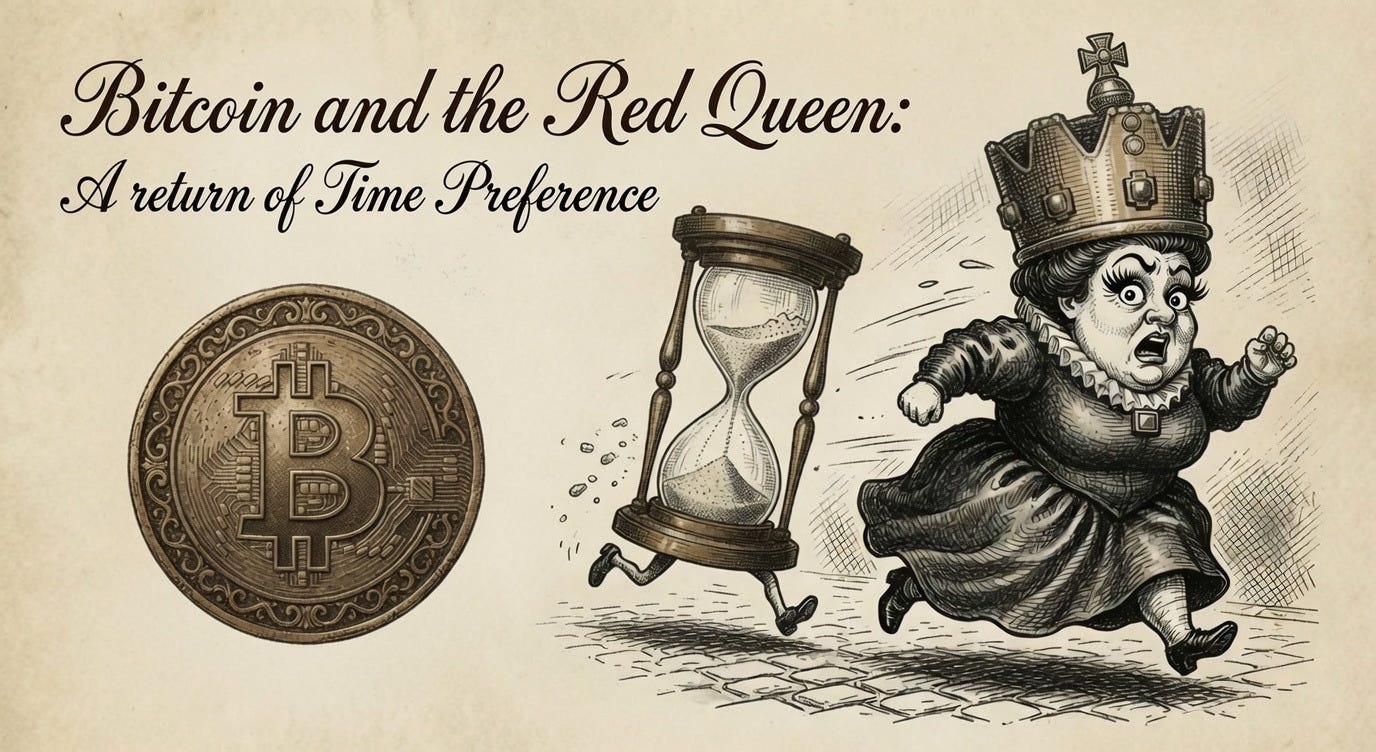
An economy exists to satisfy human wants across time, with capital enabling individual economic participation through choice. How an individual chooses to use capital is the physical expression of their time preference. Whether capital is held, deployed, pledged, or spent, every action is a judgment on what the future is personally worth relative to the present. Our fiat system structurally distorted this calculation. An expanding money supply imposes a persistent erosion on patience. Capital is driven to move out of a necessity to outpace decay, rather than being drawn towards opportunity. Movement is not a choice, but a coerced Red Queen’s race. Consequently, fiat replaces a patient option with a binary decision: you either run to stay in place, or get left behind. Bitcoin, by contrast, restores a spectrum of opportunities across a risk curve, allowing and rewarding patience to active stewardship.
Bitcoin’s fixed denominator decompresses the pressure of dilution. It allows capital to be allocated according to market judgment rather than the need to offset monetary expansion. Consequently, bitcoin cannot be reduced to a single “use case”. To do so would be to ignore the agency of the individual. Bitcoin is not inherently a store of value or a medium of exchange, but a digitized capital environment that moves across a user’s spectrum of time preference. The asset makes no structural demands from the user as the user of bitcoin only asks for a unit of fixed supply. The same unit can sit dormant in a personal reserve, fund productive capacity through credit, or be spent for immediate utility. The asset’s characteristics remain constant. Only the holder’s intent changes expressed by their choice, not coercion. By simply reflecting the economic goals of the user, bitcoin restores the spectrum of capital allocation that fiat compresses.
When allocation is driven by intent rather than the fear of eroding purchasing power, capital functions as it was meant to: the lifeblood of the economy. Blood must circulate, for no living system survives stasis, but circulation is not the purpose. Life is. Blood moves to nourish tissue and sustain higher functions and capital is no different. At its best, capital flows toward productive enterprise, financing the infrastructure that expands what the economy can satisfy tomorrow. At its worst, it merely recirculates through financial claims and extended leverage, mistaking motion for health. An economy is not strengthened by the velocity of capital, but by whether that movement nourishes the productive body beneath it.
Credit extends purchasing power across time, allowing future production to finance present growth. However, credit loses its integrity when it is insulated from consequence through monetary dilution, perpetual refinancing, or fiscal policy backstops. In such an environment, capital is used to preserve the body of what once was, rather than building the body of what could be. Bitcoin restores economic consequence. Governed by the fixed denominator and final settlement, borrowing must once again justify itself against the future it claims to finance. Credit becomes sound only when it is tethered to productive judgment.
The utility of choice on how to use bitcoin is not exhausted by the binary decision whether to hold or spend. The choice on how you can best use bitcoin can broaden within new credit structures as dynamic collateral. By infusing bitcoin into the credit stack (equity, mezzanine and senior tranches) users capitalize a structure capable of supporting new enterprises without being surrendered. Rather than being consumed, bitcoin is enlisted in the service of growth and leveraged by assuming the risk of forfeiting its future appreciation.
In this framework, volatility is not a bug to be suppressed, but a mechanism of discovery. Volatility reveals whether a lending structure deserves to endure. On the downside, falling bitcoin collateral values force earlier recognition of risk and a tightening of underwriting. Weakness is confronted rather than deferred. On the upside, appreciating collateral improves coverage, accelerates deleveraging, and can reduce lender exposure. In the right structure, bitcoin’s volatility disciplines both sides of the loan. Thus, the ultimate test of credit is whether it builds more than it protects. When borrowing finances new capacity, it enlarges the future. When credit is used to preserve inherited claims or maintain the appearance of health, capital circulates in defense of the past. This is where systems lose vitality. Bitcoin matters because it reintroduces consequence, pressing credit back toward productive ends and away from reflexive preservation.
The Red Queen’s fiat economy asks how quickly capital can be pushed into motion before it loses value standing still. A bitcoin economy asks a harder, more vital question: What is worth preserving, what is worth risking, and what future is worth building? This is the deeper significance of the fixed denominator. It does not simply improve savings, but restores the conditions for judgment. Capital can once again move according to purpose rather than decay. The result is not less finance, but finance returned to its proper task: bringing into being more of what should exist.
🎯