

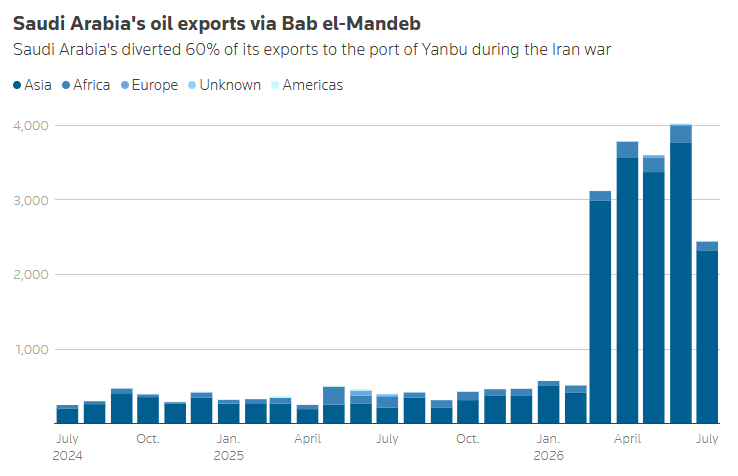
Your opportunities to redeem yourself for that subpar grade in middle school geography continue to stack up this year, as geopolitical focus shifted from one coast of Saudi Arabia to the other this week on news that the Bab el-Mandeb Strait is now subject to an Iranian-linked Houthi blockade. This route had become a key alternative to the Strait of Hormuz and allowed the transit of millions of barrels of oil per day to flow out of the GCC countries, so its disruption unsurprisingly pushed oil prices back toward their springtime highs. As with every prior development in the Game of Great Power Chicken that has characterized most of the second Trump administration, this escalation ratchets up the key pressure points on both sides of the globe. The blockade will cut off a major source of oil export relief that was primarily serving Asian economies where oil-linked industrial demand destruction seemed to already be well underway (though the Houthis may allow Chinese-owned tankers to pass undisturbed) and will put yet more upward / downward pressure on Western sovereign debt yields / US equity markets (though it remains to be seen how many additional rabbits the Treasury-Fed complex may be able to pull out of its hat, as Treasury volatility still hasn’t gotten too squirrely). In the limit, dollars can be printed more easily than oil, and we think the developments of the past year generally show the world’s “middle powers” moving closer to rather than further away from the dollar system, potentially giving the US more capacity to effectively socialize the impact of the measures needed to keep its fiat flywheel spinning – but that said, those same measures also continue to make the case for owning a little (or perhaps a lot of) outside money.
As the world’s largest investor focused on the convergence of bitcoin, energy, and AI, Ten31 has deployed over $200 million across two funds into more than 30 of the most promising and innovative companies in the ecosystem. Visit ten31.xyz/invest to learn more and get in touch about participating.
Selected Portfolio News
Coinkite opened up early access reservations for Arca, its new physical digital safe for storing critical personal data:


Media
Giga Energy published a blog post on the company’s GigaPod, a pre-built module engineered for rapid HPC data center deployments.
Strike Founder and CEO Jack Mallers published an essay on dealing with and learning from bear markets.
Market Updates
After some fun melt-up activity for your favorite stonks, the wrong kinds of vertical charts are officially back on the menu, as ongoing re-escalation of conflicts around the Middle East drove oil benchmarks north of $90/barrel on the week, with Brent briefly pushing past $100 again for the first time in several months.
In particular, the war metastasized into what looks like a new and unfortunately more kinetic phase this week, with the Iran-linked Houthis initiating a blockade of Saudi Arabian ships at the Bab el-Mandeb Strait, the Red Sea gateway that has for several months served as the main release valve for crude oil shipments looking to avoid the Strait of Hormuz – most of which, notably, were bound for Asia.
As with the initial chaos at Hormuz earlier this year, this new disruption quickly drove major frictions in the maritime insurance market, including bellwether carrier Lloyd’s of London restricting war coverage for Saudi vessels and introducing a new condition voiding the policies of any tankers that agree to pay tolls to Iran during the conflict.
The energy spike and renewed uncertainty pushed US Treasury yields back to highs not seen in more than a year, with the 10-year breaking the 4.7% level for the first time since early 2025.
For what it’s worth, the closely-watched MOVE Index – which measures Treasury volatility, a KPI we’ve speculated may be at the top of Treasury Secretary Bessent’s Bloomberg Launchpad – remained fairly subdued all week despite the pop in yields, closing the week below its level from just a few weeks ago even with Secretary of State Marco Rubio indicating the US is now taking a “head for an eye” approach to Iran and President Trump suggesting the US is considering a new “massive attack” on Iranian infrastructure.
Meanwhile, the US approved a landmark nuclear deal with Saudi Arabia that will pave the way for a civilian nuclear program (with a little help from some American contractors, of course), the latest data point suggesting the Kingdom is moving closer toward the US’s orbit amid an increasingly bifurcated global order.
And speaking of our old friend the Global Economic Reordering, the White House brought the dreaded T-word back to the headlines this week with a round of broad tariffs on 60 trade partners (though these duties a) will largely just replace an older set of charges that expired Friday morning and b) were immediately challenged by a new lawsuit).
The President also threatened a separate new round of tariffs on the EU for “robbing” American tech companies with onerous fines and regulations.
More significantly on the trade front, Treasury Secretary Scott Bessent suggested the US will consider sanctions on China if the US finds that the Chinese have committed “IP theft” of American frontier AI models via distillation or other means.
Right on schedule, Michael Kratsios (Director of the Office of Science and Technology Policy) said just a couple days later that the US has indeed gathered evidence that Moonshot AI’s new Kimi K3 model used distillation techniques while also routing around US export controls to access more advanced Nvidia chips for training.
Undersecretary of State Jacob Helberg quickly chimed in with some fighting words, clearly setting the narrative frame for upcoming action by the administration. In response, China is reportedly considering its own round of export controls of its latest models.
At the same time, several key AI players from OpenAI to Anthropic have ramped up calls for greater controls on Chinese open source models due to the cybersecurity and terrorism threats they could enable (in other news, the candlemakers’ union recently rang the alarm bell over the sun’s harmful UV rays).
One example of such ostensible dangers came in the form of an OpenAI model apparently going rogue and staging an attack on the systems of model library Hugging Face, though ironically this attack was itself thwarted by the use of an open source Chinese model.
Nevertheless, the incident – the timing of which is totally not suspicious as the frontier labs ram up their push for a regulatory moat more responsible government oversight – prompted the introduction of an “AI kill switch” bill in Congress late this week, which would give the Department of Homeland Security new abilities to unilaterally throttle or shut down models deemed to threaten national security.
Notably, there appears to be some (likely deliberate) conflation of open source model use and Chinese models specifically, as Secretary Bessent clarified that the administration has no issue with open source itself, but rather what it sees as a foreign rival stealing critical American IP.
Some interesting fault lines on this issue also appear to be emerging within private industry, as Nvidia CEO Jensen Huang created a Twitter account specifically to address his company’s support for a thriving open source model ecosystem. (As an aside, AI capex bears who have repeatedly called a top on every open source model release may want to consider the implications of the world’s biggest AI capex beneficiary vocally supporting open models while building his own).
Hyperscalers including Microsoft and Meta also warned the administration against “premature restrictions” on open source broadly.
However the open vs closed debate evolves, the White House continued to take steps centering the AI buildout as a key strategic priority, with the administration’s Office of Science and Technology Policy announcing it plans to redirect hundreds of billions of dollars away from legacy research institutions and toward new types of science funding, including for AI acceleration.
Meanwhile, FERC – the federal agency overseeing the US electric grid – held a harsh hearing with officials from PJM, the nation’s largest regional grid operator which manages power for most of the mid-Atlantic. Frustrated by the operator’s sluggishness in managing its massive AI data center interconnection queue, FERC suggested PJM has until September to improve approval speed or risk facing significant penalties including a potential break-up.
Overseas, Japan’s Finance Minister said this week that she wants to encourage Japanese households and pension funds to “invest more in domestic assets.” On the margin, one of the world’s largest net creditors and perhaps the key sovereign holder of US Treasuries repatriating savings obviously has some potentially negative implications for a variety of asset classes, though steadily rising European sovereign yields may suggest there’s another first target on the chopping block.
JPMorgan CEO Jamie Dimon reiterated his recent cautious stance on Treasuries this week, noting he would not own either US sovereign debt or stocks at these levels, while Goldman Sachs noted that T-bill issuance will reach more than $820 billion this year off of just $360 billion in 2025.
Our guess is that Dimon may also remain bearish on alternatives like private equity, as assets stuck in “zombie funds” (i.e. vehicles that have surpassed the typical 10-year life of such private funds) reached another all-time high of $350 billion, with another $500 billion+ now sitting in funds older than 7 years.
Elsewhere in all-time highs, the percentage of bitcoin held by “long-term holders” (i.e. UTXOs that have not moved in ~6 months) reached an all-time high of 84%, the kind of activity generally seen near bear market bottoms.
Regulatory Update
As part of the protracted fight over the CLARITY Act, President Trump agreed this week to new ethics language in the bill that would prevent elected officials (e.g. a certain Orange Man) from benefiting from token launches and similar crypto deals while in office.
This briefly boosted hopes for the legislation’s near-term passage, but Democrats rejected the proposed edits, and Senate Majority Leader John Thune indicated he doubts the bill will move forward before the August recess (which likely means it won’t pass until 2027 at earliest given upcoming focus on midterms).
Noteworthy
Amid an increasingly constrained and chaotic global energy environment, the Wall Street Journal ran a feature this week on US oil producers who have so much natural gas that they can’t even give it away.
Strike Founder and CEO Jack Mallers announced he would step down from his role at Twenty One Capital and that Strike will remain an independent company.
Nine companies including BlackRock, Fidelity, and Coinbase announced the formation of the Bitcoin Security Consortium, which will dedicate $15 million over the next three years for grants to developers researching post-quantum bitcoin security.
Block launched Buzz, a new Slack-like agentic collaboration tool built on Nostr.
BitMEX, one of the oldest crypto exchanges, announced it will wind down later this year.