

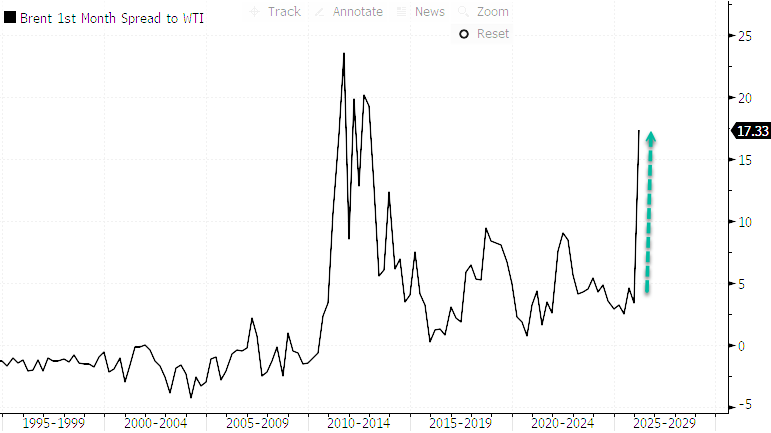
We are as eager to stop writing about obscure details of Persian Gulf geography as you are to stop reading about them, but unfortunately that story remained the dominant driver of global markets this week. Once again, though, we suspect that the narrative generally being propagated by both poles of the mainstream press may be missing some important angles. The chaos being wrought in the Gulf is obvious, but few pundits seem to be asking some of the most important questions, including: who’s actually keeping the Strait of Hormuz closed, what are the relative impacts of that standstill, and who benefits from that state of affairs? Once again, we’ll keep our claims modest as our circle of competence does not extend into international game theory, but we find it curious that President Trump – among the most prolific and outspoken critics of any individuals or industries that seem to be hampering his popularity – has yet to publicly denounce oil companies or insurance companies for spiking energy prices and maritime insurance rates. We also find it interesting that the spread between WTI crude oil (the key grade for US consumption and export) and Brent crude (which is primarily consumed in Europe and Asia) has ripped to an 11-year high, a dynamic that if sustained would put asymmetric pressure on both key US rivals and recalcitrant allies the White House may be looking to bring to the table. This testing of the Law of One Price for oil may be particularly advantageous for an energy-independent net oil exporter facing down a fast-advancing but energy-constrained rival, particularly when said net exporter has broad refining capacity ideally equipped for locally abundant heavy crude.
All that being said: the bond market gets a say too. Even if, for the sake of argument, all of the above considerations are top of mind for the folks crafting the StrategeryTM at the DOW, the US still has to confront the key sequencing question of whether Western financial markets can actually sustain the level of near-term pain that may be required to make some version of this plan work. Sovereign debt markets are starting to definitively vote in the negative on this point, with the US 10-year yield rising back toward highs from last summer, the MOVE volatility index reaching its highest reading since Liberation Day, and European sovereign yields hitting levels not seen since the Eurozone crisis of the early 2010s. This will all get even more complicated if – as some traders are now betting – the Federal Reserve reacts to upward momentum in inflation prints with benchmark rate hikes rather than the cuts the market was banking on just a month ago (though to be frank, this isn’t 1978 anymore, and we would tend to fade the idea that anyone in the Eccles Building has the stomach to raise rates into the biggest global economic shock since COVID). If the US truly wants to commit to a bifurcation of global commodity markets, we would lean cautiously toward the view that it has the monetary tools to anesthetize financial markets enough to do so (while fulfilling the populist demands that will likely follow); notably, that view also has clear implications for bitcoin, which the magic internet money’s recent resilience against global turmoil may be starting to suggest.
Selected Portfolio News
Primal rolled out version 3.0, a major update including an overhauled wallet and many new features:

Strike launched its line of credit product for businesses in 43 states:


While expanding its consumer-facing line of credit product to 21 more states:
As the world’s largest investor focused on the convergence of bitcoin, energy, and AI, Ten31 has deployed over $200 million across two funds into more than 30 of the most promising and innovative companies in the ecosystem. Visit ten31.xyz/invest to learn more and get in touch about participating.
Media
Giga Energy was featured in The Information for its impressive revenue and operational milestones achieved with very little capital raised. Ten31 is proud to have written the first check to support Giga at launch.
Market Updates
With the world wrapping up week three of President Trump’s “four weeks or less” romp through the Persian Gulf, US Energy Secretary Chris Wright assured the public that the conflict will end in the next few weeks, maybe sooner (we just need Two Weeks to Slow the Shells).
Even so, the situation in the Strait of Hormuz remains extremely uncertain. The US is allowing Iranian tankers through the passage for now, though Germany rejected the White House’s request for naval support in the area. France heroically suggested they will answer the call (but only once the whole fighting part is done).
In response to the hand-wringing from NATO allies, the President floated the idea of just abandoning the waterway altogether and letting others figure it out, which may or may not happen but would likely have asymmetrically negative impact on US adversaries.
Trump reiterated that stance more directly on Friday evening, suggesting that while he doesn’t want a ceasefire (because we are, after all, “obliterating them”), he is considering winding down military operations in the Gulf and letting “the nations who use [the Strait]” police it as necessary.
Whatever might be the truth underpinning this latest round of Strategic Uncertainty, Trump has continued to commit to not deploying US troops for the fight.
But somewhat curiously for an operation that may wind down soon and won’t involve boots on the ground, the Pentagon requested $200 billion of additional funding (roughly the cumulative amount spent on whatever we want to call the whole thing in Ukraine) for operations in Iran.
Drawing on the wisdom of history’s great military theorists like Sun Tzu and Carl von Clausewitz, Secretary of War Pete Hegseth justified the appropriation by noting “it takes money to kill bad guys.”
In a similar vein, Israeli President Benjamin Netanyahu suggested the same day that ground operations will be required to complete the mission in Iran (despite the US and Israel once again totally eliminating the nuclear program that we somehow also totally eliminated last June).
Treasury Secretary Scott Bessent also didn’t rule out the idea of the US seizing Kharg Island – a key hub for Iranian oil exports through the Strait – though it’s unclear how much impact that would ultimately have regardless.
The continuing chaos – which the IEA called the greatest threat to global energy security in history – kept oil prices elevated all week but wasn’t quite enough to drive new highs relative to a few weeks ago; however, officials in Saudi Arabia suggested that oil could clear $180 per barrel if fighting continues into mid-April.
At the same time, it’s worth noting that the Middle Eastern markets most affected by the disruptions are already seeing prices north of $150 per barrel, and more generally, the spread between WTI (the key US-linked benchmark) and Brent crude (a benchmark primarily linked to Europe, the Middle East, and Asia) has blown out to an 11-year high, underscoring the often hidden heterogeneity of the global oil market and the potential advantages of being a net oil exporter.
However long a resolution takes, one theme that’s increasingly clear is that a good deal of damage to global oil and commodity markets has already been sustained that won’t be easily mended even if all conflicts cease tomorrow, as QatarEnergy’s CEO indicated that 17% of the country’s LNG capacity has already been knocked offline for up to 5 years.
Meanwhile, the conflict has also thrown many adjacent commodity markets into disarray, as the suspension of traffic through the Strait has choked off a major source of fertilizer supplies and has already driven 30-50% price spikes in key benchmarks, likely putting upward pressure on food prices in many developed economies and outright shortages in less developed areas.
These disruptions are problematic enough, but S&P flagged the downstream impact of more than $300 billion of potential capital flight out of the Persian Gulf that could put a major strain on regional banks should fighting continue much longer (though this is not the rating agency’s current base case).
Back in the US, the latest wholesale inflation report added fuel to the fire, as the February PPI was up 70bps M/M and 3.4% annually, well above expectations even before any meaningful impact from this month’s Middle East stalemate.
You could almost forget that this was also a Fed Week, but everyone’s favorite central bankers indeed met for their periodic entrail-reading, this time resulting in a decision to hold benchmark rates steady. Outgoing (?) Fed Chairman Jerome Powell acknowledged, in what may be the understatement of the year, that the implications of the situation in Iran are “uncertain” for the US, though the central bank expects reported inflation to move higher.
The market was a little less measured, as investors more or less priced out any further rate cuts until well into next year – with increasing chatter about rate hikes – and the Fed grapples with what could be a bout of stagflation. The bond market was even more forceful, as the US 10-year yield broke 4.3% for the first time since August and closed Friday just under 4.4%.
As we noted last week, these levels on the 10-year remain in the range established over the past few years, but perhaps more importantly, the MOVE Treasury volatility index printed 109 on Friday evening, its highest level since Liberation Day.
European sovereign debt also continued to get rocked even more notably, with yields on major continental issues putting in new post-2011 highs once again this week and long-end UK gilts reaching for nearly 20-year highs.
Just for good measure, gold joined the selloff party in earnest, dropping 10% on the week for its worst weekly performance since 2011. The downdraft – a somewhat surprising move for what many investors view as the apex risk-off safe haven – may reflect a noteworthy evolution in gold’s role within the global monetary system, but either way it prompted a wave of “in it for the tech” tweets from the online Goldbug support group.
Equity indices also got hammered, with the small-cap Russell 2000 officially entering a correction while the S&P500 reached a 6-month low and lost its 200DMA support.
Very interestingly, against this increasingly volatile backdrop, bitcoin maintained its recent relative resilience, ending the week basically flat.
Even as the Middle East threatens to bring the global economy to a standstill, the Donroe Doctrine has continued apace in the Western Hemisphere, as Cuban protest activity has reportedly intensified just as the Trump administration looks to finally oust the country’s Castro-linked government.
Domestically, the US trade deficit shrunk 25% M/M in January, though that follows a spike in December, the current levels are still not far off the pre-2025 range, and much of this month’s positive move was driven by gold exports.
Following a multi-week streak at par, Strategy’s STRC preferred vehicle fell slightly below its key $100 level all week; however, the company’s latest 8K filing indicated that STRC enabled MSTR to purchase nearly 17,000 bitcoin in the prior week.
Regulatory Update
The CFTC delivered a no-action letter to Phantom Wallet, a prominent wallet provider in the Solana ecosystem, indicating that the agency will not pursue regulatory action against Phantom for providing self-custodial interfaces to registered derivatives platforms. This update could help to demarcate a welcome bright-line distinction for developers of non-custodial software.
Noteworthy
A research group out of Cambridge published a longitudinal study based on 11 years of data suggesting that the bitcoin network could maintain global connectivity even if the vast majority of worldwide undersea cables were simultaneously severed, a data point highlighting the resilience of bitcoin’s design.
As of March 30th, Square will auto-enable bitcoin payments for all eligible merchants using a Square terminal, removing the need for sellers to explicitly opt in.
Travel
OPNext, New York, April 16
Bitcoin 2026, Las Vegas, April 27-29