

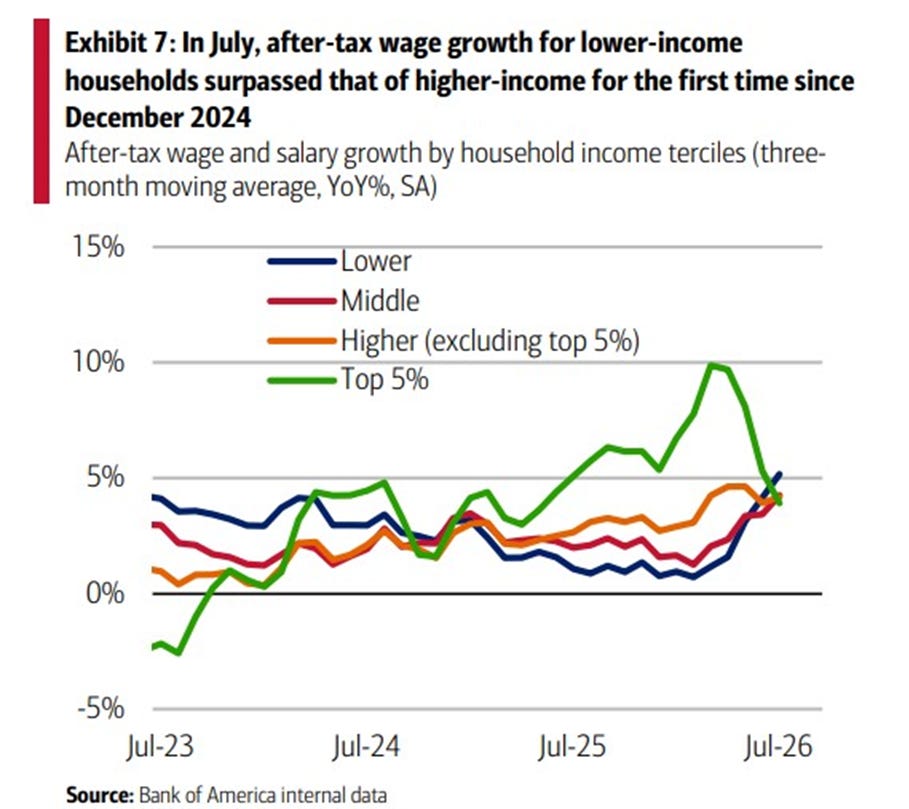
The summer doldrums seem to have set in for the US-Iran conflict, which for the moment appears to be in a Sisyphean stalemate between two sets of abnormally large egos volleying “I know you are, but what am I?” back and forth without much progress. That said, although transit through the Strait of Hormuz once again declined to multi-month lows, it was yet another strange week for those members of the Twitterati who have been assuring the world that the US will have to cave any day now because its overfinancialization can’t handle the disruption: despite the uncertain outcome, bond volatility has continued to compress as US equity markets continue to make new highs every week. To be sure, you can’t eat Nvidia shares, and many of the machinations needed to keep this flywheel going no doubt have downstream real-world impacts (see: SPR lows, inflation well above 2%); however, it’s increasingly tough to argue that financial market sensitivity is by itself an unmitigated binding constraint that will imminently force the hand of the most powerful global hegemon in history. November’s midterm elections may be a more significant near-term roadblock for the administration’s ambitions, though we’d flag that both the YTD reacceleration of wage growth for the lower- and middle-income terciles as well as Elon Musk’s reported $100 million+ midterm advertising blitz may tilt the board more in favor of a counter-consensus outcome there. In any case, though, the simplistic narrative about the US’s positioning seems harder to defend by the week, and we think the degradation of that story continues to point to a much more structural and long-term shift; and if that’s the case, it’s worth asking what it means that one of the chief architects of that shift is out here quoting Satoshi.
Selected Portfolio News
Maple AI added support for DeepSeek-V4-Flash and Kimi K3 models:


Media
AnchorWatch Co-Founder and COO Becca Rubenfeld appeared on Bloomberg to discuss the fallout of the Coldcard exploit and its implications for cybersecurity going forward.
Ten31 Managing Partner Marty Bent led a discussion with Cholla Energy Founder Gideon Powell on energy maximalism and grid resiliency at the Institute for Humane Studies.
Market Updates
It was Groundhog Day again in the Middle East, where talks between the US and Iran continued to range anywhere from unproductive to nonexistent as an American ship fired on a vessel attempting to break its blockade while Houthi strikes killed six in the Red Sea.
The IRGC and President Trump fought for the upper hand in this ongoing BS competition, both insisting that they’re in control of the region, while the President teased plans to turn the Strait into another US territory once this is all over (we can only assume blueprints for the Trump Kharg Island are already in the works).
Treasury Secretary Scott Bessent responded to the latest agitations with an announcement that the US will soon hit Iran with the dreaded Double Secret Sanctions, driving “economic isolation like the world has never seen before.”
Whoever actually has the upper hand, shipping traffic through the Strait sank back toward 3-month lows, though oil remained fairly rangebound and well off YTD highs (at least partially due to ongoing strategic petroleum reserve drains worldwide, which have put US stockpiles at their lowest level since 1983). At the same time, the S&P500 notched yet another all-time high.
Importantly, the MOVE Index – a closely watched measure of volatility in US Treasuries – continued its recent downtrend despite the protracted uncertainty in the Gulf.
The latest inflation data gave the bond market a little more support on the margin as well, with CPI printing in line with consensus at 3.4% (remember when the target for this manipulated hedonically adjusted figure was 2%?) and PPI coming in below expectations (though still at a less than flattering 4.7%).
It remains an open question how long this metric can stay in high but not catastrophic territory, and that dynamic (specifically its ultimate impact on rates) gets more important every month as the US continues to post historic deficits, with July’s figure of $432 billion marking the highest July print ever and the widest monthly gap since early 2021.
Most notably, total YTD interest now sits at $1.2 trillion, officially surpassing both defense and Medicare spending on the year. As we’ve written elsewhere, we wouldn’t count out the “run it hot” playbook as a means of extending and pretending here, but that has yet to push nominal GDP anywhere close to where it needs to be for the gambit to work out.
Speaking of ramping up spending, the Department of War made a new $400 million investment into an Australian scandium miner, the Pentagon’s latest foray into direct equity ownership of companies that may chip away at China’s critical minerals dominance.
As the globalization mirage continues to fracture, China announced new travel rules that will restrict citizens with potentially sensitive technology and engineering expertise from leaving the country.
Meanwhile, US Commerce Secretary Howard Lutnick has reportedly “encouraged” Apple not to buy from Chinese memory giant CXMT (which recently went public in a massive IPO) as a solution to the multiyear DRAM crunch.
Perhaps most notably on this theme, Reuters reported that the US is preparing to tell members of the “Pax Silica” semiconductor framework that they must exclusively commit to the US-led initiative and reject any alternative framework or coalition proposed by Beijing.
New data from Bank of America pointed to the economy becoming less “K-shaped” in recent months, with both wage growth and discretionary spending among lower income cohorts surging to converge with or surpass that of the top cohorts.
Readers will have to take their own view on whether the AI buildout supports that trend (ripping demand for skilled trades) or cuts against it (Dario says we’re all about to join the permanent underclass once Claude can swing a hammer), but in either case the week offered no signs that that’s slowing down, as Nvidia announced a massive program with six of the largest asset management firms to offer up to $500 billion of third-party AI compute infrastructure financing.
Many opinions on what this suggests about where we are in the cycle could be reasonable, but we do hope that this development and CoreWeave’s announcement that it will be leasing A100s (an Nvidia GPU that was launched in 2020 and is now essentially 3 generations behind) through 2029 at least retires the “understated depreciation schedule” trope about accelerators.
But alongside sustained momentum for the buildout came more tailwinds for “AI safety oversight”, as Google’s Chief AI Scientist Demis Hassabis reportedly held talks with the major AI labs and government officials including Scott Bessent on the creation of a new public/private AI regulatory body.
While the world understandably continued to look elsewhere, bitcoin kept consolidating in a very narrow band around $64,000, with the orange coin’s 30-day volatility compressing to multi-year lows.
The latest 13F season brought forth a couple notable updates here, with Tudor Investments increasing its IBIT holdings by close to 20% in the second quarter, while Abu Dhabi’s sovereign wealth fund Mubadala held pat on its bitcoin position, currently the second-largest holding in its publicly disclosed portfolio (which remains notable given both the Q2 price action and the broader disruption affecting the Gulf states this year).
With relatively little fanfare, BlackRock significantly reduced the threshold for in-kind conversion (the mechanism by which a client can swap between bitcoin and IBIT without a tax event) to just $1 million from $25 million previously, noting that it ultimately aims to offer this capability at any size.
Bitcoin treasury stalwart Strategy sold another ~1,600 bitcoin on the week, though CEO Phong Le indicated the company plans to resume bitcoin accumulation by the end of the year.
Regulatory Update
The Bitcoin Policy Institute submitted an open letter to policymakers (on which Ten31 was one of ~80 signatories) regarding the need for easier access to frontier models for defensive cybersecurity applications, a gap that was painfully highlighted by the Bitcoin Red Team’s attempts at urgent white hat security audits over the past several weeks.
Noteworthy
The Bitcoin Improvement Proposal BIP-110 – which sought to “limit arbitrary data storage” in bitcoin – caused a chain split, with the new chain stalling out at two blocks and the main bitcoin chain continuing without issue. Longtime readers may note that this is approximately the second time we’ve mentioned this proposal in this newsletter over the past year, and we think this week’s events validate that that level of coverage was roughly commensurate with (or perhaps even excessive relative to) the long-term relevance of this story.
In a totally healthy development, new data this week from wealth management platform Betterment suggested Gen Z is increasingly using sports betting and prediction markets as key bulwarks of its collective portfolio.