

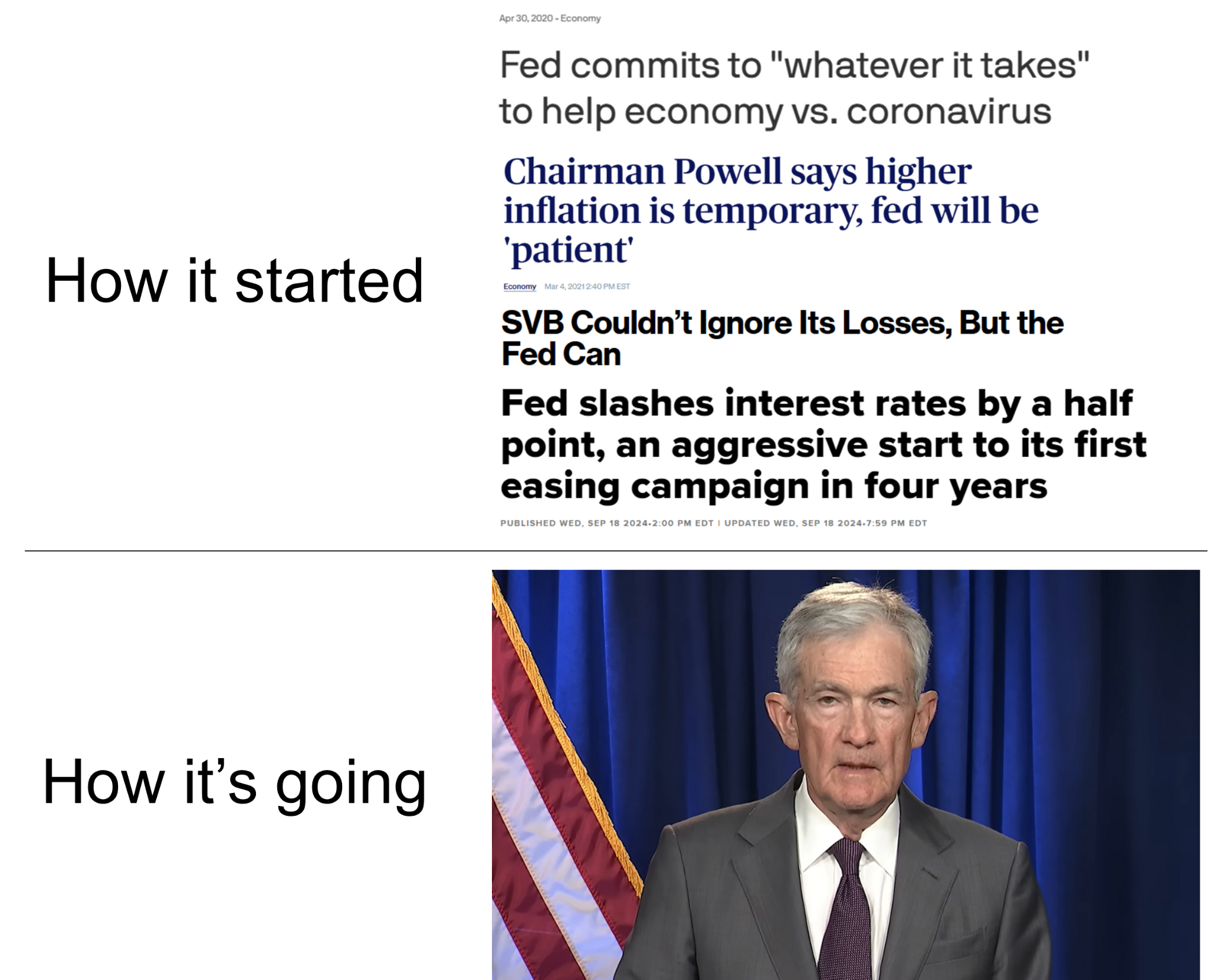
The showdown we all knew was coming finally reached a boiling point this week via news on Sunday night that the Department of Justice is threatening a criminal indictment against Federal Reserve Chairman Jerome Powell (who is set to step down as Fed Chairman in May) over his testimony about the central bank’s spending on controversial building renovations. Powell – looking highly beleaguered, potentially due to the loss of the new building’s planned rooftop beehives – released his version of a hostage video over the weekend wherein he argued the threat was simply the White House’s retaliation for the central bank’s refusal to accommodate President Trump’s interest rate demands. In the video, the Chairman suggested this constitutes an attack on the hallowed principle of Fed Independence, and that he will continue to defend the central bank’s autonomy in setting monetary policy going forward. We understand Powell’s frustration (and think he’s almost certainly right in his assessment of the administration’s intentions), but his video may have left some viewers wondering where this “independent” Fed has been lo these many decades? Where was it when the smartest guys in the room blew up their balance sheets because housing prices didn’t go up forever? Where was it in spring 2020 when it used its “infinite cash” to accommodate an unprecedented shutdown of the economy (then added trillions in additional liquidity just for good measure for two full years thereafter)? When it chose to cut rates by 50bps for no clear reason the month before a general election? Or how about every time it stepped in to quiet down a squirrely MOVE Index over the past 20 years?
Strike Founder Jack Mallers said it better than we can, but the reality is that the Fed has never been functionally independent in the modern era, and the organization’s choices (across many Presidential administrations and Fed Chairs) have consistently made that reality very plain. But let’s just take the argument at face value and say that until this unique and unprecedented encroachment by a blowhard wannabe Caesar, the Fed has indeed operated independently – is that actually any more flattering? Under the rein of this supposedly independent Fed, housing prices have dramatically outpaced wage gains, disproportionately hurting the middle class and the country’s younger generations. Based on official statistics, this Independent Fed has presided over the dollar losing ~28% and ~85% of its purchasing power over the last 10 and 50 years, respectively (and when compared to more objective markers like the price of gold and scarce assets, the record is even worse). During this Independent Fed era, the percentage of Americans living paycheck to paycheck has ballooned to as high as 78%, and so-called deaths of despair statistics look like charts from the late-era Soviet Union. We won’t comment on the wisdom (or lack thereof) of the President’s tactics, but if this is really what “Fed Independence” looks like, perhaps it’s time to consider an alternative path – preferably one where monetary policy is not set at the whim of a few central planners (in either the Eccles Building or the White House).
Selected Portfolio News
Strike rolled out its bitcoin-backed lending product to a variety of new states this week. The product is now live for both consumers and businesses in the vast majority of US states:


As the world’s largest investor focused on the convergence of bitcoin, energy, and AI, Ten31 has deployed over $200 million across two funds into more than 30 of the most promising and innovative companies in the ecosystem. Visit ten31.xyz/invest to learn more and get in touch about participating.
Media
Ten31 Managing Partner Marty Bent joined The Last Trade podcast to discuss the outlook for 2026, the growing power of AI, and much more.
Mempool.space Founder and CEO Wiz was featured in an article on the growth of the bitcoin ecosystem in El Salvador.
Market Updates
In a dramatic escalation of the ongoing war to determine who controls US monetary policy, Fed Chairman Jerome Powell announced late Sunday night that the Justice Department has threatened him with a criminal indictment for perjury regarding his Congressional testimony on the Fed’s headquarters renovations last year.
Essentially every former Fed Chairman and Fed-linked official (other than, curiously, Larry Summers – we can’t imagine why) circled the wagons around Powell shortly thereafter, coming together to release a statement condemning the DOJ’s actions.
The heads of the ECB, Bank of England, and virtually every other European national bank published their own statement in support of Powell. For our part, we can only imagine that the Founding Fathers must be rolling in their graves over this encroachment on the autonomous power of a small body of unelected lawyers and bankers, particularly one with such strong support from the Europeans.
Beyond the somewhat predictable outcry from the DC–Frankfurt axis, the move – which we can probably all fairly assume is politically motivated – could easily backfire, as Republican Senator Thom Thillis announced he will block any Trump nominee to fill Powell’s seat (which is set to be vacant in May) until this matter is resolved. This threat could have some teeth, as a defection from even one Republican Senate Banking Committee member could lead to a stalemate on confirming nominees, complicating President Trump’s clear desire to bring the Fed to heel.
Either way, the President still doesn’t seem to have made up his mind on which courtier will receive that nomination, as he mentioned this week that he might want to keep Kevin Hassett – previously the frontrunner for the nod – in his current White House seat. Those comments immediately made Kevin Warsh the overwhelming favorite to win the nomination.
Beyond the ongoing monetary Game of Thrones, macro data this week generally looked pretty favorable, with headline December CPI meeting expectations and Core CPI coming in slightly below.
Meanwhile, existing home sales spiked in December for the metric’s biggest gain in two years on lower mortgage rates, and both the Empire State Manufacturing and Philadelphia Fed Manufacturing Indices were much stronger than expected for the month.
BlackRock’s Larry Fink noted he now expects the US will grow “above trend” for the next few years, a pretty stark reversal from consensus expectations on Wall Street less than a year ago.
It’s been a relatively quiet period for explicit updates on the trade war, though this week saw both a new $250 billion deal between the US and Taiwan, as well as an apparent attempt by Canadian PM Mark Carney – the central banker par excellence – to cozy up to China and show the US he’s super duper serious.
We’ll be watching closely for more updates on this front soon, as the Supreme Court’s ruling on the legality of Trump’s tariffs should drop any day and could come as soon as January 20th.
Despite – or perhaps because of – uncertainty caused by all the threats to Fed Independence, bitcoin broke $97,000 for the first time since November, while precious metals also extended their recent banner runs.
Dartmouth University’s endowment reported a new $10 million IBIT position in their latest 13F filing this week, joining Harvard in the Ivy League Bitcoin Club. Interestingly, the filing comes on the heels of a December Institutional Investor article citing Dartmouth as an example of an endowment that passed on bitcoin several years ago.
Regulatory Update
The “crypto” industry’s long-awaited “market structure” bill stalled in Congress once again this week. While the latest draft generally included positive updates such as explicit protections for non-custodial software developers and favorable self-custody language, Coinbase CEO Brian Armstrong said the company would not support it as current language would overly advantage banks relative to stablecoin issuers.
Meanwhile, Senators Cynthia Lummis and Ron Wyden proposed a new standalone bill specifically geared toward protections for software developers, though it’s unclear if anything like this can be passed while the market structure bill is still outstanding.
West Virginia’s legislature introduced a new bitcoin reserve bill that would allow the state to invest up to 10% of public funds into bitcoin and gold.
The Bitcoin Policy Institute submitted a letter to Congress advocating for any de minimis tax exemption for “crypto” payments to include bitcoin.
Noteworthy
Pro-bitcoin Venezuelan opposition leader Maria Corina Machado met with President Trump at the White House this week, presenting him with her Nobel Peace Prize medal.
Bitchat – the open source, offline messaging tool launched by Jack Dorsey – has become Uganda’s most-downloaded app as the country’s government curbs internet access in an attempt to control opposition.
Amid skyrocketing silver prices, the US Mint announced temporary suspension of new silver coinage pending price stabilization.
Travel
Nashville Energy & Mining Summit, Jan 2026
Bitcoin Investor Week, Feb 2026