

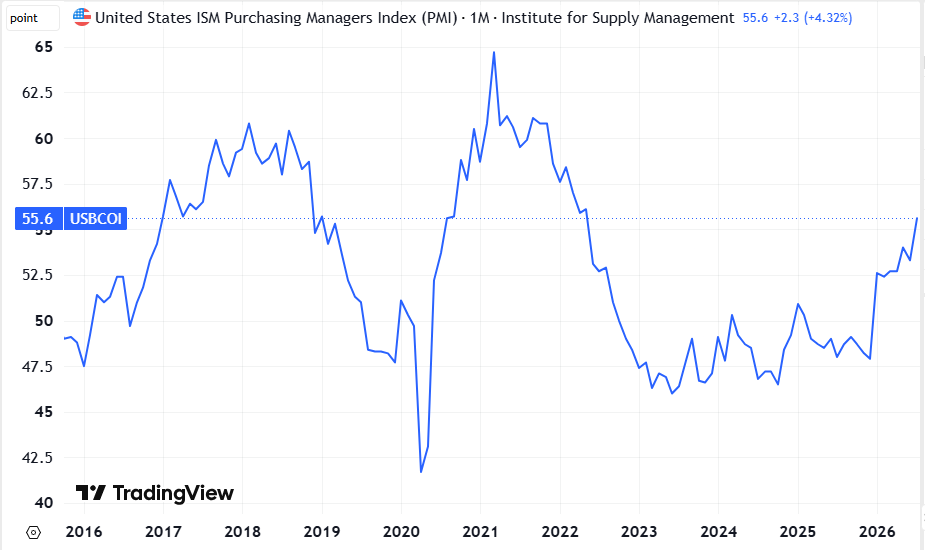
Don’t look now, but the whole “running it hot” thing may have some legs. The latest ISM Manufacturing PMI data came in very strong this week, confirming a solid S&P report from last week. At the same time, trucking company earnings call commentary about freight volumes starting to clearly break out of a multi-year trough also pointed to renewed signs of life in the manufacturing and core industrials sectors that are the lynchpin of much of the current administration’s economic policy focus. Whether that continues and actually ends up flowing through to meaningful and durable GDP growth (read: tax receipts and growth-based deficit reduction) is still anyone’s guess as we’re still quite a ways off from the goals of the widely touted “3/3/3 Plan”, but it’s getting harder to deny that there are some green shoots sprouting up in US heavy industry for the moment. Initiatives like SpaceX’s $17 billion Terafab facility and 8GW of incremental HPC capacity coming online next year may deserve an Elon-sized asterisk (his timeline for putting a man on Mars was juuuust a bit outside), but even a delayed version of projects like that will only further pour fuel on this fire.
Of course, arguably the key tailwind for much of that industrial activity is the unprecedented data center buildout to support artificial intelligence, and some of the potential downside consequences of that technological shift have been on full display in the bitcoin ecosystem over the past week, as the tragic Coldcard exploit was followed by what appears to be a series of AI-assisted attacks on a variety of bitcoin services and open source projects. That said, we would note that the ecosystem has shown remarkable resiliency across these episodes, as evidenced most clearly by the organic emergence of the “Bitcoin Red Team,” a volunteer group of bitcoin technical experts (loosely led by AnchorWatch CEO Rob Hamilton and several other key developers in the space) focused on aggressive and swift reviews of hundreds of bitcoin codebases amplified by open source AI models. The episodes of the past week have undoubtedly been painful and difficult, and we would expect that they represent something like the starting gun for a new era of cybersecurity generally, which will demand a much more proactive and AI-native approach; however, one silver lining from this period is the clear validation of bitcoin’s antifragility and the hardening of the project’s overall security stack that we’re watching emerge in real time.
Selected Portfolio News
Unchained added support for Slipstream, a direct miner-submission service operated by MARA that allows users to avoid potential risks of broadcasting multisig transactions with compromised private keys:


AnchorWatch waived its custody fees for 60 days for new accounts as many users look to migrate to new setups:


Fold announced a partnership with Lead Bank:

Media
AnchorWatch’s Co-Founders Rob Hamilton and Becca Rubenfeld were featured in a Bloomberg report covering the Coldcard vulnerability and the bitcoin community’s Red Team response to harden the broader ecosystem.
Rob also appeared on the Bitcoin Policy Institute podcast to discuss his work on the Red Team project and the future of open source software in a world of powerful AI models.
Strike published an article on the company’s long-running internal red-teaming procedures for testing its infrastructure.
Giga Energy CTO Angad Sandhu (former director of data center infrastructure at Google) published an article on Giga’s differentiated, end-to-end approach to data center buildouts.
Market Updates
In a pattern that may sound just a bit familiar to longtime Situation Monitors, the Trump administration spent the week hinting at another Iran deal just around the corner, only for nothing to materialize ahead of the weekend.
Various reports suggested that Iran and Oman are in talks on their own deal for shared control of the closely watched Strait of Hormuz – a deal that would allegedly restrict US and Israeli access to the Strait – though we wouldn’t put strong odds on that one getting through.
Regardless, markets responded to the prospect of the concept of a framework of a deal with “so you’re telling me there’s a chance?” once again, as the S&P500 made new all-time highs while both oil and 10-year yield both continued declines off recent spikes.
Amid the protracted disruption in the Middle East, the US officially imported zero oil from Saudi Arabia in July for the first time in four decades (with much of the delta backfilled, notably, by Venezuela).
Following much speculation last week, Treasury Secretary Scott Bessent confirmed he coordinated with the Bank of Japan to tame “disorderly Yen activity” following the Japanese currency’s decline to 40-year lows against the dollar.
The move only popped the Yen back to roughly May levels, so we have a feeling this isn’t the last coordinated action we’ll see here near-term, and it appears Bessent may agree, as he publicly called for the FIMA Repo Facility to be expanded to provide more firepower for these types of currency interventions. Notably, the facility is actually a program administered by the Federal Reserve, so Bessent’s exhortations here could present an interesting new chapter in the relationship (dare we say, accord?) between the two institutions.
Also of note, the Fed in this case sold euros, not dollars, for the operation, a move that appears to be effectively unprecedented in the history of these interventions, reportedly blindsided officials at the ECB, and represents the latest instance of the US socializing the downsides of its machinations disproportionately onto “middle powers” like Europe.
As Bessent menacingly says “that’s a nice independent monetary policy you’ve got there” to the folks in the Eccles Building, the mainstream financial press appear to have gotten their marching orders regarding new Fed Chair Kevin Warsh, with pretty much every outlet now echoing the sentiment that “experts say” and “sources familiar with the matter report” that Warsh has already lost credibility on inflation after holding rates steady at his first FOMC meeting.
The President seems interested in giving journalists even more fodder on this front in the near term, as he revived suggestions that he’s considering firing Fed Governor Lisa Cook once again, though it’s not entirely clear what legal mechanism he’d use to do so following a recent injunction that kept Cook in place.
Whatever the state of the central bank’s credibility, the latest jobs figures this week did not make the pundits’ case much stronger, as July’s Non-Farm Payroll numbers came in well below expectations with a decline of 23,000, plus a downward revision to June’s numbers.
That said, the July ISM Manufacturing PMI confirmed S&P’s solid reading from last week, coming in at a four-year high of 55.6 on the back of declining business inventories, higher factory hiring, and strong new orders growth.
In the same vein, Q2 results from the major US trucking and logistics operators generally came in quite strong, with management teams pointing to what looks like an emerging structural inflection in freight volumes.
It was once again a big week for AI – one of the key drivers of that industrial resurgence – as Elon Musk revealed more details on his $17 billion initial plans for SpaceX’s Terafab facility, an Elon-sized semiconductor foundry in Texas that would ostensibly be the “largest and most valuable building on earth.”
Elon may need to put in a word at the Capitol, though, as Texas Governor Greg Abbott called for an audit this week of all large loads in the state’s massive 474 GW ERCOT interconnection pipeline, an order that will indefinitely delay a variety of AI data center projects.
Those delays notwithstanding, the semiconductor industry and AI buildout are continuing to take center stage within the Trump administration’s strategic and reshoring agenda, with the White House implementing a new protectionist executive order for American polysilicon manufacturing while also reportedly considering another EO that would ban new imports of Chinese optical transceivers (devices becoming increasingly important for data transmission within the most advanced data centers).
That trend of nationalist AI industrial policy could make things a bit awkward for Oracle, whom the New York Times suggested may be indirectly supplying almost 25% of China’s AI computing power.
Elsewhere, new reports out this week indicated that the Trump administration’s AI guidelines will likely exempt US open source models from prerelease review by the federal government, placing the regulatory onus primarily on OpenAI and Anthropic.
We’d expect the calls for greater control over the ecosystem to probably get louder, though, as this week was filled with yet another flurry of reports on rogue AI deployments from all of Meta, Anthropic, and OpenAI.
Whether these reports are, to some extent, performative kayfabe intended to add credence to the case for greater regulatory capture by the big labs (e.g. the recently proposed “AI kill switch bill”), it’s clear that increasingly powerful AI models have driven a phase shift in cybersecurity assumptions, and unfortunately early signs of that were visible this week across bitcoin projects including Boltz, Zeus, and BTCPay Server, all of which were forced to temporarily suspend services or ship emergency patches in response to a wave of (presumably AI-assisted) attacks.
Encouragingly, a decentralized group of bitcoin ecosystem developers and founders – loosely spearheaded by AnchorWatch CEO Rob Hamilton – have stepped up to form the “Bitcoin Red Team,” an initiative focused on using the latest open source AI models to aggressively test and harden hundreds of bitcoin ecosystem technology stacks.
OpenSats has started a new Red Team fund specifically to support this effort, which we believe is one of the clearest examples of bitcoin’s fundamental antifragility in the protocol’s history.
Regulatory Update
The Treasury Department sanctioned two Iranian firms involved in the so-called “Hormuz Safe” protection racket insurance program that had attempted to collect bitcoin payments from vessels in the Strait in exchange for safe passage.
The US Senate officially delayed the next CLARITY Act vote until after the August recess, which likely materially reduces the odds of passage this year as midterms are set to take focus going into November.
Tyler Williams, the top digital assets adviser to the Treasury Department, announced his resignation this week.
Noteworthy
MARA’s Slipstream service, which allows users to submit transactions directly to the pool’s private mempool for inclusion in a block without the potential for “in-flight” attacks on compromised keys, has helped safely migrate over 5,600 bitcoin from multisig addresses since last week.
Michael Saylor’s Strategy sold another 1,688 bitcoin this week to fund obligations on its preferred stack, marking six weeks since the leading Bitcoin Treasury Company last bought bitcoin.