

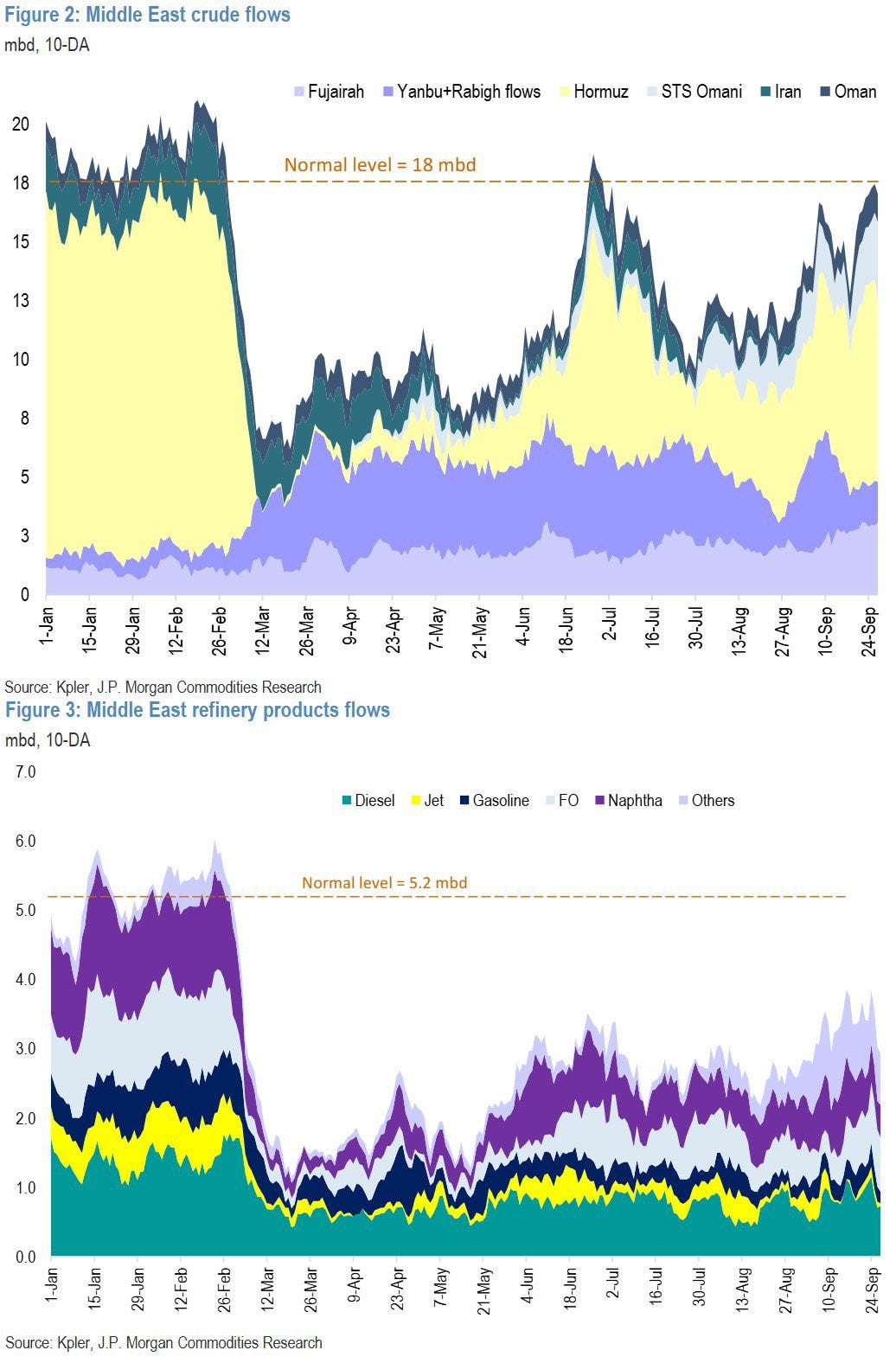
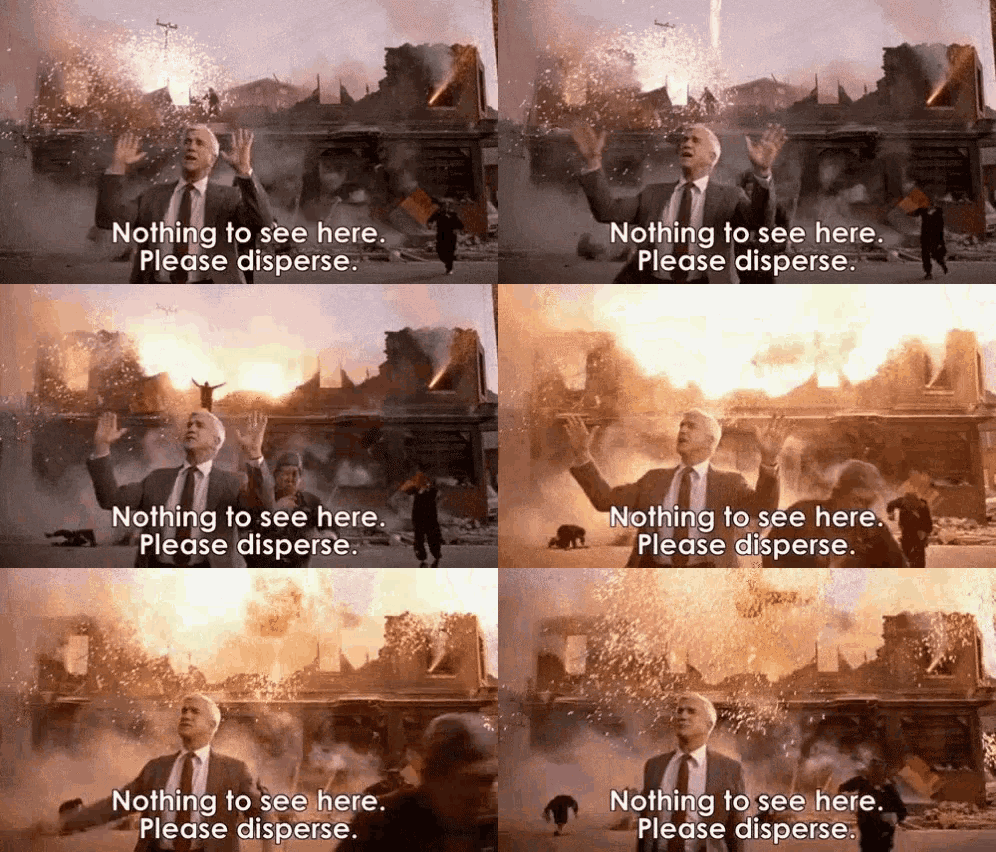
The bond market beatings will apparently continue until morale improves, though this time the sharpest pain was felt on the other side of the Atlantic. The US 10-year pushed up toward its highest level since roughly the turn of the century, but the picture looked considerably uglier in Europe, where the 30-year gilt broke 6% for the first time since 1997 and French CDS spreads blew out to Eurozone crisis levels, ultimately prompting the IMF to do its best Leslie Nielsen with a public assurance that bond markets are functioning in an orderly manner (roughly as encouraging as when your waiter assures you your food will be right out). We’ll let readers form their own judgments on the degree to which the chaos in European bond markets is tied to the recent launch of Operation Economic Outcast, but there’s no doubt that the ongoing disruption to energy flows is putting Europe in traders’ crosshairs heading into winter. Encouragingly, shipments of crude products through the Middle East appear to have returned almost to normal for now (a tough look for the Twitterati posters assuring everyone of financial apocalypse by May), but diesel and refined product supply remains heavily disrupted, which finally gave the White House the ammunition it needed this week to arm-twist a 100-million-barrel SPR release out of the Europeans. Whatever its long-run effect on prices, we think this whole situation is a decent microcosm of the White House’s overall strategy: squeeze relatively weaker allies and near-allies on energy and funding costs to drive concessions that will make a Western decoupling from China more feasible (and French President Emmanuel Macron’s public heel-turn on Chinese industrial policy this week may give readers some sense of how this agenda is proceeding).
That said, the US’s runway isn’t infinite. A softer than expected PCE print, a jobs report that barely showed a pulse, and two of the Fed’s top officials pushing back on an October hike would typically make for a pretty friendly setup for Treasuries, yet none of it did much to get the 10-year down on the week, and bond volatility is getting decidedly uncomfortable. It’s against that backdrop that we found a few other headlines particularly interesting, including President Trump’s comment that “certain levels of inflation” will help pay off the debt (while there are also “other means” of dealing with the national debt he’d prefer not to discuss) and Treasury Secretary Scott Bessent’s hiring of longtime gold standard advocate Judy Shelton as an advisor. It’s hard to say how much to read into any one of these, but taken together with everything we’ve seen over the past couple years and the administration’s clear willingness to socialize negative externalities onto vassals allies, they make for an eyebrow-raising cluster pointing to an ongoing phase shift in the dollar system. That of course brings us to bitcoin, which held up remarkably well against ripping global yields and a stronger dollar, historically about the worst hand you could draw for the corn; instead, it has started to trade with dollar strength, while the bitcoin/gold ratio has continued grinding higher. This could just be another late-bear headfake, but we think ahistorical divergences like this are going to be increasingly important to watch as the global game board gets reset.
Selected Portfolio News
Unchained began offering bitcoin-backed loans for trust-held bitcoin, allowing clients who hold bitcoin in a trust to borrow against it for qualifying business or investment purposes:

As the world’s largest investor focused on the convergence of bitcoin, energy, and AI, Ten31 has deployed over $200 million across two funds into more than 30 of the most promising and innovative companies in the ecosystem. Visit ten31.xyz to learn more and get in touch about participating.
Media
Unchained launched Bitcoin Ecology, a new essay series from the team behind Bitcoin Astronomy arguing that peer-to-peer markets for data transmission, storage, and computation built around bitcoin are the natural “ecology” for AI.
Market Updates
The ongoing stalemate in the Persian Gulf saw a particularly interesting development over the weekend, as last week’s US-China summit in DC concluded with a joint statement suggesting both Trump and Xi agree that Iran should not develop nuclear weapons and that no country “can be allowed to impose tolls on international waterways.”
Tehran’s list of allies may be growing thin at a tough time, as the Wall Street Journal ran a deep dive on just how far Operation Economic Outcast has reached, with Treasury teams fanning out across the globe to pressure governments, banks, and airlines into cutting off the regime.
The rest of the Gulf, meanwhile, seems to have largely gotten back to business, with Saudi Arabia’s East-West pipeline resuming exports after repairs and total crude shipments through the Middle East recovering to more than 90% of pre-crisis levels (though that increase in flow hasn’t dramatically reduced final costs to consumers so far, as the workarounds needed to traverse the Strait of Hormuz are adding something like $30-40 per barrel in added costs).
Iran’s own exports, on the other hand, remain at zero, as Secretary Bessent was happy to confirm in all caps.
The Saudis, for their part, have ended up in firmly net positive territory relative to the pre-war status quo, with the Kingdom’s annual oil export revenue climbing from $150 billion to $210 billion or more as the increase in prices has more than offset volume headwinds (though it’s worth keeping an eye on new dust-ups with the Houthis that resumed late Friday).
Perhaps in response to a progressively less favorable setup, Iran allegedly agreed to halt uranium enrichment in exchange for sanctions relief, though President Trump later said no such deal is on the table.
The IRGC also tried its hand at a DTC campaign, sending an open letter to the American people which called the US a “third world country” that now has to rely on selling its natural resources to survive (Operation Economic Outcast has apparently also depleted the Ayatollah’s sense of irony).
Washington’s reply came in the form of more hardware, with the US sending a third aircraft carrier and up to 10,000 more troops to the region.
Despite the buildup, increasing flows from the Gulf pushed WTI back below $90 for the first time in several weeks. That said, diesel remains a different story, with Gulf exports of refined products still running at half of 2025 levels, while oil & gas executives surveyed by the Dallas Fed projected diesel prices won’t return to normal for more than a year.
That ongoing diesel pain led the administration to tell France and Germany to release their emergency diesel stocks or face a US export ban, which we previewed last week might be the real motive behind all the export ban chatter.
Europe got the message quickly, as the G7 countries agreed to release 100 million barrels of diesel and crude over 4 months, putting some downward pressure on diesel prices for now as that release would represent roughly a third of the net decline in seaborne diesel supply this year.
Shortly thereafter, the President clarified that “we were never going to do” a US diesel export ban, a Lucy/Charlie Brown dynamic that incidentally may be instructive in thinking through virtually everything the White House says about the war.
Beijing unsurprisingly went in the other direction, with Chinese refiners halting exports of oil products until further notice as local stocks draw down.
China also tightened export controls on its human capital, broadening existing travel curbs to encompass the families of top tech and AI talent.
French President Emmanuel Macron started sounding a lot like Trump this week, excoriating China for “massacring” Europe’s industrial base through excessive state subsidies and export dumping. Japan has likewise been voting with its feet, with a record number of Japanese companies exiting China over the last two years.
Closer to home, the WSJ reported that the Trump initiative to build China-free supply chains for military gear and critical minerals is, in the paper’s own words, “starting to work” (though it will take at least a few years to drive meaningful progress), while JPMorgan CEO Jamie Dimon used a Journal op-ed to call for more industrial policy and tariffs as part of a plan for the Western world’s revival.
In the industry at the center of that tug of war, Nvidia launched its Open Agent Safety Platform with more than 100 ecosystem partners, a set of tools the company says would have prevented the infamous Hugging Face breach and other recent cybersecurity incidents.
Nvidia’s pitch that better tooling can keep AI in check was likely music to the administration’s ears, as House Speaker Mike Johnson reiterated the President’s stance that we’re not slowing down AI, saying “we do not need a moratorium” and calling the doom narrative “a Chinese psyop” (FWIW, it would not be the first time).
President Trump kept the focus on AI by gathering the industry’s key leaders to develop and sign a White House Accord on Super Intelligence focused on safety, though it appears no one used AI (sorry, SI) to proofread the document.
Trump also ruled out nationalizing the labs, though he noted the government might take a 10% stake in OpenAI and Anthropic as it did with Intel (an arrangement we’ve been flagging since the summer).
That may be just what Anthropic is angling for as it prepares to go public, with a leaked S-1 reportedly showing a staggering operating loss of $8 billion in 2025 (though this also predates the company’s parabolic revenue ramp this year) and plans to spend over half a trillion dollars in compute buildout in the coming years.
We don’t imagine this IPO, if it indeed happens later this year, will do many favors for S&P 500 breadth, which is now at its worst level since 2000. That said, the Ed Zitrons of the world may need to wait a bit longer for the apocalyptic AI blowup that has been the subject of much Twitter fantasizing, as neocloud Lambda closed a 7-year, $1 billion investment-grade term loan at 6.78% fixed (i.e. 60 bps tight of your federally subsidized 30-year mortgage).
Elsewhere in AI, Synopsys and OpenAI struck a chip design partnership that includes a revenue share for OpenAI based on how much its model improves designs, potentially a sign of things to come for how the labs monetize.
That AI productivity story is also doing some heavy lifting at the Treasury, as Bessent urged the Fed to keep an “open mind” on interest rates given the deflationary benefits of AI.
Bessent also hired Jefferies economist David Zervos — who is known for supporting Treasury’s buyback strategy, arguing that recent pressure on yields has come from growth rather than deficit spending, and being Kellyanne Conway’s boyfriend — as a counselor to the Treasury. Joining Zervos is longtime hard money advocate Judy Shelton, who has pitched 50-year Treasury bonds backed by US gold reserves.
But apparent progress in the Strait of Hormuz and a recommitment to pushing the AI frontier didn’t do much for the long end, as the 10-year rose to 5.3%, a quarter-century high, with the MOVE Index staying above 100.
That was despite New York Fed President John Williams saying there’s “no need for urgency” on rates and Vice Chair Philip Jefferson saying the same a couple days later, both pushing back on an October hike that markets had priced as high as 70%.
Interestingly, the pressure on yields also came against the backdrop of generally softer data points that would typically drive a kneejerk bond bid, as August’s PCE reading came in well below expectations with core at 3% Y/Y and September’s jobs report missed expectations badly, with barely any net new hiring.
The latest S&P manufacturing PMI did advance to another post-COVID high, though prices paid ripped much higher as well.
European bonds got hit even harder than Treasuries (you may be sensing a pattern here), with OATs reaching 20-year highs and French CDS spreads jumping back to Eurozone crisis levels, while 30-year gilts broke 6% for the first time since 1997.
But the IMF said don’t worry, nothing to see here, reassuring the public that bond markets are “functioning in an orderly manner.”
President Trump seemed relatively unbothered by the inflation side of the ledger, noting that “certain levels of inflation will also pay off [the national] debt very rapidly,” and adding that there are “other means” of dealing with the debt he doesn’t want to talk about.
One of those means may be hiding in plain sight, as a new San Francisco Fed paper found that Treasury purchases by stablecoin issuers (whose tokens are, in effect, spendable T-bills) have offset more than 40% of China’s divestment from US government debt.
Foreigners apparently continue to view the dollar as the tallest of the seven dwarves as well, with net foreign purchases of US equities spiking to a new all-time high of roughly $400 billion in Q2, no doubt a narrative violation for the adamant de-dollarization Millerites (though a good chunk of this likely came from Cayman-domiciled hedge funds).
Despite worldwide yields continuing to rip, bitcoin held in strongly on the week, rising as high as $87,000 again while the corn started to form an interesting positive correlation to dollar strength.
Importantly, this looks somewhat unique to bitcoin, as the bitcoin/gold ratio also kept looking much better this week.
Regulatory Update
The SEC proposed new rules to make institutional bitcoin custody easier in the absence of CLARITY legislation, including letting advisers and funds self-custody client assets when no qualified custodian is available.
A Senate investigation linked leading stablecoin issuer Tether to Iran, finding rampant use of USDT by the regime, and on the same day Tether said it has frozen roughly $550 million in Iran-linked USDT this year.
Noteworthy
Pseudonymous bitcoin and ecash developer Calle unveiled Federated Cashu, a new design that lets a federation of operators run a Cashu mint, so users no longer have to trust a single operator with the security of their funds, an encouraging step forward for scalable bitcoin privacy tools.