

Another September, another walk up to 5% on the 10-year, another round of Twitterati posts about how this may finally be The Big One. All Bloomberg Terminals were pinned to the 10-year Treasury chart this week as the benchmark rate for the world’s economic activity flirted with the 5% level for the first time since October 2023, which is fair enough given how much is downstream of keeping that number in a workable spot. Not helping matters was the price of oil — a key input into where that benchmark shakes out — once again breaking triple digits for the first time since the slap fighting in the Persian Gulf began in the spring. Despite the uncomfortable price action, neither of the two key architects of the Grand Plan (or the nation’s two Riverboat-Gamblers-in-Chief, depending on your persuasion) seemed particularly ruffled, with President Trump promising gas prices will come crashing down SoonTM (though only after midterms) and Treasury Secretary Scott Bessent flippantly dismissing all his former hedge fund colleagues trying to fade his bond market balancing act.
Fed Chair Kevin Warsh may not be feeling quite so hot going into next week’s pivotal FOMC meeting, with markets now pricing in a more aggressive hiking cycle than we think is really tenable given the need to finance the buildout of all these cool killer robots (and as true patriots, we will only allow ourselves to be hunted down by American killer robots), not to mention that pesky matter of funding interest and entitlements. That said, a couple data points that we thought didn’t get enough airtime as the world holds its breath on the bond market were Treasury volatility remaining fairly rangebound and nowhere near the levels it touched the last couple times we were here (though we grant that the neat thing about volatility is that it is decidedly nonlinear) while the 30-year had one of its best auctions on record this week. Perhaps most notably, Treasury only used $5.2 billion of its announced $6 billion capacity for the closely-watched buybacks this week, marking just the third time in 53 long-end operations since the program began in 2024 that the agency has elected not to use all of its announced headroom, which may be tough to square with a Treasury that’s running out of options (or, to be fair, a thin dealer offer pool with a wide bid-ask spread).
So the way we continue to look at it: either Trump and Bessent have reason to be as confident as they appear — possibly due to some of this weeks’ headlines out of Iran, including new crude loadings down to 15% of prewar average with seaborne product about to run out; fuel lines lengthening in Tehran; and a Turkish bank in the penalty box with a much bigger one allegedly queued up for Monday — and the whole thing really is about to fall into place going into the midterms, which then clears a path for the reshoring and decoupling playbook we think they’re trying to run (and which we think will ultimately have a meaningful role for bitcoin). Alternatively, it’s all a bluff, something breaks, and we get another alphabet soup facility alongside what would likely amount to a new era of Fed-Treasury coordination, which is decidedly good for the corn as well. We look forward to seeing whether the house indeed always wins.
As the world’s largest investor focused on the convergence of bitcoin, energy, and AI, Ten31 has deployed over $200 million across two funds into more than 30 of the most promising and innovative companies in the ecosystem. Visit ten31.xyz/invest to learn more and get in touch about participating.
Selected Portfolio News
AnchorWatch announced a partnership with CoinCorner to offer its unique, 1:1 insured custody option directly to CoinCorner users:


Stakwork launched Stadeum, an open-source platform focused on enabling “enterprise general intelligence”:

Media
Stakwork Founder Paul Itoi appeared on the Intelligence Snacks podcast to discuss the company’s unique approach to enterprise intelligence.
Market Updates
The Situation welcomed everyone back from Labor Day with an eventful week of Monitoring, kicking off with a reescalation in the Middle East that saw US forces destroy three IRGC tankers in the Gulf, followed by Houthi drones and missiles attacking various Saudi cities and energy facilities.
The renewed tensions pushed Brent crude back above $100 for the first time in months, with WTI following suit later in the week. Even more importantly for heavy industry (and by extension that whole running it hot thing we’ve been harping on), US diesel prices also ripped to new all-time highs.
Despite the proximity of this upward move to midterms, President Trump didn’t seem especially worried, assuring reporters that “right after the election, oil prices are going to be tumbling downward.”
The Houthis made that forecast considerably harder in less than 48 hours, torching the East-West pipeline that has served as Saudi Arabia’s main method for bypassing the Strait of Hormuz and then, for good measure, seizing the port of Mokha, a fresh complication for anyone with cargo in the Red Sea.
While the fight (and its proxy fights) continued to get more kinetic, the US Treasury spent the week ramping up its promised “financial violence,” sanctioning an Istanbul investment bank accused of moving Iranian oil revenue out of China, with Bessent expressing hope that no further institutions would need the treatment. He then promised a much larger bank will get the belt on Monday, warning the remaining holdouts they’re welcome to risk an “extinction-level event” for their companies.
The long-term success of the White House’s economic pressure campaign remains TBD, but the near-term signals sharpened considerably this week, as Iran’s new oil loadings fell to a YTD low of roughly 15% of the prewar average as seaborne barrels outside the American blockade are set to run out next month. Meanwhile in the domestic sphere, fuel lines in the country have reportedly become more common as government subsidies for local gas consumption expire.
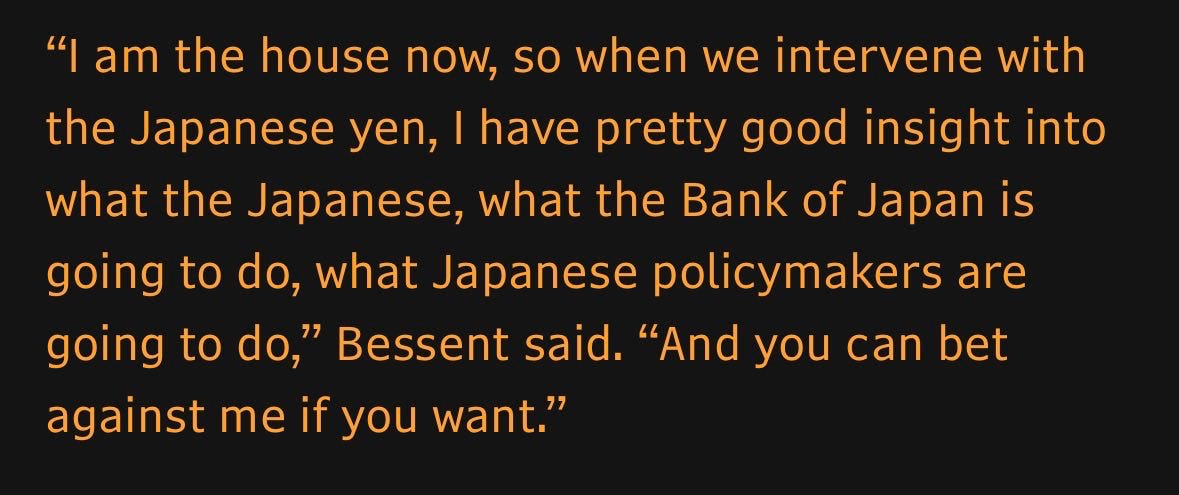
Bessent was, justified or not, in similarly confident spirits on FX, telling an audience of aspiring SMU financiers “I am the house” when it comes to anyone betting against him in currency markets, while informing the Republican midterm convention that if the “Bloomberg Terminal bros” are unhappy with his policies, that’s too bad. (As recovering Bloomberg Terminal bros, we ask that you respect our privacy at this difficult time.)
The Japanese Yen, meanwhile, ripped from 160 to the low 150s as the BOJ (or perhaps someone named Schmott Schmessent) may or may not have leaned on the tape once again.
Elsewhere on Bessent’s increasingly packed agenda, Treasury said it would buy back up to $6 billion of longer-dated paper, above the $4 billion minimum he announced a few weeks ago, though below the $8-10 billion some had predicted. Notably, the desk then filled only $5.2 billion of it, which strikes us as a strange way to behave if the Treasury is in an increasingly desperate position (though we grant there could be some classic beating the sandbagged guide going on here; Bessent is a former hedge fund guy, after all).
But the 10-year was not happy, kneejerking higher on the announcement before breaking 4.9% for the first time since 2023 and settling, as of this writing, just a hair under 5%. Of course, it remains worth flagging all the same that the MOVE index is still sitting in the same range it has maintained since April, and we continue to think rate of change is more important than absolute level on a short time horizon.
After the week’s breakout action, the market is now pricing a significantly more aggressive hiking cycle over the coming year, which is not an especially comfortable place for Bessent counterpart Kevin Warsh heading into next week’s FOMC meeting.
Bessent’s old boss Stan Druckenmiller turned up again to argue rates are still too low given the profligacy of the US government, calling Committee members who describe current policy as restrictive “just ridiculous.” But perhaps more interesting to our eyes was his admission that he’s “afraid to short the dollar” because of the US’s enormous advantage in AI development (where have we heard that one before?).
But despite Druck’s (largely well-founded) concerns, this week’s 30-year auction drew the second-highest indirect bid on record alongside the lowest primary dealer takedown ever, an interesting signal from the foreign accounts that are supposedly on a buyer’s strike.
But it’s all good, as President Trump used the GOP’s midterms circus convention to promise every adult American $5,000 (the “Trump Dividend”) should the Republicans hold both chambers in November (my DOGE and Tariff Dividends must have gotten lost in the mail).
At an estimated cost north of $1.2 trillion, we can all rest assured this surely wouldn’t have any impact on inflation, which came in firm but broadly in line on the wholesale side at its highest 12-month reading of the year. The CPI print told a similar story, and while core slightly beat expectations, it also came in at its lowest level since 2021.
Over in the compute complex, an OpenAI researcher laid out the ways the company is closing in on recursive self-improvement, while Nvidia CEO Jensen Huang used the release of OpenAI’s Astra model to declare that AGI is here (his third such declaration, but who’s counting?). OpenAI also proposed a solution to the Navier-Stokes problem, which various Twitter experts who didn’t make it past Pre-Calc assure us is very impressive.
The mood was somewhat less upbeat at Anthropic, where a researcher four months into the job publicly ragequit over safety concerns, with the company’s own alignment lead chiming in to peg the odds of the machines killing us all at better than 10% within the decade. There are, we would note, some reasons to be skeptical about the motivations and timing of the narrative here.
Totally coincidentally, Anthropic also released a threat intelligence report cataloguing all the ways terrorists and threat actors are apparently using its models for espionage and other dangerous activity, while claiming that China’s gains in open source models have come on the back of ongoing distillation via fraudulent accounts — and specifically that hosted Kimi models are often silently redirecting to Claude and presenting the results as their own. And to top it all off, the company published its latest round of research reiterating that all your white collar work are belong to us.
Either way, President Trump says lmao, don’t worry about it babe, waving off the extinction risk while framing the whole thing as a race the US cannot afford to lose.
South Korea was similarly unconcerned about Skynet, announcing an AI for All initiative that hands every citizen free access to generative models on a budget tripled to roughly $7 billion.
And even more notably, the Pentagon is reportedly in talks to backstop a $5 billion loan to AI cloud provider Fluidstack, which slots directly into the new American industrial policy we’ve been tracking since Trump 2.0 began and validates a point we’ve made in previous issues: if the private market won’t fund the whole buildout, Washington appears prepared to.
Less apocalyptically, Americans without college degrees are enjoying one of their best job markets in years even as many of their credentialed peers face the worst conditions since the financial crisis, and new Economist data likewise points to AI as a net job creator for both blue collar workers and many segments of engineering and science.
Local governments increasingly don’t seem particularly sympathetic to that data, though, as a growing list of states are ripping up the tax breaks they previously offered to hyperscalers, with Illinois imposing a two-year pause and New Jersey scrapping $250 million outright. Meta is trying a different tack, promising to push local power prices down and cut direct bonus checks to teachers and firefighters.
While the sustainability of all this capex continues to be an open question, Oracle’s latest earnings call this week provided yet another data point indicating GPU useful lives are not quite as short as certain Substack savants might have you believe, with four-year-old accelerators renewing and reselling at a 20% premium to their original contracts.
Block (founded by Twitter’s Jack Dorsey) threw its hat into the banking ring this week with an application to the OCC for a national trust bank charter to custody bitcoin and stablecoins, putting the bitcoin-focused fintech in league with dozens of other digital asset-adjacent companies who have filed for banking charters this year.
Regulatory Update
Senator Cynthia Lummis warned this week that if CLARITY doesn’t clear the current session, the next realistic shot at comprehensive market-structure legislation may not arrive until 2030.
Various regulatory agencies look increasingly determined to proceed without it, with the SEC advancing its own regulatory framework of targeted exemptions for token offerings and the CFTC taking a piecemeal approach to specific activities.
Senate Republicans nevertheless sent around a 630-page revision ahead of one final vote opportunity next week, incorporating what Lummis says are more than 100 separate provisions added at her Democratic colleagues’ request (a concession rate that has so far produced no actual Democratic support).
And Bessent again pressed for passage, urging everyone to remain at the negotiating table and agree to the motion to proceed.
Noteworthy
In the latest AI-assisted attack on bitcoin infrastructure, Blockstream’s Liquid Network was drained of roughly 4,000 bitcoin, allegedly by white hats, though as things progressed it became clear the hats were decidedly gray, as about 85% of the funds came back and $47 million stayed behind as a self-awarded bounty.
Former Silvergate Bank CEO Alan Lane published a piece correcting the record on the closure of the bank, arguing that Silvergate survived a 70% deposit run intact and was wound down under political rather than financial pressure.
The publication of Lane’s piece makes the timing of new reporting on a DHS unit engaging in “predictive policing” based on Americans’ banking data even more sobering, as elements of Operation Chokepoint 2.0 clearly remain alive and well despite a change in administration.
Quantum computing poster child IonQ says it now has a path to breaking elliptic curve cryptography by 2028, publishing a full resource estimate that puts a 256-bit signature within reach of a 20,000-qubit machine in about 26 days, though there’s still no actual device anywhere near what’s required (and the path to actually get there remains uncertain).
Separately, StarkWare — fresh off last week’s first mainnet quantum-resistant transaction — reported that its researchers helped halve Google’s estimate of what an ECDSA compromise would actually require, cutting the earlier logical qubit figure by more than half.