

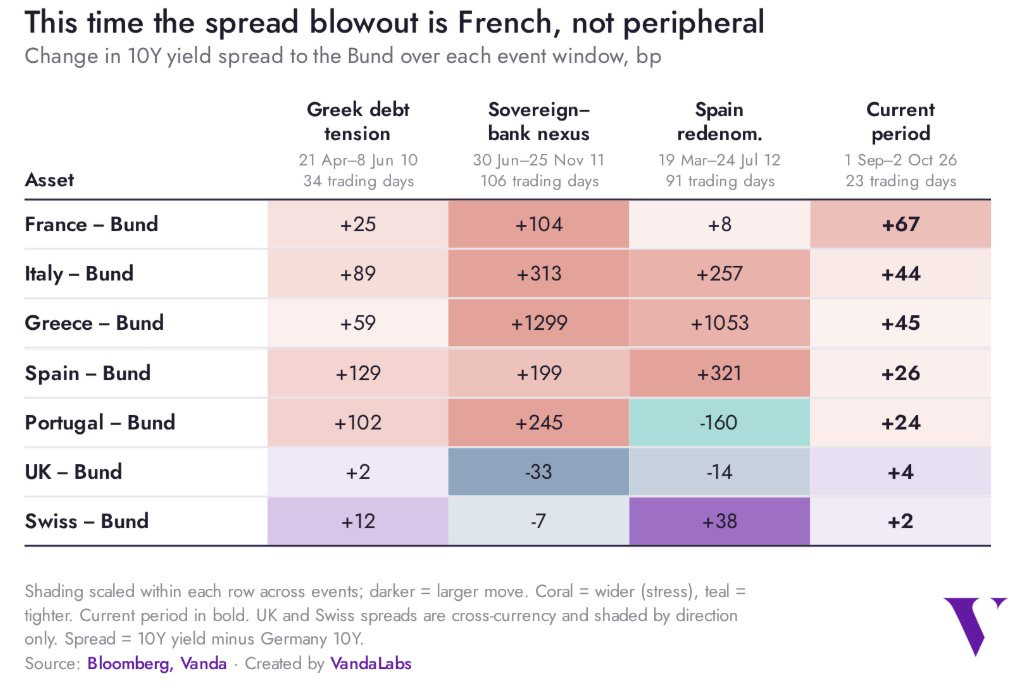
The so-called Bond Vigilantes have spent the better part of two decades as the Bigfoot of the fixed income world (plenty of grainy footage, never quite a confirmed sighting), but anyone looking for proof of life this week had to look across the Atlantic, where French spreads to German bunds have blown out faster than they did at the height of the 2010 Greek crisis while the leading candidates to succeed President Macron spent the week proposing solutions like lowering the retirement age and imprisoning the head of the country’s central bank. This all unfortunately looks a lot like the latest symptom of Washington’s ongoing rugpull of 40+ years of post-Cold War orthodoxy about the Rules-Based OrderTM, glimpsed early this year at Davos and followed swiftly by an expansion of the Donroe Doctrine, an aggressive reshoring push, allies getting stuck with more of the bill for their own defense, and so on. This transition was always going to hit the weakest links in the Western alliance first, and Europe checks just about every box on that front: worse energy sovereignty than the US, similar or worse debt loads, generally inferior capital markets depth, and an even more generous welfare state sitting atop still grimmer demographics. When squeezed hard enough on energy and sovereign funding costs, “middle powers” in this arrangement will eventually have to pick a side between the available spheres of influence, and this week brought some pretty clear evidence of which way the continent is trending, as Paris and Berlin – which until recently sat at opposite ends of the EU’s China debate – jointly sent Brussels a proposal for a trade “kill switch” that could cut China out of the single market altogether. Meanwhile, the European Parliament followed a couple days later by backing a tougher China line by a landslide, complete with calls for a European naval presence around the Taiwan Strait, which would have read like geopol fanfiction not too long ago.
We think all of this is of a piece with the reshuffling of the eurodollar system we’ve been writing about for much of this year (the short version being that the global financial system’s free ride on US dollar rails is over) and with the administration’s broader attempt to pull more economic gravity back onshore. That in turn plays into where we see the puck going with Treasury’s efforts to tokenize the dollar, which longtime readers will know we think is best understood as an attempt to make T-bills spendable at global scale and to install them as base collateral at the center of a more Treasury-aligned dollar system. As we’ve always said, a great deal has to go right for this to work out: the 10-year once again spending the week flirting with quarter-century highs on top of heightened volatility doesn’t give the administration a terribly long leash, and it’s even harder to call the vicissitudes of the European electorate than it is to predict the contents of the President’s next tweet (sorry, Truth). But we continue to think this effort benefits bitcoin one way or another in the long run: either the volatility required to get there blows something up and forces an acceleration of the new Fed-Treasury Accord that already seems to be taking shape, or some version of it works and opens up a whole new vector for expanding dollar liquidity in the form of a Treasury-led dollar, with scarce assets and hard money sitting downstream of both paths.
Selected Portfolio News
Strike launched Bitcoin Interest on Cash, allowing users to earn 3.6% interest on FDIC-insured cash balances, accrued daily and paid out monthly in bitcoin:


Strike also launched Stacks, a new feature that lets users organize their bitcoin savings into distinct buckets for both personal and business accounts:

StatMuse launched StatMuse MCP, giving AI agents built on Claude, ChatGPT, or any other MCP client direct access to StatMuse’s stats, odds, box scores, and injury news across every league:


As the world’s largest investor focused on the convergence of bitcoin, energy, and AI, Ten31 has deployed over $200 million across two funds into more than 30 of the most promising and innovative companies in the ecosystem. Visit ten31.xyz to learn more and get in touch about participating.
Market Updates
The Iranian economy appears to be buckling under the weight of the US blockade and sanctions, with the New York Times (yes, that New York Times) running a feature on the heavy toll, while the country’s oil minister abruptly resigned with no reason given.
Tehran nonetheless maintained a tough posture, with a senior official telling Reuters that Iran will never give up its right to enrich uranium and that there are currently no talks underway with the US, which was enough to push Brent back above $102 / barrel.
Kinetic action in the area matched the rhetoric, as tanker strikes picked up pace and pushed deeper into the Persian Gulf, including an attack on a vessel off Qatar, the first reported strike that far inside the region in about a month. On the other side of the Arabian Peninsula, Yemen’s Saudi-backed government forces retook the key Red Sea port of Mokha from the Houthis, reversing last month’s capture.
All told, oil stayed elevated, with WTI hovering around $90 and Brent above $100 for most of the week, though Chinese refiners are set to resume fuel exports just a week after halting them, which should help the diesel situation on the margin.
That said, while total volumes through the key Middle Eastern chokepoints generally remained solid on the week, the cost of facilitating those volumes has continued to skyrocket, with tanker rates that will soon need to be plotted on a log scale (though note this is a relatively larger problem for Asian industrial economies).
President Trump tried to cool things off late in the week, pinky-swearing that the US won’t attack Iran before the midterms and describing talks with Tehran as “productive,” a characterization Iranian officials apparently didn’t share.
The President also announced an agreement for the US to lift sanctions on Russian oil to allow for imports of Russian diesel, though – aside from this being an interesting way to flex the recently passed Lindsey O. Graham Sanctioning Russia and Iran Act – it’s unclear how needle-moving this will actually be in the near term.
Europe’s sovereigns had another rough week, with French spreads to bunds widening faster than they did during the 2010 Greek debt crisis, as France’s debt to GDP now nears 120% against a backdrop of tight energy markets and accelerating demands on the welfare state.
Paris’s answer was to copy the US’s homework and consider issuing more at the short end, with the country’s finance minister conceding that demand for 30-year paper has gotten “a bit trickier at the moment.”
Local appetite for austerity to address the unsustainable fiscal situation appears limited, as Marine Le Pen (the right’s leading candidate to replace President Emmanuel Macron next year) proposed a budget that immediately drew backlash despite including a provision to lower the retirement age all the way down to 60. At the same time, a leading leftist candidate vowed to prosecute the head of the country’s central bank for having the temerity to notice the impending fiscal crisis.
But the growing fiscal pressure seems to be clarifying positions on the China question, as Germany and France jointly sent Brussels a proposal for a trade “kill switch” that would allow an immediate cut-off from the EU market.
The European Parliament followed suit by a landslide, voting for a tougher China stance that labels Beijing a “decisive enabler” of Russia, backs a continuous European naval presence around the Taiwan Strait, and most importantly targets Chinese “export dumping” into European markets (I feel like I’ve heard this one somewhere, but can’t quite put my finger on it).
Elsewhere in efforts to firm up the Western flank, Secretary of State Marco Rubio stopped in Iceland, where both sides signaled openness to a larger US military footprint in the area.
South of the border, Trump ally Flavio Bolsonaro pulled ahead of incumbent President Lula in the first round of Brazil’s presidential election, setting up a runoff on October 25. The result, which once again defied projections from most mainstream polls, is the latest example of a clear rightward shift in the US’s backyard since the start of Trump 2.0.
Back in the US, the FCC said it will vote to require that the labs testing electronics sold in America be located domestically or in countries with reciprocal arrangements, as the White House continues to focus on reshoring and supply chain security at the edges.
Those reshoring efforts have yet to show up in the topline trade figures, as the US trade deficit widened to its largest since Liberation Day, though stripping out the AI buildout’s computer and telecom imports tells a very different story, with the deficit across everything else halved since April 2025 to its lowest since at least 1994.
Beijing, meanwhile, is busy shoring up its own foundations, closing hundreds of banks in what has become a record consolidation drive ostensibly to “bolster the financial system.”
Bank balance sheet hygiene was on the agenda stateside as well, as the New York Fed has apparently been reviewing major banks’ exposure to a deteriorating private credit market, with bank lending to nonbanks having ballooned past $1.5 trillion.
As the Fed looks into private credit, the White House has continued to look into the Fed, with the President escalating his ongoing feud with Fed Governor Lisa Cook via appointment of a new committee to investigate mortgage fraud allegations against Cook.
Despite growing volatility in the Fed-Treasury-White House relationship and ongoing inflationary pressures, Citadel Securities made the case that almost all of September’s increase in the 10-year came from real yields, pointing to stronger growth and stiffer competition for capital rather than inflation or sovereign instability as primary drivers of the recent surge.
New Treasury henchman David Zervos published some charts arguing in the same direction, highlighting that four key measures of core inflation are all trending lower for now.
The bond market seemed to take a breather this week, though only after a strong 10-year auction on Wednesday got the benchmark rate back below 5.3% alongside the MOVE Index falling back below 100.
Of course, the load on prospective Treasury buyers isn’t going to get any lighter, as President Trump expanded his $5,000 check offer to all adult citizens (clocking in at a roughly $1.2 trillion total tab) if Republicans hold both chambers in the midterms.
Treasury Secretary Scott Bessent will likely continue to run the Activist Treasury Issuance playbook to fund initiatives like that (which, to be fair, may meet the same fate as DOGE Dividends), as Citigroup projects Treasury will continue shifting billions in 30-year issuance to the front end while potentially discontinuing 20-year issuance altogether.
As for the main growth engine implicitly supporting all this issuance, OpenAI shared another batch of hundreds of results on open math problems from an unreleased internal model, though one researcher flagged that the company’s earlier Navier-Stokes proof may not actually be as robust as the lab initially claimed.
But either way, rumors suggest that most of the latest results came from one-shot prompts to a single model that’s still in training, with none of the elaborate agent swarms behind the Navier-Stokes work, which if true would arguably be the most meaningful data point out of this latest round of abstruse proofs that ~12 people in the world can actually verify.
All the galaxy brain math wasn’t enough to get markets going, though, as attention quickly shifted to a Financial Times report that OpenAI’s annual recurring revenue is ~$20 billion lower than previously reported, tanking equities as investors fretted that the lab’s ARR is “only” $50 billion (a number that likely would have gotten you laughed out of most rooms nine months ago).
There’s likely some nuance here, including that the “previously reported” larger figure has somewhat unclear provenance and that the delta may come down primarily to definitions, but the episode shows just how levered the whole trade is to a small handful of companies in the short run.
The week also brought some signs that the overall AI winners trade may have a path to fanning out, as emerging American lab Reflection AI (notably backed by accelerator giant Nvidia) launched an open-weight model built to compete with top Chinese open-weight offerings.
Less encouragingly, CrowdStrike reported that a cyberattack on several of South Korea’s biggest banks last week may have been carried out by a single person armed with an open-source AI tool and a handful of off-the-shelf models.
As the math and cybersecurity advancements of the latest models continue to proceed at a breakneck pace, “bitcoin security researcher” Justin Drake argued that the industry should prepare for AI to break elliptic curve cryptography – the cryptographic scheme underpinning private key security in both bitcoin and many other systems – within months, even ahead of any breakthroughs in quantum computing.

Coinbase’s head of cryptography Yehuda Lindell was not so sure, publicly disagreeing and arguing this is a low-evidence claim. We lean very much in this direction as well, though we would note for concerned users that various mitigation measures against an overnight left-tail scenario already exist (e.g. avoiding address reuse) and that long-term explorations of new cryptographic approaches by serious bitcoin researchers are well underway.
In any case, bitcoin stayed mostly rangebound in the mid-$80,000s all week as ETF flows remained stuck in neutral.
Regulatory Update
Treasury’s FinCEN withdrew two controversial proposals targeting digital asset users, scrapping both a 2023 plan to treat cryptocurrency mixing as a primary money laundering concern and the 2020 “unhosted wallet” rule that would have forced banks to report transactions with self-custodied wallets.
Noteworthy
Robinhood added $25 million of bitcoin to its balance sheet as it continues its broader digital assets push.
Ledger said it is investigating what appears to be an elaborate supply chain attack after reports that more than $86 million was drained from hundreds of wallets tied to devices sold through a Southeast Asian reseller.