

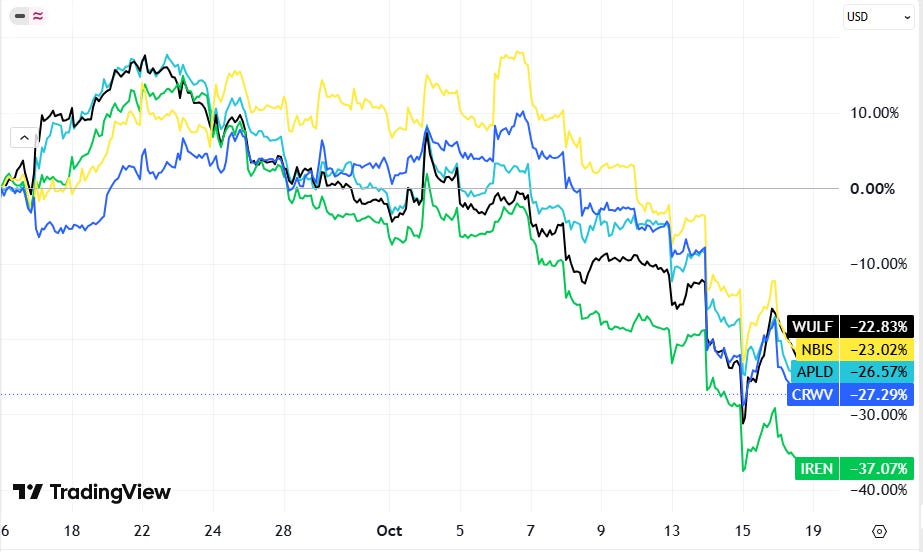
The ever more frequent We’re Back / It’s Over cycle reached its latest local nadir this week, as the timeline got flooded with a slew of “Black Monday incoming” posts as the S&P crashed to roughly, uh, 2.5% below its all-time high. The culprit this time around was an Anthropic pre-IPO roadshow that revealed growth slowing to a mere 45% quarter over quarter, which was enough to induce some long-awaited victory laps from deep value investors who’ve been making bubble calls since NVDA was at $30, while nuking anything with a hint of correlation to the AI supply chain and spiking the nominal cost of neocloud default protection to levels that, at face value, would imply better-than-even odds of a default within five years. The sheer volume of exuberant doomposting from accounts whose AI experience seems limited to free tier ChatGPT makes us suspect that the top is in fact not yet in, but this is no doubt a historic capex cycle funded increasingly by borrowed money and “creative” financing packages, so the heightened volatility on even a whiff of deceleration isn’t entirely surprising (even if there’s a fair argument that at least some of the Anthropic slowdown might have been driven by recent efforts to crack down on distillation, which, if successful, could set the stage for more meaningful tailwinds in the medium term).
But price action in the bond market might actually have been more interesting, as the 10-year looked at a hot CPI print and a record monthly jump in wholesale goods prices only to finish the week substantially lower anyway, while no less than three Fed officials took turns explaining why there’s no particular rush to tighten rates further. Fed Chair Kevin Warsh, meanwhile, was tight-lipped on near-term Fed policy but had some notable meta-commentary on the overall system, including praise for a more synchronized tightening cycle among the world’s central banks that leaves “no free riders,” which if you squint looks rather like the anti-Eurodollar direction of travel that’s been emanating from the Treasury all year (perhaps not surprising given the self-declared house making it clear back in August that the two institutions would “work together” on US debt management while expressing confidence that his fellow Druckenmiller alum will “do the right thing”).
That growing alignment may become even more important in the coming months, as it seems like the AI question resolves in one of two ways from here. If the buildout carrying so much of the administration’s plan runs into a hard wall of financing capacity and physical resource constraints (and the AI bears have a point that extreme diesel tightening, heightened kinetic tension around the Middle East, and weaponization of critical minerals are not helping the bull case), volatility will go nonlinear and someone will need to engineer a creative backstop, which is materially easier with the Fed and Treasury rowing in the same direction. If instead the doomers are early yet again and a once-in-a-century technological shift steamrolls these concerns for a while longer, that buys the US cover to keep rebuilding the dollar system around the Treasury (a project that looks increasingly likely to outlive this administration, as we now have senior House Democrats sounding more or less like President Trump on China and Europe), which would be an outcome that we’ve long argued moves in a strongly pro-liquidity direction. Timing the exact peaks and valleys in a credit cycle is not our game, but we don’t think readers need to call the precise event path here to see that both branches end up somewhere pretty constructive for bitcoin.
Selected Portfolio News
Strike cut rates on its bitcoin line of credit product for both new and existing customers, letting users draw cash against their bitcoin without selling it:


As the world’s largest investor focused on the convergence of bitcoin, energy, and AI, Ten31 has deployed over $200 million across two funds into more than 30 of the most promising and innovative companies in the ecosystem. Visit ten31.xyz to learn more and get in touch about participating.
Media
Giga Energy CTO Angad Sandhu published a piece in Data Center Dynamics about the company’s modular construction strategy, which aims to bring HPC capacity online cheaper, faster, and at higher quality.
Amid questions about AI’s long-term impact on cryptographic security, AnchorWatch Co-Founder and CEO Rob Hamilton published a breakdown of the five open mathematical questions that would need to be answered for any classical algorithm, AI-assisted or otherwise, to weaken bitcoin’s elliptic curve cryptography.
Unchained Co-Founder Dhruv Bansal joined What Bitcoin Did to discuss why AI agents that need to pay for compute, bandwidth, and storage would ultimately prefer to transact in bitcoin.
Market Updates
Because the market is increasingly just one big pod shop, everyone hit the panic button this week after Anthropic’s third-quarter numbers pointed to decelerating growth, even as revenue grew 45% from the prior quarter to nearly $17 billion (the junk credit rating, admittedly, did not help the optics).
Some of that slowdown may have been by choice, as the lab said it has meaningfully clamped down on what it characterized as distillation attacks by Chinese AI labs, cutting the data they could harvest by as much as 90% to 99% and turning away “meaningful revenue” in the process. If those measures prove successful, that may have real implications for how quickly open-weight models can keep closing the gap with the frontier.
Regardless of the qualifiers, most of the AI value chain got smoked on the sentiment hit, with the neocloud complex selling off particularly violently as CoreWeave’s five-year CDS blew past 1,100 bps (though it’s worth noting that CDS can gap wider on a rush of hedging demand alone, so we’d be careful reading it as a sign of an imminent blowup).
Levered operators across the AI supply chain got hit hard as well, while default protection on Oracle and even the hyperscalers continued moving to record highs. The broader market got whacked right along with them, with semiconductor weakness dragging the S&P 500 to its worst week since June.
BlackRock CEO Larry Fink, for his part, warned that a moratorium on data center construction (the threat of which has become a real headwind for the buildout) could tip the US into recession, a fairly candid acknowledgment of just how important this one trade is to everything else.
Not helping sentiment were the much hotter inflation updates, with PPI coming in dramatically above expectations at +6.3% Y/Y against 5.4% expected and final demand goods jumping 2.6% in a single month, the biggest increase on record.
Stripping out energy brought the annual figure down to a still-hot 5%, though BLS noted that almost half of the increase in processed goods prices came from much higher diesel prices. At the same time, September CPI came in above consensus on both headline and core.
Underneath the hot prints, the consumer looks a bit wobblier, as gas station spending rose 24% Y/Y and accounted for nearly all of the growth in consumption, leaving retail spending outside the pump growing at its slowest pace in two years.
The lower end of the credit spectrum is also stretching to keep up, with more than 30% of subprime auto loans originated in the first half of this year not scheduled to be paid off until the 12-year mark (up from 7% at the end of 2019).
Interestingly, the hot CPI print initially caused the 10-year to spike back above 5.3% before a massive intraday reversal landed it closer to 5.1%, and PPI the next day only pushed it lower, with the benchmark yield closing out the week a bit under that level.
Against the backdrop of a swooning AI complex and hotter inflation, Fed Governor Christopher Waller insisted that the surge in yields reflects growth and capital competition, with long-term inflation expectations still well anchored.
New York Fed President John Williams similarly said he sees one more hike this year as appropriate but no need for further hikes in 2027 (a notably specific roadmap for a Fed that has ostensibly sworn off forward guidance).
Going for the jawboning hat trick, Vice Chair for Supervision Michelle Bowman indicated that while inflation is above target, she sees no urgency to get aggressive, while also reiterating the point she’s been making for a couple of years (right alongside Treasury Secretary Scott Bessent) that too much credit creation has been pushed out of the traditional banking sector and that capital requirements and other rules should be eased to bring it back.
Fed Chair Kevin Warsh, meanwhile, declined to tip his hand on an October hike but welcomed the synchronized tightening around the world as an indication that there will be “no free riders” going forward.
On the energy front, the IEA now expects the global diesel shortage to last well into next year, with inventories unlikely to recover until the back half of 2027.
The Gulf did its part to keep things tight, as a Houthi missile hit Riyadh’s main airport in the deadliest attack on the Kingdom in a decade, increasing concerns about a widening conflict. The group followed up days later by striking Aramco’s headquarters and vowing more attacks on Saudi airports and oil facilities.
That threat looked like it may have materialized late Friday, when Brent ripped above $109 on still-unconfirmed reports that Yanbu or the East-West pipeline had been targeted yet again, though satellite imagery shared early Saturday appears to show tankers at the port actively loading.
Traffic through the Strait of Hormuz has proven sturdier than the headlines might suggest, with average daily oil flows running above 12 million barrels so far in October, ahead of September’s pace, even as 26 vessels came under attack this month (more than 9 million of those barrels are moving under direct US military protection).
Yet despite everything, implied US oil demand is sitting at a five-year high for this time of year (is the demand destruction in the room with us right now?).
The pain is landing considerably harder in Tehran, where the IMF now sees the Iranian economy shrinking by 7.6% this year, its biggest contraction in nearly 40 years.
Further north, President Trump announced an “energy truce” between Russia and Ukraine, which was apparently news to Ukrainian President Volodymyr Zelensky. The truce followed close on the heels of Trump’s diesel deal with Putin, which opened a new rift with Europe and drew a pointed response from Zelensky that “gifts to Putin will not lead to peace,” as both attacks and acrimony ramped up on the back of it.
Escalation continued all week regardless, culminating Friday in Poland scrambling fighter jets as Russia struck western Ukraine and drones hit cargo ships in the Black Sea, adding even more uncertainty to the global energy backdrop.
After the close on Friday, Trump proceeded to waive many of the sanctions in the Lindsey O. Graham Sanctioning Russia and Iran Act, the bipartisan bill he signed just last month, two days before they were due to take effect.
Despite recent chest thumping on both sides of the US’s northern border, Canadian Prime Minister Mark Carney pledged to “continue to maximise” the country’s oil and diesel exports to the US, with diesel alone running well over a million barrels per day.
Elsewhere in the rapidly shifting international trade picture, Trump publicly linked potential tariff cuts for South Korea to its $150 billion US shipbuilding pledge, speaking at the launch of a new Maryland shipyard in which he said US taxpayers will hold a 40% stake.
The House Select Committee on China urged DHS to revoke COSCO Shipping’s privilege of facing fewer inspections at US ports, alleging the state-linked shipper’s vessels have been conducting espionage near American coastlines.
Beijing’s export machine has continued to rip regardless, with September shipments up 36% Y/Y against expectations for 26%, though those flows are increasingly overweight Europe, which may be contributing to the recent hardening of anti-China sentiment among EU leaders.
In response, Berlin will reportedly press EU leaders to quickly put quotas on more Chinese imports, from chemicals to pharmaceuticals, following last week’s joint “kill switch” proposal with Paris and a record EU trade deficit with China in September.
China also appears to be aggressively diverting exports into emerging markets as an offtake valve for its industrial model, though transshipment hubs like Vietnam and Mexico look especially strong, suggesting some of that is likely still finding its way into the US.
The picture inside China’s manufacturing base continues to look wobbly on some key fronts, as the Wall Street Journal detailed a growing debt spiral with exposure to an increasing share of unproductive projects, and the latest data show that more Chinese industrial firms are losing money than five years ago.
Perhaps tellingly, Beijing moved to support its stock market with selling curbs and liquidity injections, a playbook it has reached for more than once over the past decade.
At the same time, a new analysis from Bloomberg this week suggested that China might have been using Canada to quietly accumulate as much as $600 billion in Treasuries, which would pose a noteworthy potential challenge for the received narrative of rapid diversification away from US obligations.
In a very notable data point for any asset managers with their fingers crossed that all of this disruption is just a Trump-specific phenomenon, House Intelligence Committee Ranking Member Jim Himes (whom you’ll note has a “D” next to his name) sounded a lot like the President this week, arguing that Europe needs to shoulder far more of its own defense burden and that no one should expect Democrats to unwind Trump’s trade policies.
Bitcoin held up surprisingly well amid the AI carnage and a wall of concerning energy headlines, dipping below $80,000 for the first time since mid-September before quickly recovering to $82,000 and settling back into its recent range.
Regulatory Update
White House Crypto Council executive director Patrick Witt – who had a lead role in pushing for the CLARITY Act and other digital assets initiatives – stepped away from the administration this week. It’s not immediately clear whether his position will be filled.
Noteworthy
Lightning Labs introduced LayerTree, a covenant-based scaling proposal in which a single bitcoin UTXO can hold the balances of potentially millions of users in an off-chain Merkle-sum tree, letting any user exit on their own in a single transaction with no timeouts and no need to be online to receive funds (though it relies on opcodes that aren’t yet active on bitcoin).
Anthropic’s Frontier Red Team traced the origins of the long-mysterious seeds behind the NIST curves used in ECDSA (the widely used signature standard behind bitcoin and many other systems), offering additional confidence that those curves weren’t deliberately backdoored.