

It increasingly feels like we’re coming up on a point where this phase of the game breaks one way or another, at least temporarily. Energy prices have returned to year-to-date highs on the back of an attack on the Saudi East-West Pipeline that had been doing so much to relieve the commodity stress coming out of Iran, which pressures Europe in particular and potentially China as well, given their SPR drain through this year and a Chinese oil benchmark now widening out to a steep premium over WTI. It’s also likely causing no small amount of discomfort for President Trump and Republicans heading into midterms, since prices at the pump tend to be inversely correlated with the mood of the median voter, while ripping diesel prices are now officially crimping industrial freight profitability (a problem for successfully running it hot). Compounding the rising cost of making things in meatspace was the Fed apparently moving into a new rate-hiking cycle (though we’ll see how long that lasts) and the 10-year working its way back into what has historically been challenging territory, both of which may present an issue for financing mankind’s largest ever capex project. And if that weren’t enough, the leading lights of that same project are suddenly trying to sell everyone on the idea that maybe we should all just take a breather on this whole AGI business for a minute, though virtually every data point we see suggests that’s either posturing or ultimately not going to be up to them (the White House made it pretty clear this week that we’re not slowing down regardless of what the Effective Altruist math says about utility maximization).
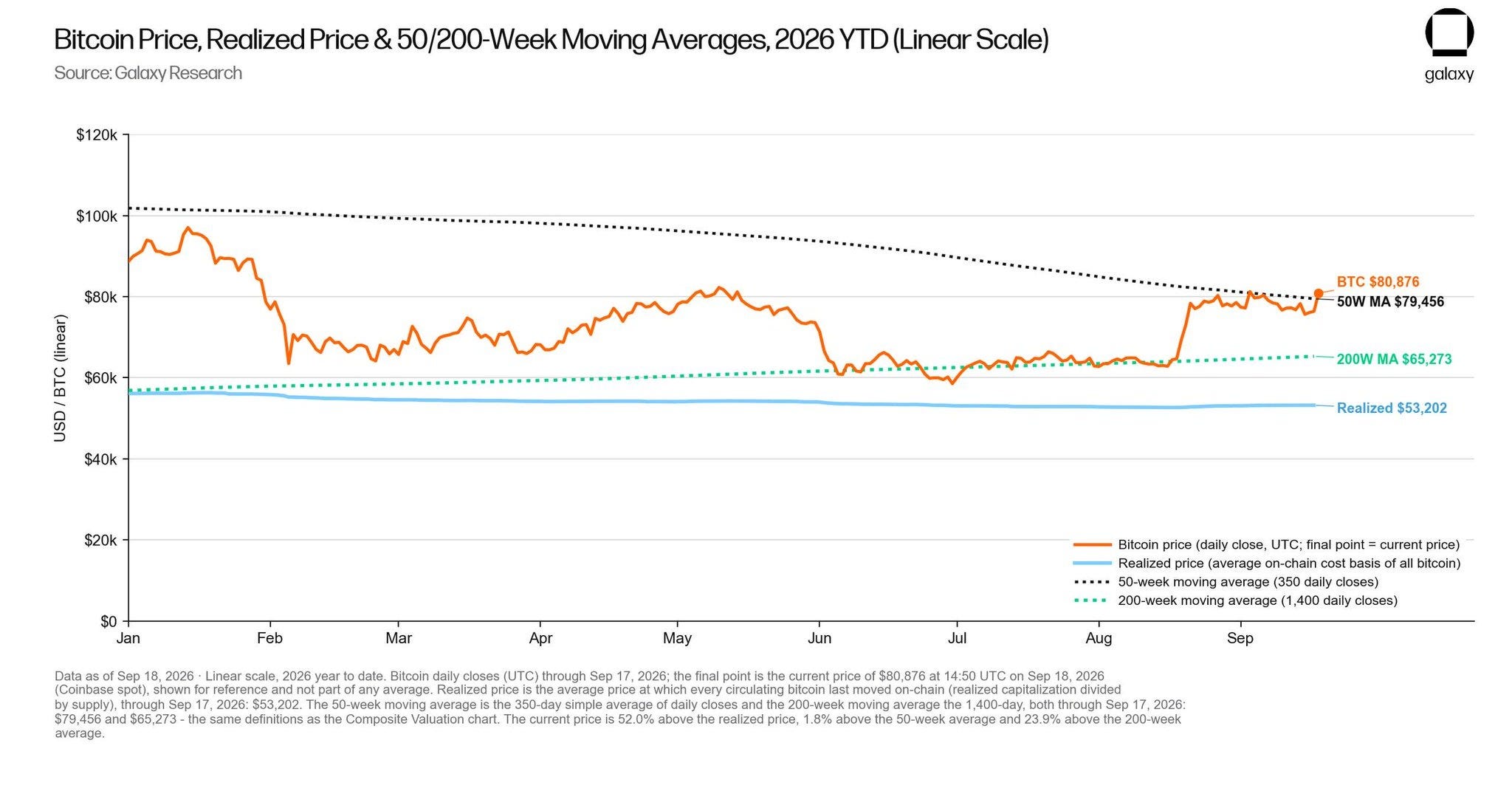
So with all that in mind, we found this week’s bitcoin price action extremely interesting, as the corn broke $81,000 again and cleared its 50 week moving average for the first time all year (traditionally a sign of a bear market coming to an end). It managed that move amid decidedly choppy macro news flow and what looks like the defeat of the long-awaited CLARITY Act, even if we’d maintain that bill was ultimately pretty fundamentally meaningless for bitcoin. We don’t make it our business to call tops or bottoms, and our crystal ball on short-term price swings is pretty foggy. But we have to say that this combination of factors looks a lot like what you’d want to see if you were keeping your eyes peeled for bottom formation.
As the world’s largest investor focused on the convergence of bitcoin, energy, and AI, Ten31 has deployed over $200 million across two funds into more than 30 of the most promising and innovative companies in the ecosystem. Visit ten31.xyz/invest to learn more and get in touch about participating.
Selected Portfolio News
Unchained launched support for ACH deposits, adding an alternative to wire transfers for funding client cash balances:


Media
AnchorWatch Co-Founder and CEO Rob Hamilton appeared on BMTV to discuss a wide variety of topics including bitcoin’s fundamental differentiation and shoring up security for bitcoin projects.
Market Updates
Anthropic CEO Dario Amodei blew up everyone’s weekend PA with an essay arguing that the industry must “pace” the rate at which it improves model capabilities after years of pushing aggressively toward recursive self-improvement and AGI.
Not suspiciously at all, this sudden call to pump the brakes on the largest capex project in human history was instantly echoed by Sam Altman, Elon Musk, Brad Gerstner, and various other Silicon Valley acolytes at the bleeding edge of the AI frontier.
The timing of this abrupt about-face was a touch awkward against reporting that Anthropic has locked down some $500 billion+ of compute commitments for the next few years, nearly triple its prior guidance through 2029 (a curious way to moderate frontier progress).
Amodei also floated the idea of the government taking a stake in AI companies, which we’d read as directional confirmation of the potential arrangement we laid out this summer.
Meanwhile, the company is also standing up an automated wet lab, which we take to mean they’re only comfortable allowing a rogue agent to develop a biological weapon under proper Effective Altruist supervision.
Our timeline simultaneously assured us that this means the labs are hitting a wall and totally cooked and that they’re advancing so rapidly they are legitimately unable to control their technology and that it’s all just classic regulatory capture and that it’s just a roundabout play to crack down on China and that it’s a way to crash the markets so everyone flees into bonds…but whatever the ulterior motives might be, the White House spent the week saying various versions of shut up, nerd to anyone asking about AI regulation.
Most publicly, President Trump phoned Nvidia CEO Jensen Huang mid-panel at the All-In Summit to assure the room that opposition to AI progress is all a hoax (a phone call that shouldn’t be particularly surprising given how important this capex wave is for the “run it hot” stance that is so critical to this administration’s strategy).
While the AI Millenarians were raining on the S&P500’s parade, energy markets gave the buildout something else to chew on, as oil prices ripped back up near YTD highs amid more escalation in the Middle East, with Saudi Arabia curbing deliveries to European refiners for the next several months as it repairs its crucial East-West Pipeline.
That squeeze was enough for French President Emmanuel Macron to call for an emergency G7 meeting on energy prices. Notably, the heightened oil market tightness of these past few weeks has also sent a key Chinese oil benchmark surging to multi-decade highs, good for a ~30% premium to WTI.
Energy Secretary Chris Wright seemed considerably less worried, describing the frictions as just a flesh wound, and the Saudis seemed to privately agree, with reports later in the week suggesting the Kingdom expects half its lost production from the attack to be back online within days.
Amid the pipeline disruption, the Saudis also seem to be relying on more reliable workaround routes such as – checks notes – the Strait of Hormuz, where flows broadly appear to be meaningfully picking up steam in recent weeks.
But even as some green shoots start to emerge around Hormuz, diesel is becoming a massive pain point domestically, with all-time high prices officially becoming a problem for American freight and logistics providers like JB Hunt, who issued a sharp downward revision to third quarter estimates on elevated diesel costs (not the kind of thing you want to see long term if you’re trying to ignite an American industrial renaissance).
The ongoing pain at the diesel pump even led Senate Majority Leader John Thune to float the idea of an export ban to help ease stateside prices.
Sustained upward pressure on key energy benchmarks did no favors for the bond market, with the 10-year Treasury yield moving back above 5% for the first time since 2023.
Despite these rising borrowing costs, Treasury Secretary Scott Bessent nonetheless assured Congress that there are ways to deliver the President’s promised $5,000 midterm dividend checks that “would not affect the deficit.”
On the industrial side, the CBO released new estimates suggesting the US has drawn down two-thirds of its missile interceptor stockpiles since last year as part of the fighting in Iran and that replacing that quantity could take up to five years. On the same thread, the week also brought reports that GM has been tapped (volun-told?) to use some of its production capacity to produce Patriot missile components, in line with similar announcements across the auto industry we’ve been cataloguing this year.
Elsewhere in increasingly normalized industrial policy, the Department of War announced a $450 million strategic investment into Elmet, the only integrated US producer of tungsten components critical for many defense applications.
On the trade front, Washington and Beijing are discussing some tariff cuts alongside a deal for China to buy US LNG.
The Lindsey Graham Sanctioning Russia Act was signed into law this week, authorizing tariffs of up to 100% on buyers of Russian crude (i.e. primarily China, and secondarily India if necessary).
But perhaps most notably for the White House’s attempt to reshuffle the global game board, the President announced an agreement with Denmark that (at least per Truth Social) hands Washington permanent control over security and all other needs in Greenland, ostensibly at “no cost” to the US. While it’s not quite up to the level of making Greenland the 51st state, it’s admittedly a pretty meaningful hat trick for the Donroe Doctrine alongside the moves in the Panama Canal and Venezuela that the US has made over the past year.
And speaking of our neighbors to the south, Venezuelan crude imports to the US have now ramped up to 800,000 barrels per day, the highest since 2017 after a multi-year period with no imports at all, as reports elsewhere suggest Exxon is continuing to advance negotiations to return to the country’s oil fields more than two decades after being forced out.
In a sign of the declining centrality of the Fed, this week’s FOMC meeting was not even close to the most notable event of the week, but the world’s key central bank did indeed raise rates as broadly forecasted on a unanimous vote, while signaling one more hike this year.
Interestingly, though, the Committee now appears less concerned about inflation than they were back in June when they voted to hold rates steady, which former temporary Fed Board member and noted low rates enjoyer Stephen Miran argued is an “incoherent reaction function” in a post highlighting various reasons the Fed shouldn’t hike.
Stop me if you’ve heard this one before, but the President responded to the news by once again calling for “1% or lower” interest rates.
While we can certainly debate the merits of the Phillips Curve tradeoff as well as the tenability of higher policy rates against the debt and strategic backdrop the US is facing, the latest macro data this week didn’t point to a particularly soft economy, as retail sales came in way above expectations and the Atlanta Fed’s GDPNow estimate moved up to 5.1% for Q3.
Against that particularly hairy and uncertain backdrop, bitcoin broke the $81,000 level again, trading above its 50 week moving average for the first time all year (a development that has historically marked the end of bitcoin bear markets).
Regulatory Update
The final text of the long-anticipated CLARITY Act arrived with a variety of compromises baked in, but the bill ultimately failed to clear cloture which for practical purposes ends the process for the near-term.
Some Democrats reportedly still want to keep talks going, though SEC Chair Paul Atkins reiterated that the Commission intends to move ahead with its own rules regardless, and it wasted no time, rolling out a five-year innovation exemption for trading tokenized stocks.
More notably for our purposes, the House Financial Services Committee advanced ARMA (the successor to the BITCOIN Act of 2024) on a 28-21 vote, with a 20-year lock on the reserve’s bitcoin holdings.
Noteworthy
Revolut announced a data breach driven by attackers using a spoofed government email address that compromised the identity documents and personal addresses of a “limited” number of users, once again highlighting the dangers of KYC/AML laws.
Elsewhere in data you had assumed was yours, 404 Media reported that OpenAI has hired humans to read some ChatGPT conversations, with users’ personal information often reaching reviewers despite filtering.