

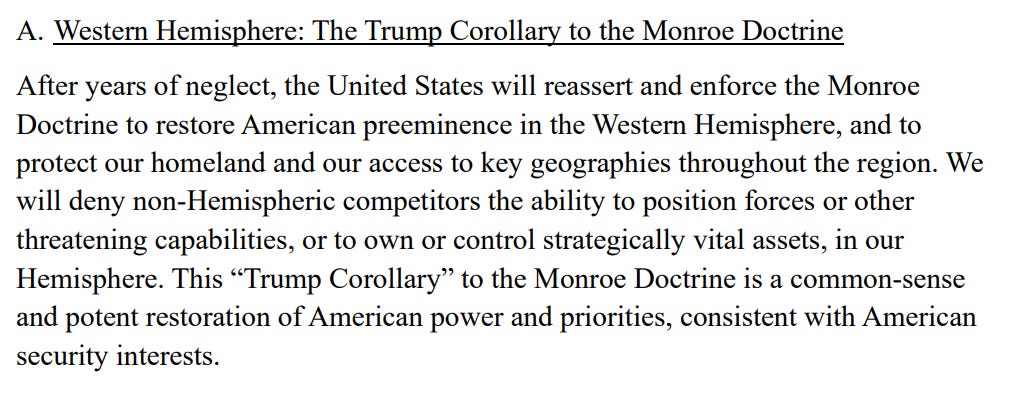
The administration continued to spell out the playbook for anyone who cares to listen this week, as Trump-friendly Kevin Hassett became the consensus pick to replace Jerome Powell at the Federal Reserve, Treasury Secretary Scott Bessent reiterated growing appetite to exert greater influence over the central bank, and banking regulators rolled back crisis-era rules meant to limit commercial bank leverage. Perhaps most notably, the White House released a comprehensive national security strategy memo which pretty directly outlines a variety of priorities geared toward re-shoring critical industries, generally boosting American manufacturing and industrialization, and an explicit revival of the “Monroe Doctrine” to support US dominance of the Western Hemisphere – including “identifying strategic acquisition and investment opportunities for American companies in the region.” Whether these ambitious / reckless initiatives ultimately succeed (place your bets depending on your Red Team / Blue Team affiliation), it once again strikes us that a world where:
The global hegemon is aggressively attempting to rework a trade order that elevated its sovereign debt to primary reserve asset status while
explicitly outlining plans to ramp up spending on a variety of domestic industries and military endeavors it sees as strategically critical to its survival despite
its debt and interest burdens bumping up against historic highs just as
its largest population segment and voting bloc prepares to cash in on trillions in promised entitlement benefits and
the same hegemon is laying the groundwork to more forcefully control the world’s most important financial institution…
…is simply not a world where you want to be short scarce, neutral assets. Despite several years of resistance, asset management giant Vanguard seemed to capitulate to that viewpoint this week, finally opening up bitcoin ETF access to users of its $11 trillion AUM platform, while Bank of America now recommends its managed accounts have up to 4% exposure to bitcoin. As a wise man once said: if you’re not paying attention, you probably should be.
Portfolio Company Spotlight
Mempool.space is the leading explorer and analytics platform for the bitcoin ecosystem. The platform provides extensive data and tools for real-time analysis of the multi-layer bitcoin network, including granular information on the bitcoin blockchain, the lightning network, and the mining landscape, all presented in an intuitive and sleek UI. The site allows users to easily estimate forecasted transaction fees, drill into in-depth data on both historical and forecasted blocks, explore the liquidity and connectivity of nodes across the lightning network, and much more. Users can either query data directly through the mempool.space site or choose to self-host an instance of the project on their own hardware to eliminate third-party dependencies. In addition, mempool.space has recently launched a Mining Accelerator product to help users more easily and predictably manage bitcoin’s volatile blockspace fee market.
As the world’s largest investor focused entirely on bitcoin, Ten31 has deployed over $200 million across two funds into more than 30 of the most promising and innovative companies in the ecosystem, and we expect 2025 to be the best year yet for both bitcoin and our portfolio. Visit ten31.xyz/invest to learn more and get in touch to discuss participating.
Selected Portfolio News
Strike added lending for customers in Chile and Guatemala:

As well as an enhanced integration with Bitkey:

And loan consolidation options:

AnchorWatch announced upcoming support for Coldcard, the most popular and secure bitcoin hardware signing device:

Media
Ten31 Co-Founder Jonathan Kirkwood published a new piece drawing parallels between Ten31’s work in funding the bitcoin ecosystem and James J. Hill’s buildout of the Great Northern Railroad.
Managing Partner Marty Bent joined the Blockware podcast for a wide-ranging discussion of the ecosystem.
Managing Partner Matt Odell appeared on the Treasury Orange podcast to discuss the latest in bitcoin treasury companies and bitcoin-backed lending.
Market Updates
The Bank of Japan kicked off the week by nuking everyone’s bags via suggestions that it is considering its first rate hike in over a year at a meeting later this month. Reports later in the week suggested the Bank is open to more hikes thereafter, which pushed long-end Japanese government bonds to yields not seen in 20+ years.
Asset prices generally recovered over the week, with the Wall Street Journal’s Fed Insider suggesting that Trump-friendly dove Kevin Hassett has all but won the Jerome Powell replacement sweepstakes.
Trump did suggest later in the week that he now plans to announce the official decision “early next year,” which pushes back the expected timeline a bit, though Hassett remains the clear Polymarket favorite.
Some bond market participants, apparently having not yet identified the sucker at the card table, have reportedly expressed concerns to the White House about Hassett’s potential impact on the real value of their bonds.
They may have additional reason to sweat soon, as Treasury Secretary Scott Bessent suggested this week that the White House is contemplating new requirements for future regional Fed Presidents, as well as veto power over new appointments.
Heading into the December FOMC meeting next week, the latest macro updates generally paved the way for the outcome the administration would like to see, as ADP private payrolls data for November came in worse than expected and well below the prior month, while core PCE inflation for September was also below consensus.
The Fed – which officially terminated its multi-year “Quantitative Tightening” program this week – will likely also be watching ongoing tremors in the repo market, as SOFR again spiked to well above the Fed’s policy corridor for several days over the past two weeks, and the Standing Repo Facility (SRF) was tapped for $85 billion over five days.
To be fair, this latest spike once again reflects month-end funding dynamics more than an imminent outright crisis, but regular repo observers may notice that these temporary spikes that we’re supposed to dismiss as irrelevant plumbing artifacts are happening with progressively more frequency and severity. This dynamic may not abate anytime soon given that, per the Wall Street Journal this week, banks continue to view use of the SRF with stigma.
Elsewhere in wonkish but noteworthy financial arcana, the FDIC and OCC rolled back 2013 guidance on leveraged lending, making it easier for commercial banks to engage in higher-risk loans to private equity firms and earlier stage companies. Like last week’s update to bank SLR rules, this move is of a piece with Secretary Bessent’s openly stated goal of reducing barriers to commercial bank credit creation.
Meanwhile, the White House released an extremely telling national security strategy memo that very explicitly outlines the administration’s key military and economic objectives. Among many noteworthy takeaways, the document explicitly highlights a revival of the Monroe Doctrine in the Western Hemisphere and a primary focus on aggressive reindustrialization of the US, all of which will have significant implications for the global trade order and fiscal policy.
On that same theme, following last week’s Genesis Mission announcement, the Trump administration is now reportedly all in on robotics, and SoftBank’s Masayoshi Son is reportedly working on financing (to the tune of hundreds of billions of dollars) “Trump Industrial Parks” to revitalize American manufacturing.
Michael and Susan Dell announced that their foundation will fund the first $6.25 billion check to seed the “Trump Accounts” plan, which will provide millions of American children a $1,000 stock market investment account. This program may lay the foundation for an innovative new way of bringing incremental capital into assets to solidify returns for the existing base of holders.

US Trade Representative Jamieson Greer said this week that the US is prioritizing “stability over conflict” in its relationship with China, a notably softer tone than the administration has taken for much of this year.
However, a new bipartisan bill looks to restrict exports of leading edge Nvidia accelerators to China for 30 months, and Bessent noted this week that the US will be able to replicate its aggressive tariff program even if the Supreme Court overturns the current incarnation.
The good diplomatic vibes did not extend southward, as President Trump declared that the world should consider Venezuela’s airspace closed as the US continues to ratchet up heat on the Maduro government. Trump also reportedly told Maduro he had until the end of the week to vacate the country peacefully, though it’s unclear if that deadline has been extended.
After years of protecting their clients from bitcoin (while ensuring they could access 3x levered single-stock ETFs), massive asset management platform Vanguard – which accounts for $11 trillion of AUM – opened up access to spot bitcoin ETFs this week.
In another notable update from the suits, Bank of America now recommends that clients of its $2 trillion wealth management business shift up to 4% of their portfolios to digital assets.
Bitcoin influencer extraordinaire Larry Fink appeared at the DealBook Summit alongside Coinbase CEO Brian Armstrong to issue his latest mea culpa on bitcoin, while noting that there are a number of sovereign wealth funds gradually building long-term positions with the view that “this is not a trade.”
Fidelity CEO Abigail Johnson said this week that she expects bitcoin to “play a role in the savings hierarchy.”
Finally, four years after China’s most extensive bitcoin mining “ban” (which actually seriously disrupted operations in the country after several prior attempts with less bite), China has quietly returned to controlling an estimated 14% of global hashrate.
Regulatory Update
Fed Governor and Vice Chair of Bank Supervision Michelle Bowman issued a strong statement against covert de-banking efforts of particular industries as part of prepared testimony before Congress.
SEC Commissioner Hester Peirce reiterated that she views bitcoin self-custody as a fundamental right.
The Bitcoin Policy Institute published a brief arguing for the pardon of Samourai Wallet’s developers.
Indiana lawmakers introduced a bill that would allow state pension funds to invest in bitcoin ETFs while introducing new protections for digital asset companies operating in the state.
The CFTC approved the launch of onshore leveraged spot bitcoin trading in the US.
Noteworthy
Institutional Investor magazine ran a piece on how bitcoin has become the “secret sauce” behind some of the most successful endowments.
Strategy established a $1.44 billion USD reserve for preferred dividend payments, which would cover 21 months of dividends at the current capital structure. This update should relieve some pressure for the company to sell some of its bitcoin holdings as the stock drifts closer to book value, though the company explicitly noted it will be open to selling bitcoin to buy back stock below 1x NAV.
Block’s “Chain Code delegation” design for more private collaborative custody was assigned a BIP number, bringing the idea one step closer to formal protocol standardization.
OpenSats published a report on recent advancements in Nostr clients.
Peter Schiff, the Ric Flair of bitcoin twitter, admitted the difficulty of verifying gold’s authenticity (highlighting a comparative strength of bitcoin) in a debate with Binance Founder CZ. Bitcoiners were quick to fly off the top rope in response to the conversation.
Travel
Bitcoin MENA, Dec 8-9
Nashville Energy & Mining Summit, Jan 2026