

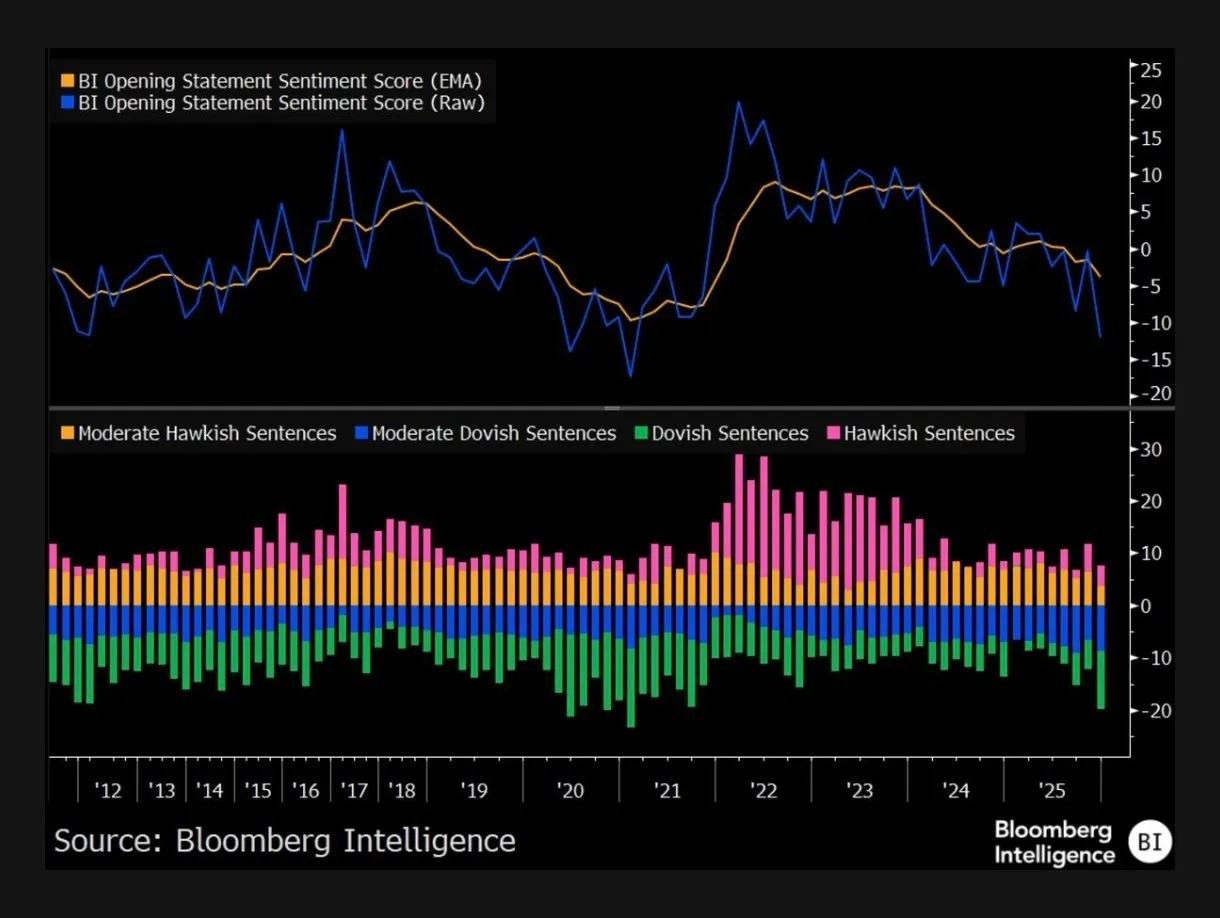
Everyone’s favorite cabal of lawyers and tenured professors congregated for the global banking system’s periodic entrail reading ritual, with this week’s session resulting in some of the most dovish updates the market has gotten from the monetary high priests all year. As was widely anticipated, Fed Chairman Jerome Powell announced a 25bps cut to the central bank’s benchmark interest rate, but the FOMC’s ancillary commentary around both the Fed’s balance sheet and general market conditions pointed to a more accommodative stance than expected, including the official resumption of regular Treasury purchases (with targeted durations out as far as three years) and an acknowledgment that the stagnant labor market seems to be much more of a concern than CPI at the moment. While it’s fair to note that the Fed seems to be clinging to a focus on the short end of the curve (i.e. so-called “Reserve Management Purchases”) just to shore up financial plumbing and bring down funding costs for more rate-sensitive sectors – rather than unbounded purchases of longer-duration debt to goose asset prices – it’s hard not to see this as the first step toward the world’s key central bank once again becoming a meaningful marginal buyer of Treasury issuance, particularly as incremental government funding shifts more and more to short-duration bills. The FOMC updates didn’t do much for stock indices or bitcoin, as some rough prints from Oracle and Broadcom reignited AI jitters and sent equities down on the week, but we think the direction of travel for markets – and hard assets in particular – is only getting clearer, especially given President Trump’s latest comments on the influence he will seek to exert over monetary policy next year.
Portfolio Company Spotlight
Primal is a first of its kind application for the Nostr protocol that combines a client, caching service, analytics tools, and more to address several unmet needs in the nascent Nostr ecosystem. Through the combination of its sleek client application and its caching service (built on a completely open source stack), Primal seeks to offer an end-user experience as smooth and easy as that of legacy social media platforms like Twitter, Substack, and eventually many other applications, unlocking the vast potential of Nostr for the next billion people. Primal also offers live video streaming and an integrated wallet that substantially reduces onboarding and UX frictions for both Nostr and the lightning network while highlighting bitcoin’s unique power as internet-native, open-source money.
As the world’s largest investor focused entirely on bitcoin, Ten31 has deployed over $200 million across two funds into more than 30 of the most promising and innovative companies in the ecosystem, and we expect 2025 to be the best year yet for both bitcoin and our portfolio. Visit ten31.xyz/invest to learn more and get in touch to discuss participating.
Selected Portfolio News
Strike now allows ACH and Fedwire transfers from any US bank account:

While opening up new lending options in Rhode Island and Oklahoma:

And lowering lending minimums for customers in the EU:

Media
Strike Founder and CEO Jack Mallers joined CNBC to discuss the official listing of Twenty One Capital on the NYSE.
Ten31 Principal John Arnold joined Ten31 Partner Matt Odell on Citadel Dispatch to discuss quantum computing, bitcoin’s cycles, stablecoins, and more.
Market Updates
The latest FOMC meeting brought the latest 25bps rate cut that investors had broadly priced in, pushing the Fed Funds Rate to 3.5-3.75%. Two voters dissented on the cut, while recent Trump appointee Stephen Miran again advocated for a 50bps decrease.
More surprisingly, Fed Chairman Powell’s public commentary was about as dovish as anyone could have hoped (particularly after Powell attempted to cast a much more hawkish image at the last meeting), including commentary pointing to growing weakness in the labor market and a growing bias toward managing that risk relative to inflation.
Specifically, the Chairman implied that US labor statistics – which have already been less than stellar on the surface – have likely been meaningfully overstating job growth by as much as 60,000 jobs per month, implying negative employment gains in many periods of this year.
Probably most importantly, though, the Fed confirmed it will begin purchasing $40 billion of Treasury securities per month starting this week, reversing the “Quantitative Tightening” program it has been running since 2022. This was expected by many analysts, but the duration profile was more surprising, with the central bank noting it will purchase maturities of up to 3 years, which could potentially have a more supportive effect on “risk-on” assets than shorter-duration purchases.
President Trump continued to jawbone the central bank all week, noting that a requirement for his selection of the next Fed Chair is that his chosen candidate must immediately lower rates upon taking the helm.
The President also suggested that the new Fed Chair will need to consult with him on interest rate decisions going forward, and that the US “should have the lowest interest rate in the world,” down to “1% and maybe lower.” At the same time, Trump indicated he’s now leaning toward Kevin Warsh as his top choice for the job, following weeks of Kevin Hassett moving firmly into pole position.
In a probably totally unrelated update, Hassett mentioned in an interview this week that there is “plenty of room” for the Fed to cut more from here, as well as many opportunities for additional fiscal stimulus next year (though he also suggested he wouldn’t allow himself to be pressured into further cuts if inflation increased significantly).
Whoever ends up becoming Trump’s number one boy, the President hinted that this appointment won’t mark the end of his push for more Fed oversight, publicly commenting that some current Fed Board members might have been appointed by auto-pen.
All the Fed machinations clearly left the President in a bullish mood, as he argued that there’s no reason we can’t see 20-25% GDP growth soon.
The average investor was less convinced, with equity indices down on the week due to disappointing Oracle and Broadcom earnings updates that reignited questions about the AI boom.
US federal deficit spending for November declined meaningfully Y/Y to “only” $174 billion, though the total deficit for the first two months of the fiscal year is still running near an all-time high.
Overseas, Japanese government bond yields continued ripping to new multi-decade highs as the Bank of Japan looks set to hike benchmark rates further next week.
On the trade war front, the US announced it will allow Nvidia to ship prior-generation H200 chips to China (as long as the US gets a 25% cut of sales).
In a less widely publicized headline, a large deposit of rare earth minerals – a key leverage point for China in ongoing trade negotiations – was discovered in Utah this week. While the main bottleneck for rare earth production is really refining moreso than raw resource availability, this deposit was notably discovered on land that is already permitted and outfitted for mining.
South of the border, after a year of squabbling with the President on his tariffs agenda, Mexico approved new tariffs as high as 50% on over 1,400 categories of Chinese imports, an important step in the Trump administration’s goal of negating the impact of Chinese “transshipments” through other countries.
Elsewhere in Latin America – which the US looks increasingly intent on controlling much more aggressively – the US military seized a Venezuelan oil tanker ostensibly being used to smuggle oil for sanctioned countries.
In another signpost of the fragmentation of the “rules-based global order,” Italy’s Prime Minister Giorgia Meloni escalated an ongoing push to exert more control over the country’s gold reserves this week, arguing that foreign shareholders in the Bank of Italy have no claim on the institution’s gold, which represents the third-largest publicly declared national stockpile in the world.
Two of the wealthiest and most successful men in history spoke positively of bitcoin’s link to energy in the past couple weeks, with Nvidia CEO Jensen Huang praising bitcoin’s ability to monetize energy anywhere and Elon Musk calling bitcoin the ideal money for a post-scarcity future. While we can quibble with conceptual elements of both comments, we would argue this may mark a good time for those who “can’t see a use case” for bitcoin to revisit their priors.
Regulatory Update
Several regulatory bodies issued noteworthy updates on legacy systems’ ability to interact with bitcoin this week, as the CFTC approved a pilot program for using bitcoin as collateral in derivatives contracts, while the OCC issued guidance confirming that banks can buy and sell bitcoin for customers.
On the same thread, the OCC approved several new national trust charters for a variety of digital assets-oriented groups, including BitGo and Fidelity Digital Assets.
The Supreme Court began evaluating a case that would give the President much more discretion to fire officials of government agencies. The ruling may not arrive until as late as July of next year, but this case bears monitoring as it may have implications for the durability of “Fed independence.”
Noteworthy
Several bitcoin cryptography experts published a new analysis of post-quantum updates to harden bitcoin against future advances in quantum computing. Notably, the paper suggests new optimizations that could enable quantum-resistant hash-based signatures without adding new cryptographic primitives or very data-intensive signing schemes, perhaps clearing an easier path to greater quantum resistance.
Following weeks of growing consternation about MSCI’s proposed exclusion of “bitcoin treasury companies” from its indices, Strategy maintained its place in the latest iteration of the Nasdaq 100 Index.
Bernstein’s research team noted they believe bitcoin’s so-called “four year cycles” are over.
Travel
Nashville Energy & Mining Summit, Jan 2026