

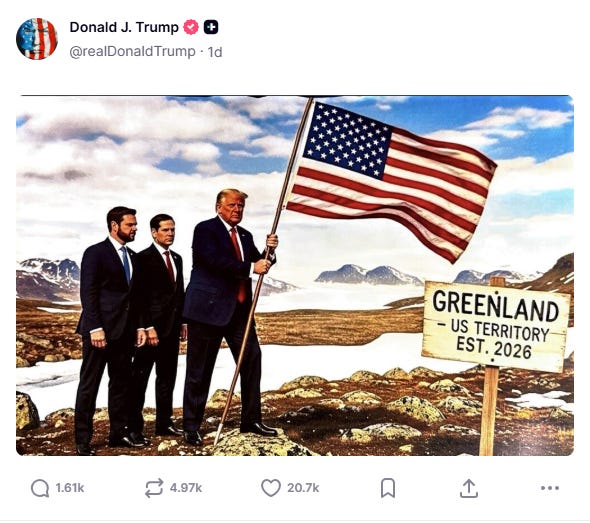
Anyone hanging on to their Rules-Based Global OrderTM stock in hopes of a dead cat bounce took another big drawdown this week, as President Trump disturbed the peace at the annual Convocation of the Anti-Civilization Cabal World Economic Forum in Davos with escalated threats to annex Greenland. The President called for new punitive tariffs on the EU until the member countries carve a path for the US to effect a “total and complete purchase” of Greenland, sending many markets – except, of course, precious metals – into a deep selloff. Trump made some reassuring comments about the use of military force later in the week that let investors breathe a sigh of relief, but not before making a string of remarks pointing to an outright repudiation of the Atlanticist paradigm that has (sometimes explicitly, always implicitly) defined international relations over the past half-century. World-renowned Long-Term Debt Cycle Observer Ray Dalio told the WEF crowd that this old paradigm is already extinct and encouraged attendees to stop being naïve about its return; while Mr. Dalio may be somewhat vulnerable to accusations that he called 10 of the last 2 bond market crises, we would have to agree with him here. It still seems far from consensus, but the international Era of Good Feelings is clearly giving way to, as one of the most powerful advisers in the administration puts it, an era of Great Power Conflict. This fracturing seems to be coinciding with and reinforcing a broad push to ramp up worldwide fiscal spending for militarization and reindustrialization even as public debt burdens sit near all-time highs – exemplified this week by the new Japanese Prime Minister’s vow to end “excessive austerity” with debt to GDP already above 250% – which only strengthens our conviction that hard assets will be increasingly essential for all investors this decade. And within that paradigm, recent boring price action notwithstanding, we continue to see substantial unrecognized value in a globally portable, instantly transmissible, easily verifiable, permissionless, energy-linked, and absolutely finite money for enemies.
Selected Portfolio News
Fold announced a partnership with Steak ’n Shake to facilitate the company’s new bitcoin bonus plan:


Strike added consumer lending in Vermont:


Unchained launched an improved mobile transaction flow to make its multi-sig transactions smoother:


As the world’s largest investor focused on the convergence of bitcoin, energy, and AI, Ten31 has deployed over $200 million across two funds into more than 30 of the most promising and innovative companies in the ecosystem. Visit ten31.xyz/invest to learn more and get in touch about participating.
Media
Ten31 Managing Partner Marty Bent appeared on the Bitcoin for Millennials podcast to discuss the precious metals rally, bitcoin’s evolving role in traditional finance, and more.
Market Updates
To make sure everyone had a nice, quiet long weekend, President Trump dropped his latest Truth Social nuke on Saturday, threatening new tariffs on the EU until the organization helps the US facilitate a “total and complete purchase” of Greenland.
Treasury Secretary Scott Bessent told reporters the US needs the territory to shore up its national security, and that the President’s actions show the world that the US is So Back.
The administration was broadly aggressive in its implications for what acquiring Greenland might involve, with Trump ominously telling the press “you’ll find out” how far he’s willing to go.
The EU immediately responded by scrapping the extremely lopsided trade deal it reached with the US in July while threatening to unload a “trade bazooka” in retaliation (though the New York Times quickly reported that key leaders were privately leaning toward negotiating).
The Chief Investment Officer of large European insurer Allianz said the European bloc should pressure Trump with market volatility (effectively betting once again on the “TACO” trade), and a Danish pension fund took him up on it, announcing it will exit its $100 million US Treasury position by year-end.
In a sign of how strong the trans-Atlantic relationship is, Secretary Bessent noted that this Treasury sale is “like Denmark itself, irrelevant.”
All the annexation kerfuffle spooked markets early in the week, with US stocks putting up their worst selloff since October as the 10-year Treasury yield spiked back up to levels last touched in the summer. The President said no one should be concerned here, as stocks “will double in a short period of time” (to be fair, we have to admit that his last call like this was pretty solid).
Like Lucy holding the football for Charlie Brown, President Trump once again pulled a gotcha on shorts later in the week, reassuring everyone that he won’t look to take Greenland with military force and that he has reached “the framework of a deal” with NATO on his demands for the island.
That said, the next Donroe candidate to watch may be Cuba, as reports this week suggested the administration is actively seeking regime change there by year-end. In a perhaps related update, Treasury Secretary Bessent indicated that the US could gain critical mineral independence within two years by leveraging the US’s broader sphere of influence.
While the administration continues to look for new real estate to add to the US portfolio, the President’s sweeping tariffs remain in a state of limbo, as the Supreme Court once again did not issue a ruling on their legality (though some have argued the longer we go without a ruling, the more likely it is to fall in the administration’s favor). The next potential update here will be on February 20th.
Nevertheless, the President reiterated his plan to distribute $2,000 “tariff dividends” to most Americans, indicating he doesn’t believe he’ll need Congressional approval. Though as it relates to the more general affordability push, he also said he doesn’t like the idea of allowing people to dip into retirement accounts to fund down payments on homes, perhaps hinting that he wants to avoid the potential downside pressure that might create for equities.
Though we didn’t get an update from the high court on tariffs this week, SCOTUS did begin hearing arguments on the Lisa Cook case. During the proceedings, Justice Kavanagh suggested that the President firing the Fed Governor would “shatter Fed independence,” potentially previewing a decision that won’t favor the administration.
Meanwhile, BlackRock Fixed Income CIO Rick Rieder shot to the top of the Fed Chair leaderboards, as President Trump called him “very impressive” while suggesting that his shortlist for the job is “down to maybe one.” As of this morning, Polymarket pegs Rieder’s chances at 60%.
It’s worth noting that the BlackRock executive has previously called for a Fed Funds Rate of 3% “without question” and potential for further cuts from there. He has also argued that bitcoin belongs in an ideal portfolio (though thinks 5% exposure is too high).
The latest PCE readout – ostensibly the Fed’s most closely watched inflation metric – printed in line with consensus this week at 2.8%, still above target but potentially in a range that could grease the skids for someone like Rieder to continue advocating for lower rates.
Perhaps the most volatile market worldwide was in Japanese government bonds, which ripped up 25bps in a single day to kick off the week, as long end yields look like they have no ceiling in sight.
The Greenland controversy no doubt added fuel to the fire, but much of this move was seemingly precipitated by new Prime Minister Sanae Takaichi vowing to end the “excessive austerity” in Japanese government spending. We are admittedly curious if this austerity is in the room with us right now, but either way, these concerns pushed JGB illiquidity to all-time highs this week.

The Bank of Japan held its benchmark interest rate steady as expected, though Governor Ueda acknowledged, with characteristic understatement, that “long-term interest rates are rising at quite a fast pace” while noting the bank “is ready to take nimble action to cope with exceptional moves.”
Shortly thereafter, the Yen gapped up hard on Friday after weeks of softness, presumably a sign of the government’s latest intervention to temporarily stabilize the currency.
Amid all the uncertainty and massive moves, silver continued its historically blistering run, breaking $100 per ounce for the first time in history while gold pushed right up against the $5,000 level for the first time.
While bitcoin continued to get no sustained debasement trade love this week, Delaware Life Insurance Company launched the market’s first fixed index annuity with bitcoin exposure via IBIT.
Regulatory Update
As part of his remarks in Davos, President Trump reiterated his support for “crypto”-friendly policies as a means to counter China, and suggested he expects to sign the long-awaited market structure bill very soon.
Congressional staffers, however, say the bill will likely be delayed for several more weeks due to ongoing disputes between Coinbase and the banking industry around stablecoin rules.
Patrick Witt, director of the White House’s Crypto Council, said this week that the US is continuing to work on mechanisms to add to the strategic bitcoin reserve, noting the administration is trying to get around “obscure legal frameworks” that have impeded the process.
Following a few similar state announcements over the past several weeks, Tennessee, Oklahoma, and Kansas all introduced their own state bitcoin reserve bills.
Noteworthy
Rabobank macro strategist Michael Every published an interesting and non-consensus piece on what he sees as President Trump’s “Reverse Perestroika” agenda to remake the US economy.
Like all good sellside analysts who make sure to wait until after a massive performance gap to recommend portfolio shifts, a Jefferies strategist published a note downgrading bitcoin and upgrading gold, encouraging clients to rotate out of the orange coin and into the yellow metal.
Meanwhile, scientists accidentally did alchemy and made gold from lead in the Large Hadron Collider this week.
Farcaster, an ostensibly decentralized, crypto-powered alternative to Twitter which raised $150 million from blue chip crypto funds less than two years ago, announced it would return investor capital while selling off assets.
Travel
Bitcoin Investor Week, Feb 9-13
Bitcoin 2026, Apr 27-29