

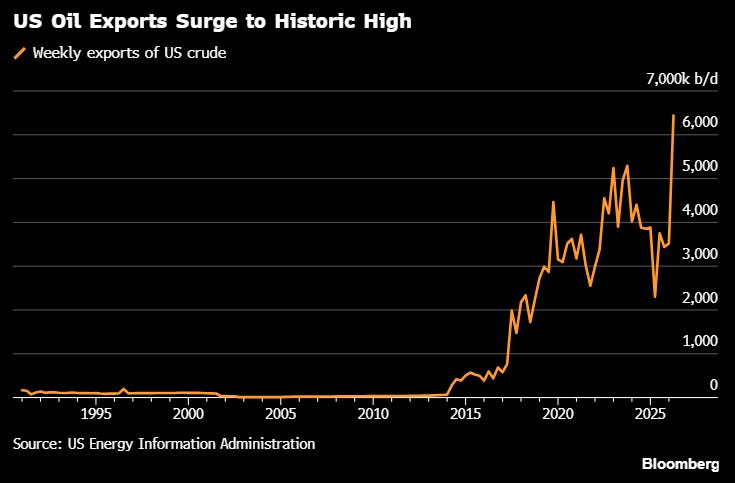
Another week of limited Strait of Hormuz traffic, another all-time high for equities. Markets are not clairvoyant (see 1929, 1987, 1999, 2008, 2021…) but they are forward-looking, and the past month’s price action is telling you something about where the investing hivemind believes the world is going with or without an official grand bargain between Orange Man and the IRGC. While bitcoiners and crypto influencers converged on Vegas this week to once again learn the meaning of negative-sum games (and we’re not just talking about the slot machines), global energy markets saw a couple headlines that we think help explain recent equity strength and will prove to be monumental developments when historians HistoryProfessorGPT eventually writes the consensus narrative on this period. First off, US exports of oil, natural gas, and jet fuel surged to new all-time highs, putting the country in league with Saudi Arabia for crude exports despite shipping virtually zero barrels only a decade ago. Even more significantly, the United Arab Emirates – which Treasury Secretary Bessent confirmed is in talks for a standing dollar swap line with the US just last week – announced it will immediately exit OPEC, the Middle Eastern oil cartel that has driven a structural floor for global energy prices for over half a century. While we can’t say for certain that those two UAE developments are directly related, we see strong odds that they collectively represent the latest bright-red signal pointing to the US’s efforts to shore up its own major sphere of influence as it looks to exert more control over energy markets, strengthen dollar dominance, and curb China’s rise.
As we’ve reiterated several times in recent months, this overall strategy is path dependent and subject to many risks, but the second-order effects of its potential success are well worth keeping in mind. If the US succeeds in securing imperial fealty from (or, more diplomatically, deepening its relationships with) various sovereign players with strategic access to critical resources and maritime routes while also wresting back control of the offshore dollar market, we think this strongly favors incremental medium- to long-run headroom for expansion of fiscal deficits and a more sustained multiplication of global dollar claims. That capacity would be further expanded by long-run structural downward pressure on energy prices (a key input to reported inflation, and in turn a key input to long-end yields); this is perhaps a tough call to make with oil over $100/barrel, but maybe not as hard to envision longer term if the US plus a friendly Alberta commit to the Sarah Palin playbook and the Middle East shades away from reflexive, centrally coordinated output cuts every time prices drift a bit too low (all of which may help to explain the persistent steep backwardation of oil futures despite no clear progress for months in the Strait of Hormuz). The totality of these forces would likely be very pro-dollar liquidity, and while markets aren’t perfect prognosticators, if a niche Substack can put these pieces together, we think it’s at least plausible that recent price action is beginning to discount this general scenario as well. It’s all a game of branching paths with varying probabilities, but if this one proves to be correct, we continue to believe the environment it creates will imply significant dollar-denominated tailwinds for the world’s scarcest assets.
Selected Portfolio News
Strike made a variety of major product announcements at this week’s Bitcoin 2026 Conference:

Twenty One Capital also proposed a business combination with Strike, further details of which can be found in Jack Mallers’ keynote at Bitcoin 2026:
As the world’s largest investor focused on the convergence of bitcoin, energy, and AI, Ten31 has deployed over $200 million across two funds into more than 30 of the most promising and innovative companies in the ecosystem. Visit ten31.xyz/invest to learn more and get in touch about participating.
Media
Strike Founder and CEO Jack Mallers was featured in a conference discussion regarding the evolution of bitcoin’s role as a medium of exchange.
Fold’s new bitcoin bonus program and broader business platform was featured in Decrypt.
Market Updates
After promising the hostilities with Iran would be over in 2 weeks, then 4-6 weeks, then by summer, President Trump said this week that he now has no particular timeline to wrap things up, and that he doesn’t even care if the episode ends in time for midterm elections.
The Wall Street Journal, meanwhile, reported that the President is telling his close advisors to prepare for an extended blockade.
After the White House canceled its planned visit to Pakistan for another round of talks last week, Iran has reportedly submitted multiple proposals to get discussions moving, but as of Friday, the US has said it’s still not satisfied with whatever it’s seeing from the Iranian side.
As Abraham Lincoln said, you shouldn’t believe everything you read on the internet, but reports out of Iran increasingly suggest that delays in talks may be bringing the country’s oil industry dangerously close to a “tank top” moment – the point at which all storage facilities are full and production would need to rapidly wind down – which some analysts believe could come in a matter of weeks.
Either way, in a headline believed by tens of people, the White House officially informed Congress that the war has been terminated ahead of the expiry of President Trump’s 60-day window to secure Congressional authorization.
Amid the global energy disruption caused by the conflict, US exports of oil, liquid natural gas, and jet fuel all reached record highs, and Energy Secretary Chris Wright suggested the US is “absolutely not” considering an export ban on petroleum products (we can’t help but think there’s an implicit “unless” in there somewhere).
That said, the backdrop remains stretched, as oil prices for both WTI and Brent ripped past $100/barrel again, and ExxonMobil’s CEO told investors that the market has not yet reflected the full impact of the disruption.
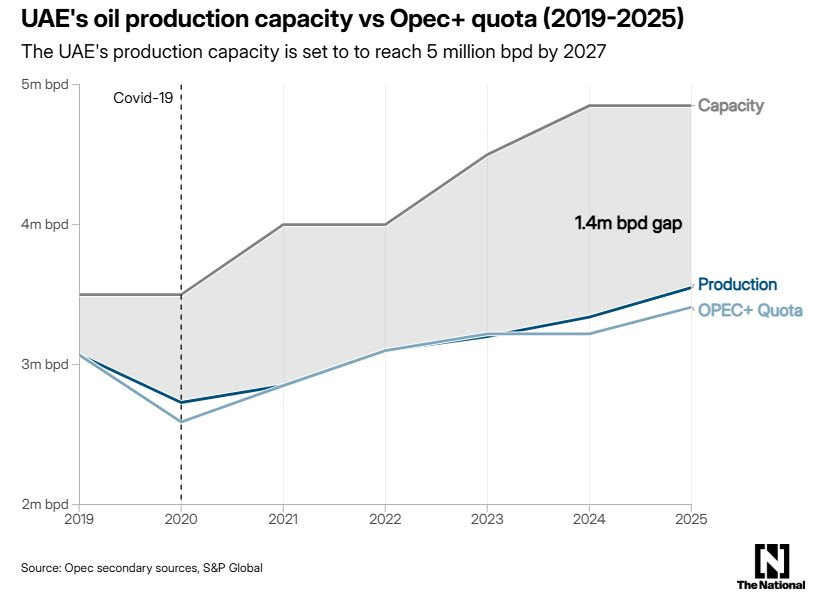
One development that may be crucial over the medium term was the UAE’s announcement – just a week after reports of its negotiations for dollar swap lines – that it will exit OPEC effective immediately, potentially opening up significant additional headroom for oil production:
Meanwhile, the New York Times ran a feature highlighting the growing impact of energy disruptions on China’s manufacturing base. On the flipside, China did increase its fuel exports M/M, suggesting at least relative near-term energy stability, though it has maintained tight export controls overall.
Elsewhere in global US meddling geostrategic influence-building, US Undersecretary of State Jacob Helberg highlighted a massive new forward deployed industrial base in the Philippines intended to “secure vital supply chain inputs” in cooperation with the US ally.
On the same note, the Wall Street Journal published a piece on the Pentagon working with rare earths producer Lynas to break China’s near-monopoly on samarium – a key input for various defense applications – with a new refinery in Malaysia.
Despite various plans and schemes clearly geared toward a US industrial renaissance, US GDP has still not shown clear evidence of success, as Q1 GDP growth came in slightly below expectations at just +2%.
However, some industrial green shoots were visible under the hood, as core capital goods orders grew 3.3% M/M to the highest level since mid-2020. At the same time, the latest US Manufacturing PMI reading came in at 52.7, in line with last month and good for the fourth consecutive month of expansion after years in contraction territory (though that came with a big spike in the prices paid component).
Two new reports of distressed multi-billion dollar private credit loans in blue chip funds added to ongoing concerns about this pocket of private capital this week, as the non-performing loans ratio in Blackstone’s massive BCRED fund jumped to an all-time high of 2.4% (vs 0.3% a year ago).
While he doesn’t think the private credit market is large enough to become a systemic threat, JP Morgan CEO Jamie Dimon channeled his inner Peter Schiff and Ray Dalio in an interview this week, suggesting that we are likely heading toward “some kind of bond crisis” due to rising government debt and fragility in various sectors.
If Dimon is right, that will certainly present an interesting wrinkle for the ostensibly hawkish balance sheet strategy of Kevin Warsh, who cleared a key hurdle this week on his way to officially taking up the mantle as the next Fed Chair.
In a written response to questions from Congress, Warsh tellingly suggested that the Beltway establishment’s much-prized notion of Fed independence “may not extend to areas like international finance” in reference to the potential for Treasury swap lines with the UAE and other allies.
But Warsh’s less conventional views may see some additional friction early on, as current Fed Chairman Jerome Powell confirmed he plans to stay on board as a Fed Governor at least until the Trump administration’s investigation into the Fed’s new headquarters has wrapped up.
Elsewhere in DC machinations, a Supreme Court decision on local redistricting this week may have meaningful implications for the balance of power in midterms, potentially tilting an advantage toward the Republicans if they can force electoral zoning changes quickly enough.
As markets broadly shrug off the stalemate in the Persian Gulf, bitcoin ETFs pulled in $2 billion in April, good for their best month of the year so far.
Meanwhile, Alberta Investment Management Corporation, a Canadian pension fund with nearly $200 billion in AUM, disclosed a $219 million position in Strategy common stock for the first time.
Regulatory Update
Following up on commentary from some military officials regarding bitcoin’s role in “power projection” over the past few weeks, Department of War Secretary Pete Hegseth said the Pentagon is working on various “classified bitcoin projects.”
Acting Attorney General Todd Blanche made comments that were directionally friendly toward bitcoin developers at this year’s Bitcoin 2026 Conference, though unfortunately the talk track still leaves wiggle room for prosecutions of noncustodial software developers.
Noteworthy
Legendary investor Paul Tudor Jones, a longtime fan of bitcoin, suggested in a new interview this week bitcoin is “the greatest inflation hedge available” given its absolute scarcity.
Block’s Bitcoin Product Lead Miles Suter said that over 800,000 merchants have activated bitcoin payments on Square terminals since the company began rolling out the capability earlier this year.
Pseudonymous ecash wizard Calle announced he’s working on a potentially monumental upgrade to ecash that would solve many of its key drawbacks, potentially laying the foundation for a fuller realization of the “bitcoin banking” vision.
energy + dollar dominance is the real game. thanks for the update
As per usual, this Ten31 post is packed with insights I'm not getting elsewhere. Thank you