

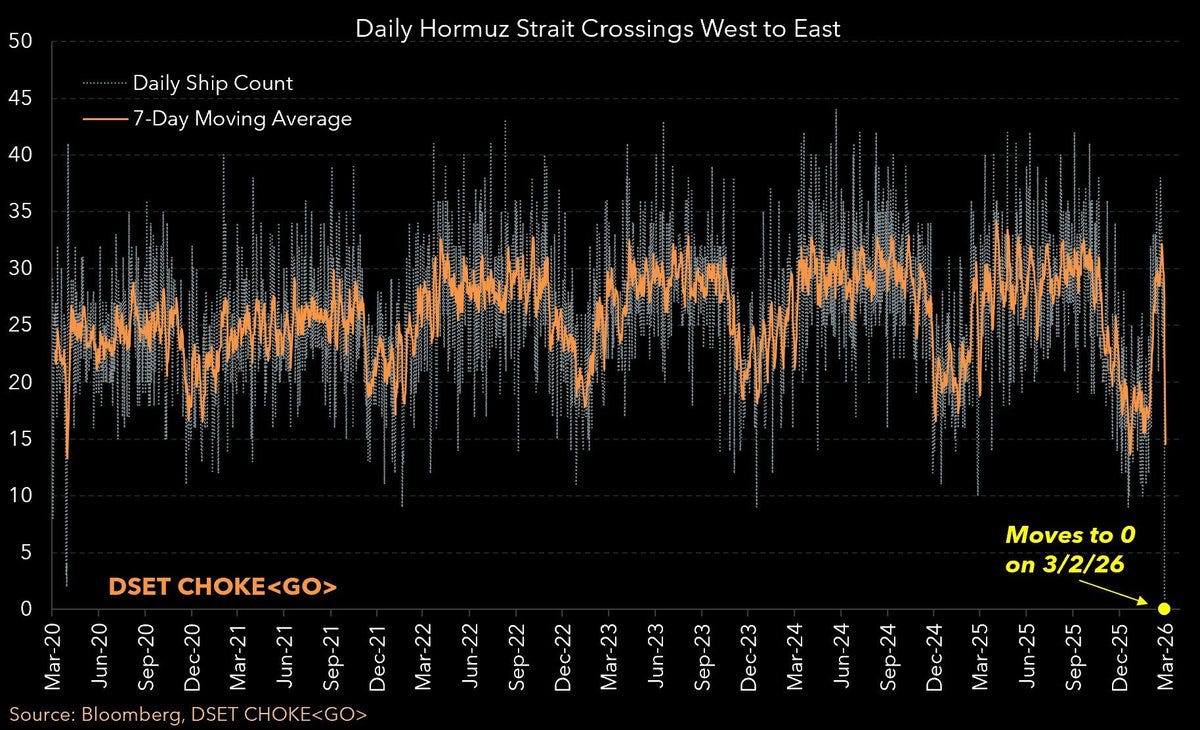
All professional Situation Monitors (and the amateurs who just do it for the love of the game) had to become military, maritime, and munitions experts this week, as the conflict between the US / Israel and Iran escalated into a broader regional disruption. Throughout the week, Iran launched missiles and drone strikes at oil and shipping infrastructure operated by various Persian Gulf neighbors (as well as some AWS data centers), and most importantly threatened an effective blockade of the Strait of Hormuz, a critical shipping chokepoint for roughly 20% of the world’s liquid petroleum products. In conjunction with rhetoric from the Trump administration that the fight won’t be done until the US wins a complete and unconditional surrender, as well as broad cancellation of maritime insurance contracts on Hormuz routes, the escalating volatility sent Gulf oil shipments to near-zero and oil prices through the roof, with WTI and Brent both finishing the week up 35% for the largest single-week moves in over 40 years. Everything you read on this conflict (including the bloviating in this particular rag) should be taken with the massive grain of salt appropriate for the Fog of War that characterizes the early days of fighting, including, per our duly elected officials, whether this actually constitutes a war at all. That said, the White House’s new munitions production commitments from major defense contractors, reported interest in arming regional rebel groups, and quiet incursion into Ecuador this week all certainly point toward the potential for extended kinetic conflict around the world in an attempt to solidify US hegemony in an increasingly fractured power landscape.
Against that bumpy backdrop, US Treasuries – ostensibly the bedrock of the global capital stack and the core safe haven asset for times like these – sold off throughout the week, with the 10-year climbing to nearly 4.2% after reclaiming a 3-handle late last week. The move so far has basically just been a reversal of recent gains, so it’s too soon to make any strong calls, but the lack of an incremental bid is nevertheless notable given the events of this week are almost certainly worse than consensus from just a few weeks ago. Meanwhile, the US private markets landscape is continuing to show more cracks in the foundation, as both Blackstone and BlackRock saw significant redemptions out of some of the largest private credit funds in the world, and major alternative asset managers extended their brutal slump, with key blue chip names in the space now down over 40% off last summer’s highs. Finally, the latest jobs numbers pointed to unexpected softness in the labor market, and this weakness notably didn’t include any observable impact from the wave of AI advancements that has sent shockwaves through markets (which either suggests everyone needs to calm down or that you’re already seeing weakness even before the hurricane makes landfall). As humble bitcoiners, we won’t pretend to have special insight into how policymakers and geopolitical lever-pullers might be viewing this confluence of crosswinds, but we’ll just say to anyone planning on a reduction in the size of the Fed balance sheet over the next few years with all this going on:

Selected Portfolio News
Strike announced it has secured a New York BitLicense and is now live in the Empire State, making it one of just a few bitcoin companies to be able to fully service New Yorkers:

Strike also announced the rollout of a new Line of Credit product to give users a more flexible way to tap into their bitcoin for dollar liquidity:

As the world’s largest investor focused on the convergence of bitcoin, energy, and AI, Ten31 has deployed over $200 million across two funds into more than 30 of the most promising and innovative companies in the ecosystem. Visit ten31.xyz/invest to learn more and get in touch about participating.
Media
Strike Founder and CEO Jack Mallers gave a compact talk outlining bitcoin’s value proposition at this year’s BLISS summit.
Ten31 Managing Partner Matt Odell was featured as a judge on the latest episode of Cypher Tank.
AnchorWatch Co-Founder and COO Becca Rubenfeld appeared on the Bitcoin Archive podcast to discuss the growing intersection of bitcoin and insurance, and much more.
MapleAI Co-Founder Mark Suman joined TFTC to dig into the latest advances in agentic AI and how to harness them securely.
Market Updates
As the world grappled with the US’s first new Military Action International Kerfuffle Gentleman’s Dust-up war since pulling out of Afghanistan in 2021, President Trump kicked off the week by trying to assure everyone that the “Mission Accomplished” banners will fly in four weeks or less.
Of course, like any good crypto influencer telling you how the price could either go higher or lower (DYOR, NFA), Trump also suggested the conflict could go on much longer, and late in the week said we’re actually not going to be done until we get an “unconditional surrender” from the Iranian regime.
The shorter end of the President’s timeline seemed progressively less likely as the week went on, as Iran did its best to extend the conflict across the Persian Gulf, including strikes against Saudi refineries and a liquefied natural gas hub in Qatar, while threatening to shut down the Strait of Hormuz, a key shipping chokepoint in a region that supplies ~20% of the world’s total liquid petroleum products.
Fears of Iranian attacks sent traffic through this critical passage down to essentially zero for most of the week, as leading maritime insurers cancelled policies on vessels in the Strait, and shipping giant Maersk suspended multiple services in response to the volatility.
The Trump administration rushed to announce a $20 billion reinsurance program to get traffic through the channel moving again, and the White House further vowed to use the Navy to defend oil shipments in the area (though it’s unclear if the US has the capacity to cash that check).
In an attempt to gain the upper hand, the White House is also reportedly considering arming a group of moderate Kurdish rebels (change the channel, this one’s a re-run), perhaps with the critical “Exquisite Class” munitions whose production American defense companies agreed to quadruple this week.
For what it’s worth, the New York Times reported mid-week that Iran has signaled willingness to come to terms to end the conflict, though Iranian leaders publicly suggested they’re not interested in negotiating. Meanwhile, Iran’s President vowed on Friday night to halt attacks on neighboring countries, and some reports suggest steep declines in the pace of Iranian missile launches during the week, potentially indicating dwindling stockpiles.
Just for good measure, the US also quietly launched an “anti-drug trafficking” operation in Ecuador, which aligns with our ongoing thesis that the White House wasn’t just bluffing when it released its National Security Strategy memo late last year.
We have no alpha on how long the Iranian conflict might last, but it’s worth noting a few second derivatives of the events so far, including the downstream impacts of disruptions in Qatar on China’s semiconductor self-sufficiency ambitions and, more importantly, a potential blockade of a region that supplies some 45% of Chinese oil. Our tinfoil hats are at the dry cleaners, but we can imagine strategists at the Pentagon considering these asymmetrically disruptive impacts on China before making the decision to launch the White House’s latest Leeroy Jenkins campaign.
Whatever the geopolitical and military implications, oil prices ripped higher throughout the week, with WTI spiking to $91, its highest level in several years and good for the largest weekly move since 1983. With prices already up 50% YTD, Qatar’s energy minister suggested the pain could get much worse, predicting $150 per barrel in the next few weeks if the conflict isn’t resolved.
US Secretary of State and future Viceroy of Cuba Marco Rubio indicated the US will institute various measures to contain the impacts of the oil price shock, while Fed Chair Silver Medalist Kevin Hassett assured the public that the White House has a whole flow chart to manage the situation. The administration was kind enough to provide Ten31 with an exclusive preview of what these measures might look like.

Trump, for his part, did his best Ivan Drago impression to project relative indifference to gas price fluctuations, noting “if they rise, they rise.”

Secretary of the Interior Doug Burgum also suggested the administration is “considering all options” to bring down oil prices, and Burgum notably flew to Venezuela this week to work on deals for American oil companies to expand operations in the country.
Burgum’s trip also included an interesting deal for the US to buy hundreds of millions of dollars in gold from a state-owned Venezuela miner, as well as discussions about American mining companies taking advantage of Venezuela’s rich (but cartel-controlled) critical mineral reserves.
Across the pond, Treasury Secretary Scott Bessent said the US may move to reduce sanctions on Russian oil shipments to help mitigate global price pressure.
Back in the US, the Department of Justice released a memo laying the groundwork for President Trump to invoke the Defense Production Act to restart stalled offshore oil drilling in California despite local permitting and regulatory pushback.
But despite the many stopgap solutions trotted out by the White House, US Treasury yields ripped higher all week on the possibility of sustained pressure in the world’s key energy input. The 10-year gave back all recent gains, touching as high as 4.17% on the week after briefly dipping below 4% just before war headlines hit the wire. It’s too early to make any definitive calls, but we think it’s fair to say this is interesting price action for the world’s premier safe haven asset during a time of escalating uncertainty.
US stock indices initially couldn’t figure out whether the potential start of World War III was bullish or not, as the S&P closed in the green on Monday, but by Friday the combination of $150 oil fears and very weak jobs data pushed equity indices firmly negative for the week.
The South Korean Kospi Index was a little more decisive, dropping 12% on Tuesday for its worst single-day drawdown in history.
USD asset markets may soon also need to contend with second-order disruptions from chaos in the Middle East, as the Financial Times reported that the major Gulf States “could review overseas investment commitments” – including the massive planned investments the US announced to much fanfare last year – to cope with financial strains from the war. That said, Gulf State governments are reportedly encouraging the Trump administration to stay the course in Iran.
The volatile environment piled onto what has already been a tough run for private markets, as Blackstone announced this week that it had allowed investors in BCRED, the world’s largest private credit fund with more than $80 billion of AUM, to withdraw almost 8% of fund assets.
Similarly, BlackRock honored withdrawals from its $25 billion HPS Corporate Lending fund this week, but only up to the quarterly maximum threshold of 5%. Total redemption requests came in at over 9% of fund assets, marking the first time the fund has seen requests above its quarterly maximum.
Finally, the collapse of MFS in the UK, which has reportedly resulted in a shortfall of over $1 billion to creditors, added to the growing chorus of concerns about hidden “cockroaches” in credit markets. All these headlines put continued pressure on the publicly traded alternative asset manager complex, which extended its nasty recent drawdown all week.
More positively, the ISM Manufacturing PMI reading came in above 50 for the second month in a row, suggesting January’s strong reading wasn’t just the result of seasonality. However, the latest Non-Farm Payrolls data for February came in well below expectations and down M/M as the unemployment rate ticked up to 4.4%, dampening excitement about the fundamental macro backdrop.
Former Fed Governor and rate cuts connoisseur Stephen Miran immediately took to CNBC to reiterate the jobs print strengthens the case for near-term cuts, and San Francisco Fed chief Mary Daly admitted this data point complicates the picture for the Fed.
Lest you forget about the US trade balance, Secretary Bessent reminded everyone that 15% global tariffs will take effect this week, and he expects duties to return to their prior levels by August. At the same time, Bessent is reportedly planning to lean on China to buy more oil from the US and deemphasize its reliance on Iran, a demand that may have a little more bite after this week.
Amid the chaos, bitcoin broke above the $70,000 level and climbed to nearly $74,000 before retracing to the high $60k range on Friday’s broad market selloff. We have no crystal ball on near-term price action, but we do think the orange coin chopping in a range against a backdrop of broad selloffs elsewhere is somewhat reminiscent of the post-Liberation Day moves last year.
Strategy’s STRC preferred stock (which is intended to approximate the characteristics of a money market fund, targeting face value stability while paying a variable rate) held the key $100 level the entire week, likely enabling purchases of ~4,000 bitcoin, above the week’s total newly mined supply.
Regulatory Update
Kraken became the first US crypto exchange to score a Federal Reserve master account, giving the company direct access to the Fed’s core settlement system. The exchange is limited to a “skinny account,” meaning it can’t access Fed services like the discount window, but the headline is nevertheless a major milestone for digital asset companies’ integration with traditional banking rails.
President Trump interestingly took time out of his Age of Empires session this week to fire off a Truth Social post reiterating that Congress needs to pass the CLARITY Act as soon as possible. The post seemed to suggest that Trump views incumbent banks (and not the crypto lobby) as the limiting factor in the process.
Wyoming Senator Cynthia Lummis reopened her push for a de minimis crypto tax exemption, this time for purchases under $300 with an annual cap of $5,000.
Noteworthy
The Bitcoin Policy Institute published a new study showing that AI agents generally favor bitcoin relative to all available monetary options, with overwhelming preference for it as a store of value. Stablecoins edged out bitcoin for the everyday payments use case.
But Ray Dalio reminded us this week that there’s only one gold, and central banks will never buy bitcoin because of privacy and quantum computing.
Fidelity published a report arguing that evidence increasingly favors the end of the traditional “Four Year Cycle” narrative for bitcoin’s price.
While this week’s soft jobs numbers did not necessarily validate fears of an imminent AI apocalypse, Anthropic released some new data quantifying the potential medium-term impact from AI advancements on a broad array of professions.
Travel
OPNext, New York, April 16
Bitcoin 2026, Las Vegas, April 27-29