

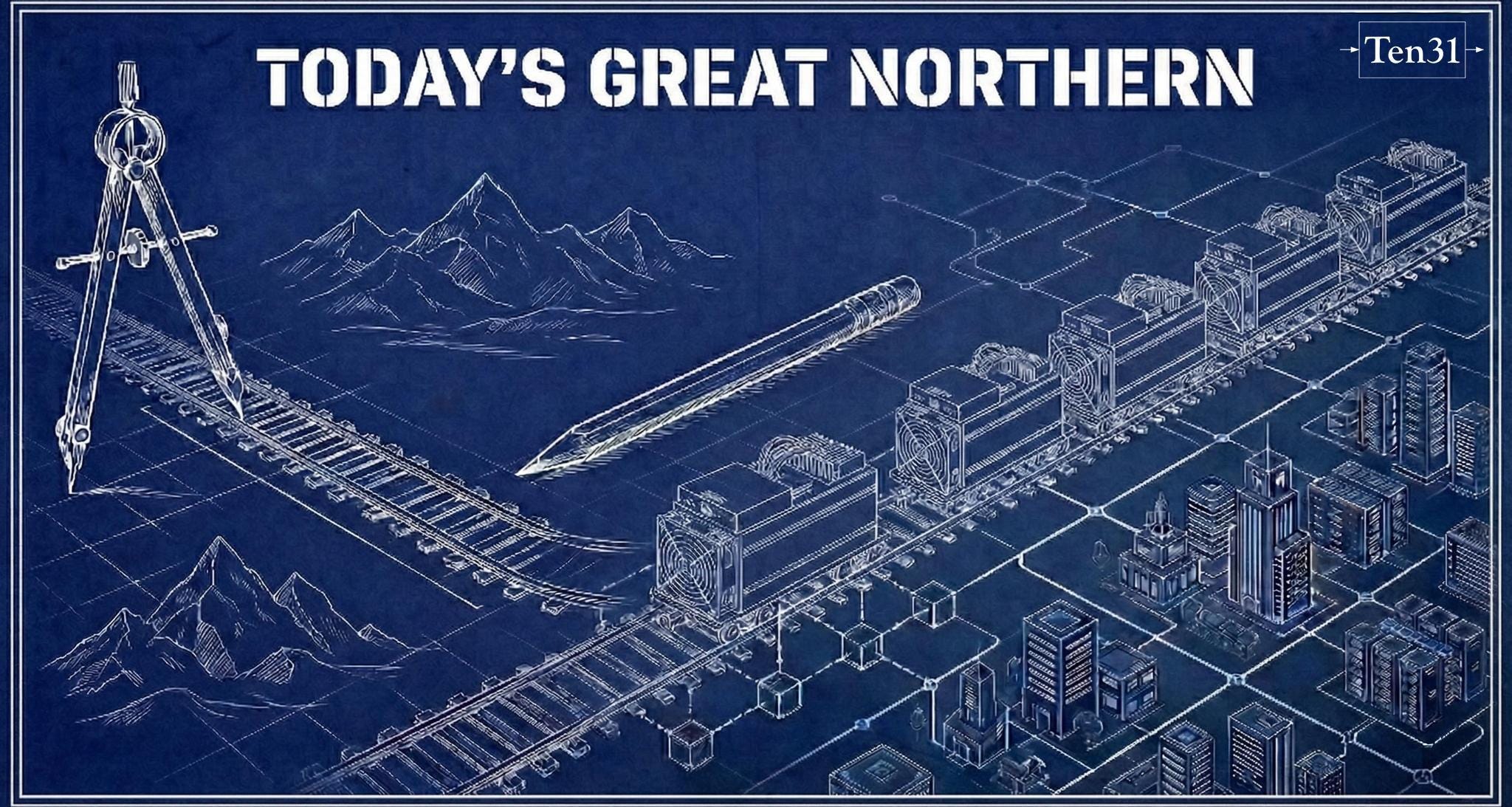
Ten31 draws inspiration from the great networks that turned empty corridors into economic mainlines: railroads, telegraph wires, payment rails, and the early internet. Each began as a skeletal infrastructure and only became indispensable once the hard work of commercializing the opportunity was completed. Among those early networks, the story of James J. Hill and the Great Northern stands out as a blueprint for today’s bitcoin industrialization.
Hill did not build the most track. He built the most used track. While subsidized lines chased financial engineering in stock schemes, land grants, and leverage that masqueraded as progress, Hill treated his railroad as a commercial organism. To Hill, rails and spikes were not the end state. He viewed empty railcars as the raw capacity that remained a liability until the trains reliably moved grain, timber, cattle, people, and capital. Hill’s low time preference approach to seeding towns, teaching soil science, importing livestock, and manufacturing demand along the route, transformed industrial hardware (rails, engines, and freightcars) into a functioning economic network. That pattern of designing not just the machinery but the usage of the machinery is the lens through which Ten31 understands the challenges and opportunities of commercializing bitcoin today. We, along with our partners, look towards architecting a living organism of prosperity by serving as the commercialization engine rather than merely a passive investor.
Structure is Important, but Usage Matters More
The same distinction that separated Hill from his subsidy-fed competitors now separates meaningful bitcoin development from the noise of the past decade. Much of the early cryptocurrency landscape mistook industrialization for victory (building rails when there was no organic demand for the freight itself) and the market confused financial engineering for commercial utility. Blockchains proliferated, protocols multiplied, and speculative assets ballooned, yet little of it translated into durable commerce. The shiny distractions of NFTs, meme coins, and ICOs harvested speculative fervor but not economic substance, despite claims from altcoin promoters that their projects provided durable utility. Industrial capacity was built at extraordinary speed, but without the architecture to convert that capacity into utility. The result was predictable: empty blocks, boom and bust anemic user growth, and networks valued for their theoretical potential rather than their realized throughput.
Bitcoin’s next chapter requires a return to proper sequencing. Its infrastructure, the shared monetary equity programmable with global settlement finality, forms the industrial scaffold. However, the true economic destiny lies in commercialization: transforming these primitives into systems that merchants use, institutions depend on, and consumers rely upon without noticing. If Hill had merely laid track, the Great Northern would have vanished into history’s dustbin. It endured because he built usage. Bitcoin now stands in a similar liminal space between what it already is as infrastructure and what it must become as a commercial network.
Commercialization is a Deliberate Endeavor
Bridging this gap between industrialization and commercialization has never been a passive process. It requires deliberate architecture from decision-makers who understand that networks do not commercialize themselves. That work is slow, iterative, and deeply operational. It requires long-term vision for cultivating new behaviors, building trust, educating markets, and orchestrating complementary industries around the core infrastructure. Commercialization is the evolving coordination of deliberate choices of the present which compound into the economic patterns of the future. The frontier has always rewarded those who can hold a long horizon in their mind while solving immediate, ground-level frictions. It is this discipline of sequencing and building not for the hype-cycle but for the habits of future users that will determine whether a new network becomes foundational or forgotten.
The commercialization of bitcoin will follow the same pattern Hill confronted: the network becomes indispensable only when the economic life around it reorganizes to take advantage of its properties. Hill did not just sell railroads, he sold the possibility of a better business if you built your operations alongside his rails. Bitcoin can offer the same value proposition but also requires the same entrepreneurial migration. The companies that will commercialize bitcoin are not those that “use bitcoin” as a novelty, but those whose economics fundamentally improve when built around it. Companies like Start9 give businesses the digital homestead, a self-hosted infrastructure that replaces brittle cloud rents with sovereign compute. AnchorWatch isolates the operational risk of holding and settling in bitcoin, enabling commerce to flow with insured, institutional-grade reliability. Giga Energy and Upstream Data transform stranded and wasted energy into productive bitcoin-denominated revenue, turning dead capital into operating advantage. These are the modern equivalents of Hill’s early towns, grain elevators, and timber camps, which are the economic actors who become more competitive by relocating their business models to the edge of the new monetary rail. Commercializing bitcoin is not about evangelizing an asset, but is about architecting the conditions under which businesses discover that building near bitcoin’s rails makes them stronger, faster, and more durable than their fiat-bound competitors. As Hill brought people to the rails so the trains ran heavy, we, with the support of our investors and partners, bring businesses to bitcoin so the blocks are filled with the weight of real commerce.
Revitalization of Productive Businesses
An inflection point arrives when legacy businesses that are often unloved, undercapitalized, and trading at compressed multiples recognize their economics fundamentally improve when rearchitected toward the bitcoin network. A regional logistics operator suffering from thin margins can eliminate settlement lags and FX friction by settling invoices on digital rails, while insulating its treasury from inflationary decay with bitcoin. A specialty manufacturing firm with volatile working-capital needs can extend its operating runway by holding a portion of treasury in appreciating monetary equity while using StartOS for self-hosted infrastructure to reduce cloud dependence and data risk. A rural energy-services company with stranded or seasonally idle assets can deploy Giga or Upstream Data solutions to turn wasted energy into a permanent sats-flow engine.
Individually, these firms may look like low-growth relics of the old economy, however when architected around bitcoin, they become structurally advantaged enterprises. And as more of these legacy operators discover that they can do more with less delay, less dilution, and less dependency on intermediaries, their competitors are pressured to follow. What begins as a collection of rational reinventions becomes a self-reinforcing commercial district. Industries will reorganize around the rail not because they were evangelized, but because the economics made the choice inevitable. Bitcoin’s commercialization grows concentrically: Gradually, then Suddenly.
Hill choreographed outcomes by financing farms, constructing grain elevators, recruiting merchants, and synchronizing the movement of goods until entire communities trusted the rail as their economic spine. Ports, telegraph hubs, and early internet backbones followed the same sequence: credibility drew the first participants, and deliberate coordination created the rest. Bitcoin is no different. Perfect settlement assurances alone will not summon durable commerce. Businesses must be shown – not just told – how redesigning treasury operations, supply chains, data infrastructure, and credit channels around bitcoin’s monetary equity creates structural advantage.
This is the work of an architect, and this is the blueprint Ten31 carries forward. Like Hill, we move deliberately and sequence patiently, focusing not on short-term advantages but on the long-term process of reorganizing industries around a harder monetary foundation. We identify the businesses whose economics improve when aligned with bitcoin’s rails, and we help them restructure so their activity becomes the network’s freight. By financing, educating, coordinating, and cultivating the complementary industries that fill the blocks with real economic throughput, Ten31 works toward what Hill once did for the Great Northern. Turning raw industrial capacity into irreversible commercial gravity.
Headwinds for Some, and Tailwinds for First Movers
Every industrial revolution arrives at a threshold where potential hardens into permanence. While legacy accountants and auditors remain cautious due to novelty and volatility, industrial visionaries build out the future one block at a time. Bitcoin now crosses that threshold. The rails are down, the spikes are driven, and the first engines of real commerce are beginning to move. But energy markets are regulated, incumbents fight back with pricing power, and nation-states can still impose capital controls or outright ban themselves from bitcoin. These are not theoretical risks, as we have seen. They are the same headwinds that delayed the railroad, the telegraph, the early internet, and every prior network before it reached critical mass. In time the era of speculative noise will quiet, while the era of commercial architecture takes hold. This is the phase that requires the discipline of a James J. Hill: the patience to align incentives, coordinate industries, and cultivate the “towns” that make the railway vital.
Our ecosystem will be built by those who understand that a network’s value lies in its traffic, not just its tracks. Ten31, with the support of our investors, is already executing this architecture. Having helped commercialize the foundational layers of exchange, custody, lending, payments, and energy, we are now expanding to fill the design. We are a first-mover architect constructing the access points of this new economic map. Adoption does not occur on its own, but through the quiet, compounding decisions driven by superior economics. We view our work as more than supporting a network. Ten31 is developing a durable commercial district, ensuring that the map of the future is defined not by what bitcoin promises, but by the dense, immutable economic value it carries.