

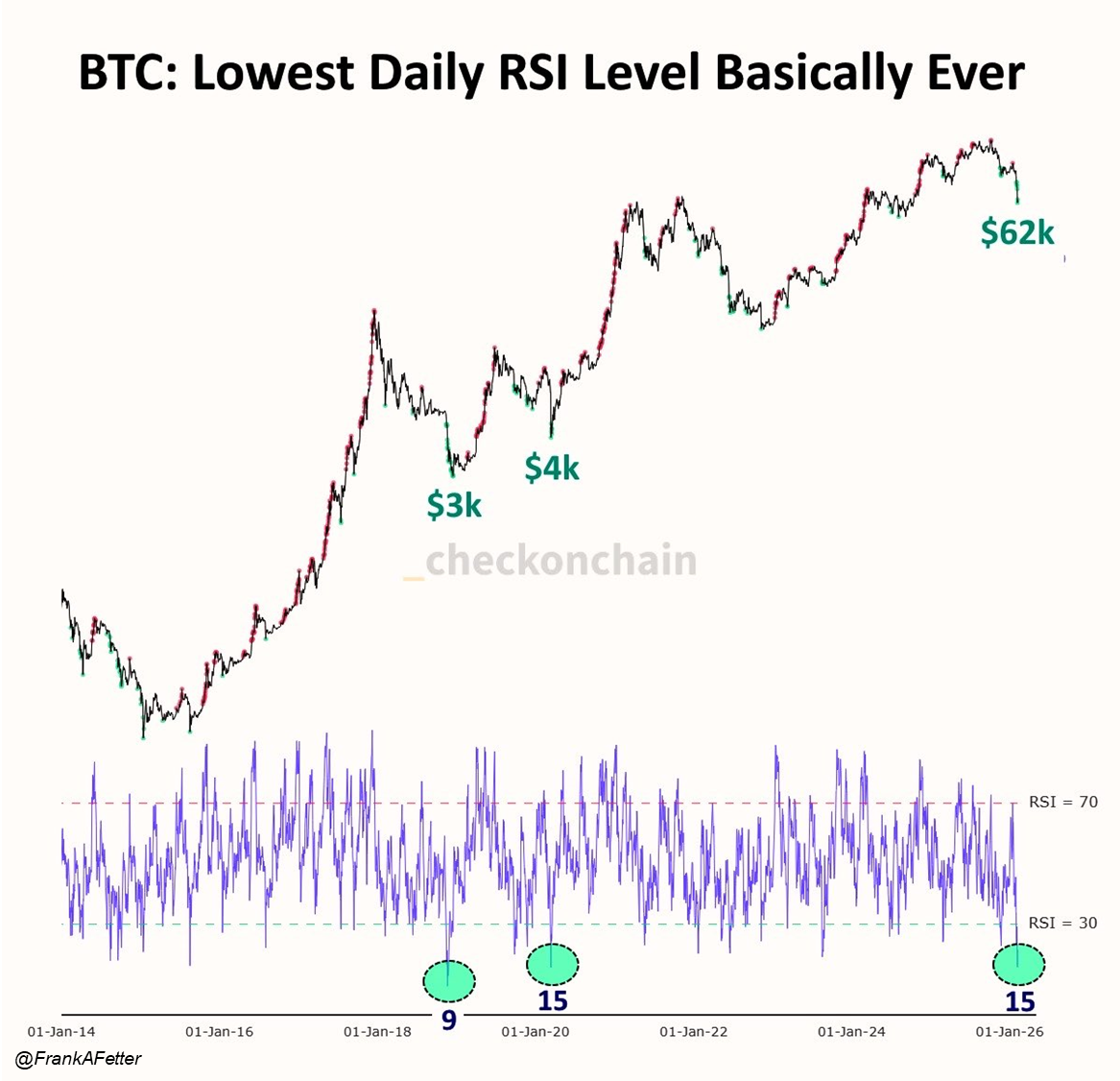
As a recent retiree in Nebraska once said – in circumstances not totally dissimilar from this week – price is what you pay; value is what you get. When price moves violently against you, when everyone is telling you you’re wrong, when legions of margin-called hedge funds are desperate to get out at any price, the only relevant question is how the price you’re being offered corresponds to your assessment of value. So, putting aside the Fibonacci levels, the Big If True rumors of insolvent exchanges, and the endless bearposting: what is the value of bitcoin?
What is the value of an open, global ledger with auditable rules that cannot be transgressed by any government or corporation in a world where both are becoming more invasive every day? What is the value of the provably scarce units of that ledger as worldwide sovereign debt burdens necessitate accelerating currency debasement – and as the most powerful man in the world takes control of the money printer to support his agenda? How much more valuable are those scarce ledger units if they can be sent across the world cheaply and instantly; if they can be safely stored without the overhead of armies and vaults; if they are trivially verifiable and easily accessible to anyone with an internet connection; if they can be spent and secured composably and programmably? In a world where the proliferation of AI is rapidly diluting the value of the purely digital and eroding trust in human communication, what is the value of the only system in the world that, through Proof of Work, unforgeably links bits to atoms? As geopolitical relationships fracture into multipolar siloes, what is the value of an apolitical, neutral system of consensus controlled by no one and explicitly built for adversarial exchange?
We’d wager that your timeline was flooded this week with Highly Credentialed Experts answering these questions by reiterating the point that they’ve been making since bitcoin was trading at $10: bitcoin’s value is near-zero because it’s not acting like a safe haven or a hedge to market uncertainty. We agree with them on the second part: bitcoin is not a hedge. It gets closer to becoming a hedge every day that it doesn’t die and knowledge of its unique properties continues to diffuse through society, but for now, no septuagenarian central banker or bulge bracket wealth manager is going to reflexively shift allocations toward bitcoin when things get spicy. If you’re still here after this week, you are making the bet that this will shift over time; you are making the bet that the market is, in the long run, a weighing machine that will drive a convergence of price toward bitcoin’s fundamental value. We could make a variety of arguments about what that value ultimately is, but we think any intellectually honest reader will conclude, after perusing the litany of rhetorical questions above, that the answer is both very far from zero and very far from today’s price.
Selected Portfolio News
Strike launched bitcoin-backed lending in Texas:


As well as Alabama:

And launched an early direct deposit feature:

Fold rolled out a totally revamped version of its mobile app:


Maple AI now supports Kimi K2.5, one of the most powerful open source reasoning models:


As the world’s largest investor focused on the convergence of bitcoin, energy, and AI, Ten31 has deployed over $200 million across two funds into more than 30 of the most promising and innovative companies in the ecosystem. Visit ten31.xyz/invest to learn more and get in touch about participating.
Media
Ten31 Co-Founder Jonathan Kirkwood published a new piece on the competitive advantage of secure and private data in an era of proliferating artificial intelligence capabilities.
Ten31 Partner Matt Odell appeared on the Why Are We Bullish podcast to discuss this week’s wild bitcoin price action.
Fold shared its 2026 customer letter, and the company’s head of brand and design was interviewed by San Francisco’s Presidio Bitcoin.
Market Updates
Congress was able to forestall yet another protracted government shutdown with a narrowly passed spending bill that will fund most operations through September 30 (despite an ongoing dispute over DHS funding), potentially clearing a near-term overhang on markets.
As soon as the lights were turned back on, Senator Thom Tillis was quick to reiterate that he won’t vote to confirm recent Fed Chair nominee Kevin Warsh until the DOJ’s criminal investigation into Jerome Powell is resolved.
President Trump didn’t seem terribly worried about that, as he told a private dinner group that he might sue Warsh if the new Fed Chair doesn’t successfully get rates lower. He later clarified that the remark was a joke and all in good fun (the classic “haha, jk … unless”).
When pressed about this comment by tribal elders during Congressional testimony this week, Treasury Secretary Scott Bessent simply said any decision to sue the Fed Chair would be “up to the President.”
The latest US Manufacturing PMI reading came in much hotter than expected, perhaps the latest in a line of recent signals cautiously signaling cyclical reacceleration in the US real economy.
The world’s largest tech companies are certainly doing their part to try to ensure that narrative plays out, as the big four hyperscalers have now updated their 2026 capex estimates to more than $600 billion, up ~60%+ Y/Y.
Amazon, Google, and Microsoft all fell pretty substantially post-earnings, as many investors are clearly trying to digest the ultimate return on capital of this spending, but Nvidia CEO Jensen Huang gave the market some comfort on Friday by assuring everyone it’s all sustainable (we would never fade Jensen, but you could be forgiven for thinking he’s doing a little book-talking here).
That said, this – along with the administration’s push to aggressively re-shore critical industries and supply chains – is a factor that will bear close monitoring this year with the potential advent of Kevinomics at the Fed, which could create some conflicts between funding reindustrialization and absorbing Treasury issuance for the commercial banking system.
Despite the hotter PMIs and hyperscalers spending roughly one TARP per year on data center buildout, Fed Governor Christopher Waller released a statement this week indicating he dissented from the FOMC’s decision to hold benchmark rates flat at the last meeting due to growing concerns around the job market, which he calls “not remotely healthy.”
Again, the President seems fairly sanguine here, as he posted to close out the week that the Dow Jones index – which just hit a record 50,000 for the first time – will reach 100,000 by the end of his term thanks to his tariff policies (good for a ~26% IRR if Trump’s forecasting holds).
On the trade front, the White House announced a new $12 billion critical minerals stockpile and reiterated plans to institute price floors on key materials, in line with the administration’s clear shift into a wartime economy stance.
Meanwhile, the US and India announced a new trade deal that will lower tariffs immediately, and after cooler heads prevailed (for now) on Greenland, the EU said it will resume work on its comprehensive US trade framework.
In a relatively rare direct statement, Chinese President Xi Jinping openly called for the Yuan to become the world’s reserve currency. For a whole host of reasons, we’ll take the under here.
Despite no clearly identifiable negative catalyst other than follow through from the Warsh nod, bitcoin experienced its largest absolute dollar decline from an all-time high in history this week, including a 15% drop on Thursday that marked the worst single-day selloff since 2022.
The orange coin is now trading below the average ETF cost basis (though it’s worth noting this also happened in summer 2024) as IBIT volumes blew through their one-day record. In general, the ETF complex has seen continued outflows over the last couple weeks, but for what it’s worth, total bitcoin held in the vehicles is down only ~10% since the bearish impulse began on October 10th despite a ~40%+ decline in price over that time.
The bitcoin price is also now below Strategy’s average cost basis of ~$76,000 – though we note that that has also happened before, and doesn’t mechanically mean anything.
Interestingly, bitcoin has been trading right in line with the software complex over the past few quarters, and the correlation intensified this week as investors suddenly seemed to calculate the threat of AI to traditional SaaS moats and began puking IGV in earnest. We don’t dispute that bitcoin is indeed software, but we’d argue any investors selling both on the thesis of the bits-to-atoms rotation may want to pull up a long-term hashrate chart.
Over the course of the wild week, everyone’s crypto greed and fear gauges fell into historically low territory, with readings on Thursday printing lower levels than both the 2022 bottom and even the COVID flash crash.
Similarly, the Mayer Multiple – a popular cyclical metric which measures the ratio of the current bitcoin price to the 200-day moving average – reached levels consistent with prior bottoming zones.
At the depths of sentiment, JP Morgan’s quantitative strategist indicated that after the recent price action, bitcoin now looks “even more attractive compared to gold over the long term.”
Regulatory Update
As the long-awaited CLARITY Act for “crypto market structure” continues to stall, Treasury Secretary Scott Bessent said it’s imperative that Congress pass the legislation soon.
Virginia’s state legislature advanced its strategic bitcoin reserve bill.
Noteworthy
Per a new report in the Wall Street Journal this week, a high-ranking UAE official bought 49% of the Trump family’s digital assets entity World Liberty Financial. The President suggested he was unaware of any details of the deal.
The latest JP Morgan annual family office report shows that the vast majority of survey participants still have no bitcoin exposure, and nearly three-fourths still have no gold exposure.
After several years of explicitly pushing for scaling the Ethereum ecosystem through “Layer 2” solutions off the main blockchain, founder Vitalik Buterin critiqued the protocol’s current roadmap and argued scaling should return to the main chain.
Elsewhere, Kraken completed the first documented $1 million settlement on bitcoin’s lightning network, the latest data point showing the progressive maturation of bitcoin’s main second layer protocol.
Prominent crypto venture capital investor Kyle Samani called it quits on digital assets, noting (in a now-deleted post) that “all the interesting questions [in crypto] have been answered.”
Tether released MOS, an open source bitcoin mining operating system.
Travel
Bitcoin Investor Week, Feb 9-13
Bitcoin 2026, Apr 27-29