

It wouldn’t be the US-Iran conflict we’ve all come to know so well if there weren’t (at least) one final fake-out, and Timestamp readers got a real-time look at the latest in a long line of these rugpulls last week when Iran briefly “closed” the Strait of Hormuz once again just ~20 minutes after our newsletter highlighting the peace deal went out. Nevertheless, the spice has continued to flow out of the Persian Gulf this week, with tens of millions of barrels of oil exiting the waterway and prices plummeting to prewar levels, though we’ll have to see how well that holds given the late-week slap-fighting between the two sides (there’s an old saying in Tennessee…). In any case, the progression of the conflict has given way to some pretty explicit acknowledgments by key officials like Treasury Secretary Scott Bessent that this and other recent military actions have been animated by a focused US effort to reassert dollar dominance and to practice “economic statecraft” whereby the US leverages its latent, under-utilized advantages to regain control of critical supply chains and shore up domestic industry. Bessent gave a lengthy, detailed speech this week to that effect which underscores many of the themes we’ve been noting over the past year, and we expect that this stance will continue to color the administration’s actions (and forward-looking investors’ allocation decisions) over the next several years.
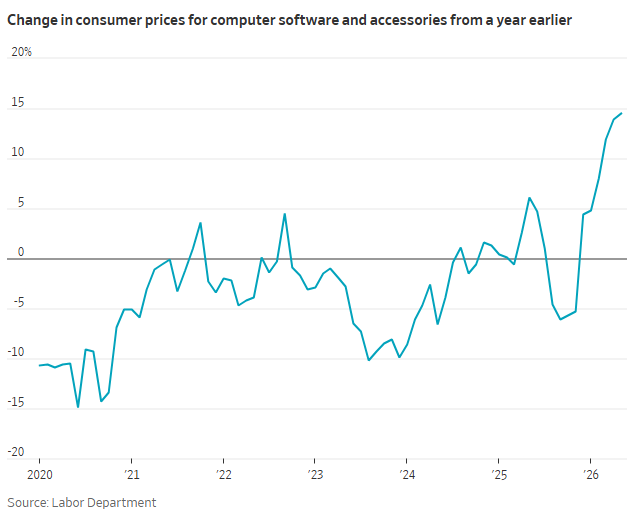
But attention spans are limited, the Iran war has jumped the shark, and market focus has moved definitively to all things AI, especially the impact of the unprecedented memory shortage – which is now driving legitimately painful inflation in consumer electronics, something most people under 40 thought was basically impossible – and increasingly aggressive federal controls on the deployment of the latest AI modes (which, while dystopian and discouraging, probably shouldn’t be too surprising if you follow the logic of Bessent’s thinking). Lines are now being drawn around who can access frontier intelligence, when they can do so, and under what terms; we could make many arguments as to the real key motivations behind this, but in any case it appears to be a trend that is just starting its upward inflection. Perhaps open source models can keep up, or at least provide “good enough” alternatives at substantially lower cost, but that probably depends on your view of how important recursive self-improvement is.
If successful investing essentially comes down to non-linear thinking and appreciation of hidden second-order effects (we’ll leave that up to the reader; it may just come down to vibes), then it may be worth reasoning through not just the implications of these shifts for your AI book (I hear some kind of glue is the next big bottleneck) but also for the broader economy over time. In a world where the US both needs to force a massive ramp of physical memory and power supply alongside 20 other critical industries while also titrating superintelligence to a select few, we would posit that you might want to hold scarce assets with asymmetrically positive correlation to the kind of spending that will be necessary to achieve those goals while supporting a permanent underclass general population that is permanently locked out of frontier intelligence. You’d probably get bonus points if that asset were free of counterparty seizure risk so that it couldn’t be arbitrarily Mythos’d, and it certainly wouldn’t hurt if the state itself also had a vested interest in seeing that asset increase in value over time. We hope readers will write in with any suggestions for what could fit that profile.
As the world’s largest investor focused on the convergence of bitcoin, energy, and AI, Ten31 has deployed over $200 million across two funds into more than 30 of the most promising and innovative companies in the ecosystem. Visit ten31.xyz/invest to learn more and get in touch about participating.
Selected Portfolio News
Strike lowered its trading fees across user tiers, further cementing the platform as the best place to onboard to bitcoin worldwide:


Media
Strike Founder and CEO Jack Mallers delivered a keynote speech on bitcoin, AI, and the return of human creativity at this year’s Bitcoin Prague conference.
Ten31 Managing Partner Matt Odell joined The Bitcoin Podcast to discuss freedom tech’s path forward and the growing importance of open source software.
Market Updates
Right in line with the tenor of this whole situation, Iran briefly declared the all-important Strait of Hormuz “closed” once again over last weekend, a mere 48 hours after signing what was supposed to be a landmark (framework of a) deal to end the protracted conflict in the Persian Gulf.
But in a clear sign that the network has seen the latest ratings and won’t be renewing the show for another season, oil apparently continued flowing through the waterway all weekend and through this week regardless, with President Trump proclaiming that “19 million” barrels of oil exited the Strait on Monday alone.
US Department of Energy Secretary Chris Wright directionally echoed that claim and even went a step further, noting that the US has effectively ended Iran’s ability to threaten the Strait ever again (though we suspect this depends in practice on the pace at which GCC member states can sprint to build new pipelines and alternative access infrastructure).
But just for good measure, the Department of War went ahead and requested a little $88 billion top-up for ongoing war efforts in the Gulf.
The White House also suggested that Iran pinky swore that the channel will be entirely free of tolls or protection rackets insurance costs…though it looks like they may need a mulligan on that one, as Iran later launched an attack on a ship that failed to cross through the “approved” route, leading to a retaliatory move by the US on Friday evening.
However the soap opera unfolds come Monday morning, oil sent a clear message all week, with WTI extending its recent precipitous decline and finishing just under $70/barrel, or right at pre-war levels.
As part of the deal, the Treasury Department granted a temporary 60-day waiver of its sanctions on Iranian oil sales – provided those sales are conducted in US dollars – which opens up the potential for the first US imports of Iranian oil in decades.
After the issuance of this waiver, Treasury Secretary Bessent made several remarkably frank public appearances where he indicated that all of the US’s recent military operations have been focused on strengthening dollar dominance.
The DXY seemed to get the message, as the dollar strength index climbed to new post-Liberation Day highs, driven partially by the continuing fall of the USDJPY cross to new ~30 year lows.
Secretary Bessent also delivered a lengthy speech to the Economic Club of New York which laid out his vision for “American economic statecraft,” borrowing a term from forward-thinking strategist Michael Every and alluding to some of the themes we’ve been highlighting here for much of the past year.
And speaking of industrial policy, the Department of Energy announced a new program offering nearly $18 billion in conditional loans for utilities and energy companies to build and acquire components needed to strengthen the domestic nuclear supply chain.
The administration’s ongoing run it hot stance has continued to show up in US Manufacturing PMI data, where the latest readout rose sequentially and cleared consensus estimates once again, though a chunk of this was driven by inventory preloading as factory job cuts also surged. Meanwhile, the latest PCE reading posted its highest level in three years (though was in line with expectations).
While consumers may get some price relief at the pump for the semiquincentennial (you totally knew that word before this week, right?) if the Iran deal holds, they may have to make up for it in several other categories, as electronics are now driving meaningful inflationary impacts again for the first time in decades thanks to vertical increases in memory pricing.
In response, Apple pushed through nearly 20% Y/Y price hikes on its flagship Macbook and iPad models with more price increases on iPhones likely coming later this year, while Microsoft boosted prices of its Xbox line of consoles by a similar amount.
But hey, maybe next year you’ll be able to get an affordable Playstation again, as the release of Chinese open source AI model GLM 5.2 made waves this week as the model that will finally kill the hyperscaler capex binge and its insatiable appetite for memory once and for all (just kidding).
That said, you may have to pair your higher electronics bill with a longer than expected wait for the latest new AI models, as the White House is reportedly aggressively pressing Meta to submit its latest models for “voluntary” review ahead of any new releases.
Even more notably, leading frontier lab OpenAI agreed this week to a “staggered rollout” of its latest flagship model GPT 5.6 at the request of the Trump administration.
It’s not entirely clear which lucky enterprise clients will win the golden ticket for early access, or on what timeline the model will become available to those of us in the permanent underclass, but what is clear (and what gives us no particular joy to report) is that frontier intelligence has been classified as a matter of national security, with all the implications attendant to that designation.
Rival frontier lab Anthropic – whose own bleeding edge models Mythos and Fable were similarly restricted two weeks ago – seems to agree, at least based on a recently publicized letter sent to Congress earlier this month in which the company accused Chinese tech firm Alibaba of an extensive distillation scheme and warned that the US needs greater controls on access to the leading models to shore up its security posture.
That said, the administration is reportedly ready to allow a limited rollout of Mythos to a select group of federal agencies and companies (still no word on when Fable 5 might see the light of day for the masses).
Overseas, Latin America continued to drift notably right this week, as Colombian voters elected Trump-friendly political outsider Abelardo de la Espriella as the country’s next President, the latest in a string of recently elected Latin American leaders promising crackdowns on crime and greater alignment with the United States.
Back in the US, however, the opposite shift seems to be afoot, as three Mamdani-backed socialists won various New York Congressional district primaries (and are likely to win their respective general elections given the, uh, skewed political leanings of the greatest city in the world).
While memory prices, model restrictions, and midterms rightfully grabbed most of the headlines this week, more pressure continued to build in the private credit complex, as Apollo once again gated redemptions from one of its key funds, where withdrawal requests topped 17% in the second quarter.
Meanwhile, the latest data from the Federal Home Loan Banks (FHLB) System – a government-sponsored enterprise providing liquidity to various types of financial institutions – showed ~$80 billion of advances to life insurers in Q1, a significant Q/Q spike good for an all-time high and a move worth watching given life insurers’ outsized exposure to private credit.
Elsewhere in thorny credit risks, Strategy’s flagship preferred stock STRC continued to get, as the kids say, absolutely mogged, hitting a new all-time low of $72 this week on continued bearish price action in bitcoin.
Despite bitcoin’s ongoing summer doldrums, BlackRock publicly reiterated its guidance for investors to allocate 1-2% of their portfolios to Magic Internet Money.
Regulatory Update
The long-awaited CLARITY Act has continued to stall at the finish line in Congress, with a variety of issues impeding its progress toward passage ahead of the August recess, which is seen as the last chance to get the bill passed before 2029 given uncertainty around midterms. Senator Cynthia Lummis indicated a new draft aiming to address remaining issues should be released soon.
Noteworthy
DMND mining pool successfully mined the first known bitcoin block using Stratum V2’s block construction protocol. This represents a notable milestone for mining decentralization and censorship resistance as this tool allows miners (rather than the pools they use for hashrate aggregation) to directly control their own transaction selection.
Given that the frontier models ship the “frontier version” every 3 months or so, is it really appropriate to jibe about “permanent underclass” not having access to these models? We’ll have cyber superpowers just give it a couple months