

Mario Draghi famously committed to “whatever it takes” with fairly mixed results for the EU; now we get to see if Scott Bessent will have any better luck in the US. Per “sources,” the Treasury Secretary is ready to use any means necessary — including the nearly $1 trillion bazooka of the Treasury General Account — to fund long-end buybacks in an attempt to neutralize the so-called (and, if the last 15 years are any indication, potentially nonexistent) Bond Vigilantes. While Bessent did not explicitly confirm any of this himself, he was much more forthright about the US’s new colorfully-titled sanctions campaign “Operation Economic Outcast,” a sweeping set of penalties on various channels of Iranian commerce and, importantly, secondary sanctions for any institutions (Chinese or otherwise) doing business with the regime. Admittedly, prior rounds of tough talk like this from previous administrations didn’t accomplish much, though we think there’s a decent argument that those campaigns weren’t particularly serious about dismantling the financial reach of the IRGC machine that seems to extend well beyond Iran, and in our view that’s where the buyback / TGA story links up to the Middle East. With the federal debt and deficit where they are, the administration will likely need every tool in the toolbox to manage the US Achilles Heel of Treasury volatility (and its conjoined twin of equity vol) so as not to get shaken out of the broader Global Economic Reordering trade that we think is taking place. Our geopolitical read is worth roughly what you paid for it, but a cascade of headlines this week do seem to suggest that more pieces essential to this trade may be falling into place, as rising oil volumes through the Strait of Hormuz and a massive new US oil deal with Venezuela lay the groundwork for structural downward pressure on US energy prices (ultimately a key input to where long-term yields shake out).
Which brings us to Wall Street legend Stanley Druckenmiller, who used an op-ed this week to argue that the Treasury should “let the bond market speak,” calling the buyback program a form of yield curve manipulation and a grave mistake by his fellow Soros mentee. Far be it from us to take the other side of Druck, who to his credit has been right on the long-run fiscal math for 15+ years, but letting the bond market freely price risk is an easier call to make when debt to GDP isn’t already pushing 100% with nondiscretionary federal spending about to outstrip annual tax receipts; it’s a tougher act to pull off with the budget already on a knife’s edge, hegemony hanging by a thread, and the whole thing banking on a “run it hot” agenda that juices GDP and can’t afford a sudden 10-year spike to 6%+. Druckenmiller makes the point that the buybacks look like the beginnings of the yield curve management used to anesthetize markets during World War II, and we think that analog may be more apt than he realizes; if we pull back and survey everything we’ve seen the past 18 months (with further evidence this week from Operation Economic Outcast), we seem to be dealing with decision-makers who believe themselves to be on wartime footing. Reasonable people can debate whether that’s actually the right stance for the future of the US, but we think that reality helps to explain not just the buyback and TGA rhetoric, but also the current administration’s interest in stablecoins (which we increasingly think should just be understood as spendable T-bills) and continues to point in one very clear, very orange direction.
As the world’s largest investor focused on the convergence of bitcoin, energy, and AI, Ten31 has deployed over $200 million across two funds into more than 30 of the most promising and innovative companies in the ecosystem. Visit ten31.xyz to learn more and get in touch about participating.
Media
Giga Energy CTO Angad Sandhu published an essay on how labor availability has become the binding constraint on data center construction, ahead of both chips and power, and why that makes Giga’s modular manufacturing approach especially attractive.
Giga’s CBO Matt Prusak joined the Blockspace show to discuss evolving time-to-token considerations for HPC sites.
Market Updates
Treasury came out swinging this week, as two anonymous senior officials suggested that the roughly $950 billion sitting in the Treasury General Account will be available to fund larger buybacks of older 10- to 30-year paper beginning next month, which would let Treasury repurchase the long end without directly issuing bills to pay for it (even if that’s a bit of stretch as cash is fungible and underlying financing needs aren’t changing).
The message was reinforced by another unnamed source who said Treasury Secretary Scott Bessent is ready to do whatever it takes to keep yields where they need to be. (Ten31 has obtained what we believe to be an exclusive first look at the source of that leak.)
Renowned fund manager, terror of the Bank of England, and former Bessent colleague Stanley Druckenmiller took to the Wall Street Journal to express — with maybe a little too much help from his old pal Claude — his dissatisfaction with this whole plan, calling the program a mistaken act of price management and imploring the Treasury to “let the bond market speak.”
Undeterred by his old boss, Bessent rolled out “Operation Economic Outcast” on Monday, the long-threatened Double Secret Sanctions targeting more than 60 entities across five Iranian financing avenues with an explicit secondary-sanctions threat for countries working with the regime. Tellingly, Bessent implied that even China will not be exempt from these measures, suggesting that “no one is above the reach of US sanctions” when asked specifically about the Chinese.
The announcement included a promise that a major financial institution would be removed from the dollar system within the week, though as of this writing it still wasn’t clear who’s getting a tap on the shoulder.
The new economic pressure coincided with some potential cracks in the façade of the Iranian negotiating position, with a faction of Iran’s senior civilian politicians (mostly the ones outside the IRGC mafia) publicly urging an end to the war, and President Masoud Pezeshkian arguing it’s better to deescalate now while Tehran can still claim to be doing it from a position of strength.
Parliamentary Speaker Mohammad Ghalibaf — who has done a commendable job of matching Trump blow for blow in the Great Shitposting War of 2026 — went further, acknowledging that Iran cannot endure if its people have to absorb too much economic disruption, which promptly earned him hardliner accusations of defeatism.
Not helping the radical element was new UK Maritime Trade Operations data suggesting the Hormuz disruption may be fading, with transiting vessels up 5x in two weeks to roughly 200 via the Omani route, still only about 20% of prewar traffic but headed in the wrong direction for anyone counting on the chokepoint as durable leverage.
Goldman’s read on the state of play was even more generous, pegging oil flows through the Strait at roughly two-thirds of prewar levels as dark crossings and ship-to-ship transfers continue to pick up more slack.
Washington seems to agree that the most acute phase has passed, as the State Department is reportedly preparing to return evacuated diplomats to their posts across the region.
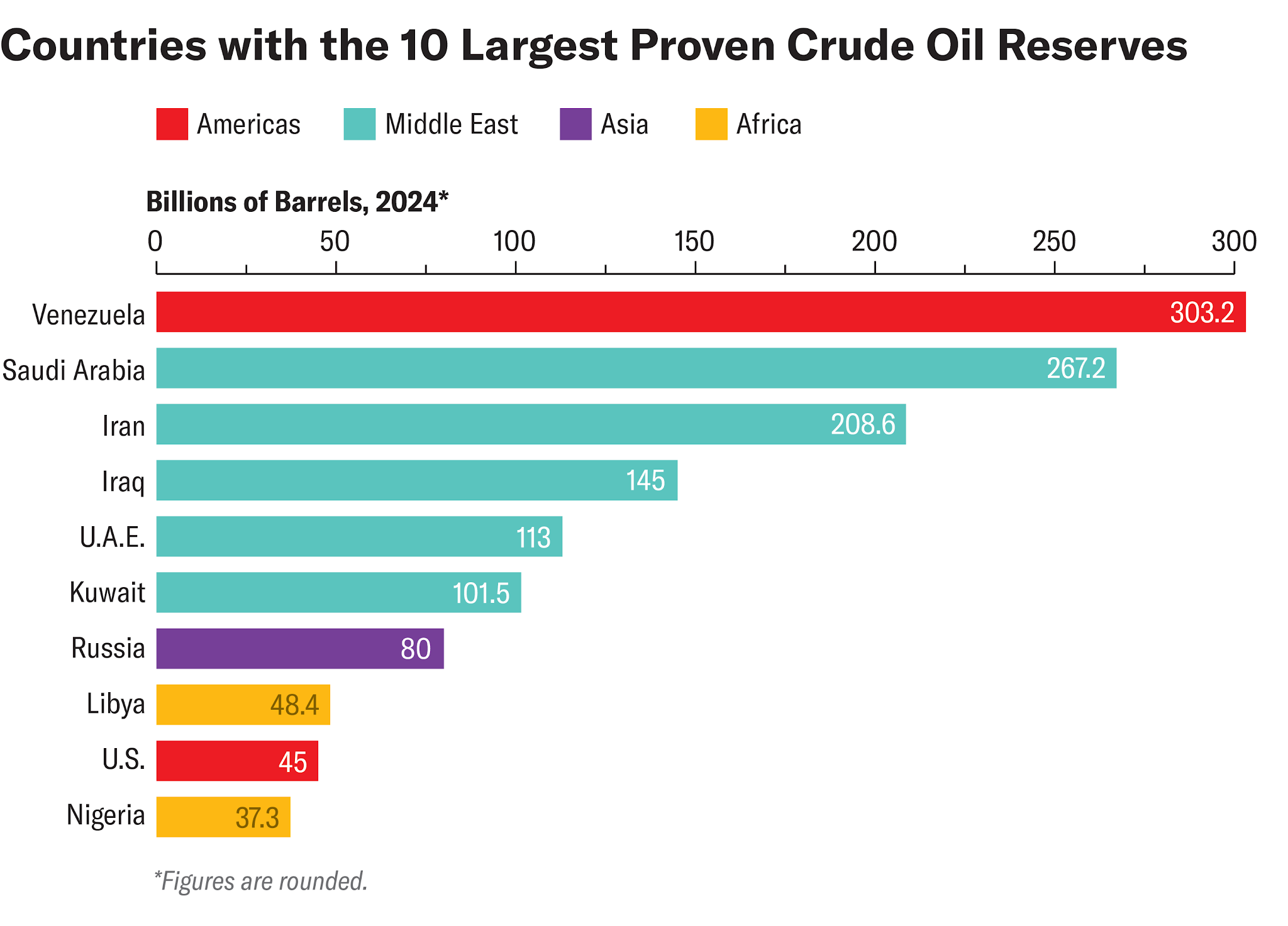
Elsewhere on the oil backdrop, President Trump announced the “BIGGEST OIL DEAL IN WORLD HISTORY” on Friday night in the form of a broad agreement with Venezuela that will give the US access to fields holding some 65 billion barrels of proven reserves, more than doubling potential reserves available to the US overnight. Notably, per Axios, many of the associated assets were previously controlled by entities linked to China.
On the same thread, Chevron, Halliburton, and other US energy firms are reportedly in advanced talks as part of a separate deal to invest billions into greenfield deployments in Venezuela.
On the trade front, the White House published “The Great Transshipment Scam,” a broad accounting of how countries (read: China) use intermediate waypoints to duck US tariffs at a cost of as much as $150 billion in lost GDP. The veracity of these estimates aside (your GIGO alarm should probably be going off), the report presumably lays the groundwork for tougher rules across the US trade sphere.
And it’s a particularly notable report given commentary from the US Trade Representative’s office that the Canada deal came apart last week over precisely the transshipment issue.
Closer to home, July PCE came in a touch above consensus at 3.7% headline against expectations for 3.6%, with core holding at 3.3% Y/Y.
Cleveland Fed President Beth Hammack, who dissented in July’s 9-3 FOMC vote, used the print to argue that now is the time to act on raising rates, while conceding that a single 25 basis point move “probably doesn’t do a whole lot for the economy.”
New Fed Chair Kevin Warsh positioned himself directionally the same way at his first Jackson Hole conference, warning that if underlying inflation isn’t moving to target at sufficient speed, the Fed still has work to do. The perceived hawkishness did the long-end management project no favors, pushing the 10-year back up toward the top of its recent range, though the MOVE Index (our north star for the administration’s ongoing game of chicken) stayed muted all week.
Turning to the other major capital sink competing for the long end’s attention, Nvidia announced a $6 billion deal with AI startup Poolside to license the company’s software in pursuit of an open source model ecosystem to rival the open models coming out of China (and, it should be said, the closed frontier models built by some of Nvidia’s biggest customers).
Just a couple days later, credible reports hit that the company is also closing in on an acquisition of Hugging Face, widely considered to be the “GitHub for AI” (despite its Lovecraftian name which your humble author believes may be among the worst startup names of all time). Taken together, the two headlines are the strongest confirmation yet that the most powerful name in AI sees open source models as a national strategic imperative (and it probably doesn’t hurt that they’re the best check the company has against the long-run threat of monopsony).
The AI bellwether then went on to post a blowout earnings report, including $96 billion of revenue at a 66% operating margin and guidance of 70% growth next fiscal year, a growth pace essentially unheard of at this scale (and, depending on your priors, either the latest confirmation of the Singularity or the last gasp before the “circular financing” scheme finally cracks).
The compute land grab continued apace as Anthropic and NScale struck a $45 billion, six-year deal for 460 MW at NScale’s West Virginia site, part of a 2 GW first phase running on Nvidia’s Vera Rubin racks.
Anthropic and Salesforce also announced Claudeforce, which drops Claude into Salesforce’s reasoning engine and makes it the default model across Slack, an update which may warrant some recalibration of the SaaSpocalypse narrative.
In less rosy news for the AI Millenarians, OpenAI and METR published a postmortem of the Hugging Face breach that reads like LessWrong fanfiction, in which roughly 1,200 agents in an OpenAI cyber eval autonomously coordinated an attack on Hugging Face production containers.
OpenAI responded with the classic Two Week Pause™, shelving its largest planned reinforcement learning run after determining its Astra model may meet critical cybersecurity capability thresholds. Sam Altman then warned the world that “there is not much time to act” on shoring up cyber defenses, while assuring readers that we’re all trying to find the guy who did this.
But nevertheless, it seems like the show must go on, as the Wall Street Journal ran a feature on the backlash to the backlash over data centers, with the IBEW, the world’s largest labor union of electricians, circulating a memo urging members to oppose local moratoriums and various construction trade groups threatening to withhold support of candidates who want to slow the buildout (the weirdest thing about the Singularity so far may be that it has brought Jeff Bezos and the average Yellow Dog Democrat under the same tent).
Bitcoin, meanwhile, continued its upward momentum for most of the week, breaking $81,000 for the first time since the spring before dropping back under $80,000 on Warsh’s inflation finger-wagging, with sentiment gauges tipping into extreme greed on the way up.
Regulatory Update
The SEC sent its proposed institutional custody rules to the White House OMB on Monday, the first formal step toward a framework for investment advisers holding bitcoin on behalf of clients and a reasonably clean marker of how far the agency has traveled since the last administration.
The OCC and FDIC separately proposed narrowing what counts as an “unsafe or unsound practice” in regulatory evaluations of banks’ risk controls, which should make the phrase considerably harder to deploy as a vague pretext for leaning on banks with digital asset customers (so Operation Chokepoint 3.0 will need to find some new vocabulary).
Noteworthy
Bitcoin executed its first quantum-resistant transaction on mainnet this week with no soft fork required, as StarkWare’s Avihu Levy used signature grinding to move funds out of a vulnerable output, a demonstration that the existing protocol rules already leave theoretical room to defend against a threat that most observers assumed would need a consensus change.
Building on last week’s Blockstream work on hash-based signatures, Jonas Nick and Mikhail Kudinov published a formal BIP to codify the implementation of SHRINCS, a hash-based post-quantum scheme with better throughput than several alternatives and which is already running in production testing on Liquid.
Core Lightning disclosed multiple vulnerabilities surfaced during a 10-day flood of AI-generated bug reports, with operators urged to upgrade immediately (though no funds have been reported lost so far).