

A gaggle of bureaucrats can rarely manage to agree on saying anything in unison even once, let alone 34 times, so when the world’s top finance ministers concluded their G20 Asheville retreat with a short statement highlighting the phrase “economic growth” with that frequency, we’d suggest there may be some value in taking them at their word. As Treasury Secretary Scott Bessent summarized quite bluntly for the group in the room: the world is awash in debt, Plan A is to grow our way out, and there is no Plan B. Growth on this scale has to come from somewhere, and as we’ve noted in prior weeks, the Trump administration seems to have decided it will come from compute, hence a new DOJ brief supporting OpenAI’s training pipeline as a matter of national security and President Trump’s warning that towns opposing data centers will end up “backwards and poor.” In turn, compute on that scale needs credit, hence Secretary Bessent’s G20 comments about Dodd-Frank strangling Main Street and the need for an uptick in private credit creation (accompanied by vigorous nods from the CEOs of Goldman and JPMorgan, invited to a seat next to Bessent at the G20 Big Kids’ Table for the first time), as well as another vintage Truth Social rant arguing for the US to have the lowest interest rates in the world. And both compute and credit need cheap energy, hence the Venezuela deal that reportedly gives the US a guaranteed fifth of the country’s production at cost and a ROFR on the rest through a private company partially owned by the Department of War, the kind of industrial policy that the US hasn’t run in over a century.
It remains to be seen if or when this whole agenda will require another round of the QE bazooka, though we increasingly think anyone waiting for a precise replay of fall 2008 or spring 2020 is probably going to be disappointed. There will have to be accommodation in some form because the simple debt math we’ve addressed extensively in this newsletter doesn’t permit otherwise, but our sense is that it will take the form of a thousand small measures on the margin, none of which will look like a sudden step function change in the SOMA chart: an upsized buyback program here, an expanded foreign swap line there, and perhaps finally the slow (or maybe not so slow) emergence of a more Treasury-aligned dollar system featuring T-bills as base collateral. If that’s the direction of travel, we continue to encourage readers to consider what would be required to make that work at scale, and why, with all these critical plates spinning in the air at once, the administration continues to push its digital assets agenda forward.
Selected Portfolio News
Zaprite Head of Business Development Parker Lewis shared an early look at the company’s new P2P app that aims to make bitcoin payments seamless:


As the world’s largest investor focused on the convergence of bitcoin, energy, and AI, Ten31 has deployed over $200 million across two funds into more than 30 of the most promising and innovative companies in the ecosystem. Visit ten31.xyz to learn more and get in touch about participating.
Media
AnchorWatch Co-Founder and COO Becca Rubenfeld joined the Bitcoin News show to discuss the recent surge in AI-assisted social engineering against bitcoin holders and the practical steps users can take to mitigate the threat.
Market Updates
All eyes were on the G20 finance ministers meeting in Asheville this week, and the joint statement that emerged contained no fewer than 34 references to prioritizing economic growth over just a few pages, which may offer a not so subtle clue as to where the whole ballgame sits in the minds of those pulling the levers. For what it’s worth, the statement also went out of its way to flag digital assets and stablecoins as inputs to that agenda.
Despite the group choosing not to meet at the Biltmore — thereby sacrificing a great opportunity for a subtle nod to the railroad magnates whose 21st century analogs are critical to the administration’s whole strategy — Bessent stated the key theme for the group pretty plainly, telling the room the world is “awash in debt” and that the only way out is to “grow our way out of it.”
The committee emphasized, though, that this needs to be the right kind of growth, as 19 signatories approved of the view that “non-market-based economies” pushing out a never-ending stream of cheap exports while under-consuming domestically “is not sustainable”; intrepid readers may be able to guess who the lone dissenter was.
In a somewhat notable first, the summit gave prominent speaking slots to major American banking CEOs David Solomon and Jamie Dimon, an interesting coincidence as Secretary Bessent reiterated his case for banking deregulation to drive faster private credit creation.
While most eyes were on the growth-fest in the Blue Ridge Mountains, the Treasury Secretary was also keeping busy with Operation Economic Outcast, promising “financial violence” in the form of more bank sanctions over Iranian transactions (though, as with last week’s promise to remove of a major institution from the dollar system, it’s not entirely clear which institution or what kind of timing Bessent has in mind).
The European Union hopped on the sanctions bandwagon as well this week, formally joining the US’s financial campaign shortly after the original announcement, an interesting contrast to European resistance to the US kinetic activities in the Gulf earlier this year.
Iran’s President (whose ultimate authority seems roughly akin to the Assistant to the Regional Manager) echoed comments from last week suggesting a declining appetite for escalation within the civilian government, offering to return to the terms of June’s tentative détente if Washington does the same.
While the US continues to exercise a heavier hand in the Middle East, the rise of a new brand of American industrial policy got one of its most explicit signposts yet in the Southern Hemisphere with the release of more fine print from the Venezuela oil agreement. Among other points, the deal gives the US — more specifically, a corporation in which the Department of War controls a 35% equity stake, a structure that by itself should tell you something about where we are in the imperial cycle — the right to purchase the first 20% of production at cost, as well as a right of first refusal on the remaining 80%.
Chevron will also invest $7 billion into Venezuelan production over the next five years, roughly doubling its regional output to around 600,000 barrels per day.
And even Coinbase co-founder Fred Ehrsam wants in on the action, bidding for operating control of three regional tracts alongside the likes of Chevron, as the digital assets world mysteriously keeps popping up in the orbit of the US’s geostrategic ambitions. No word yet on the tokenomics or airdrop date of PDVSACoin.
Despite movement on that deal, which even if fully instantiated will not be meaningful to global production for some time, oil prices still moved higher on the week, helped along by renewed escalation in the Gulf, where US forces struck rocket launchers on Iran’s Larak Island and Tehran answered with missiles at US bases in Jordan (so much for no need for things to get more kinetic), all of which helped push the 10-year to its highest level in almost two years.
That was enough for Fed Governor Michael Barr to say that if inflation isn’t moderating, the Fed should act decisively to raise rates at the September meeting. But Bessent said there’s no need for all that hiking hogwash, arguing that you don’t raise into a supply shock absent second- or third-order effects, with core inflation holding steady.
He found an unlikely ally in New York Fed President John Williams, who argued yields are surging because rates are procyclical and growth is picking up, thanks largely to “big investments in AI and data centers” (keep this one in mind for later).
Fed Governor Christopher Waller adopted a similar stance, hinting that he will vote to hold steady on September 16, reasoning that a single 25 basis point move wouldn’t do much about inflation anyway.
Making matters a bit tougher for the no-hike wing was an August jobs report that landed at +162,000 against consensus for 53,000 and a 12-month average of 31,000 (though the details under the hood aren’t quite as encouraging, with strength potentially boiling down to quirks in survey timing).
Perhaps somewhat predictably, President Trump jumped in on the back of this report to remind everyone that a “STRONG COUNTRY MEANS A LOWER INTEREST RATE”, threatening to stop trading with countries against which the US runs a trade deficit (so…all of them?) if the Fed does not lower interest rates soon.
As usual, the US wasn’t the only one with surging rates, as the Japanese 10-year touched 3% for the first time since 1996 and 10-year gilts broke out to their highest level since August 2007.
Interestingly, Bessent chimed in again here to suggest that he has “information that the market doesn’t have” about Tokyo’s intentions while publicly leaning on the BOJ to “do the right thing” by hiking rates. Totally coincidentally, the Yen strengthened aggressively on the week.
In other signs that the Rules Based Global Order is going just great, European Commission President Ursula von der Leyen wants the continent’s “lazy” household savings put “to the service of European companies” through new securitization programs, suggesting the You Will Own Nothing phase is getting closer (we promise the You’ll Be Happy part will be right around the corner).
Not helping matters there were European natural gas prices blowing out this week to the highest in nearly three years. Storage is running at 65% of capacity against 77% at this point last year, the lowest reading for the date since the series began in 2011, which leaves the continent very little margin heading into winter.
Turning to the engine on which it increasingly looks like the whole plan lives or dies, OpenAI’s GPT-6 Astra blew away most expectations this week, posting benchmark results well ahead of even Anthropic’s most recently released Fable 5.1 model.
The company’s President Greg Brockman said this release effectively represents AGI, and while we imagine there is some definite book-talking here, it’s notable that this is not the model on which the company recently paused training due to security concerns, a tacit confirmation that the frontier labs have checkpoints well ahead of what the public can access.
Almost perfectly timed with the Astra release, Senator Bernie Sanders announced a bill to ban artificial superintelligence outright and pause frontier development until a monitoring agency exists.
As support for the industry continues to separate along party lines, the Trump administration filed a brief supporting OpenAI against the New York Times, arguing that any trial result deeming model training to be copyright infringement would cut against US national security interests, which is to say clearing roadblocks so the frontier labs can keep improving.
President Trump was characteristically direct about his support for the industry, warning that communities which turn down data centers will end up living in a van down by the river while emphasizing his view that AI is America’s Golden Goose.
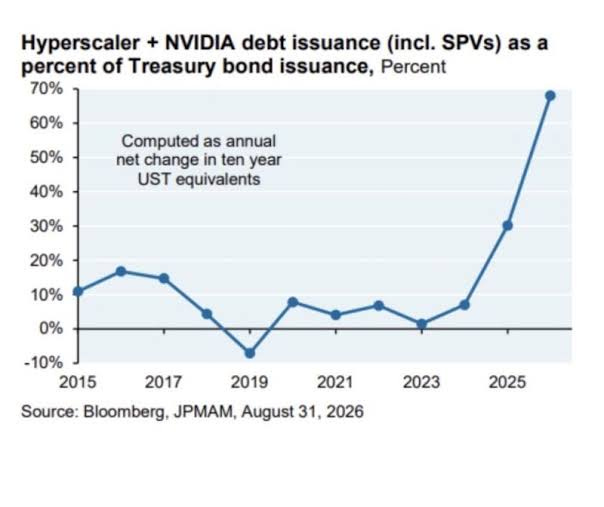
Depending on the path of operating cash flows at the hyperscalers (which have thus far been funded the majority of the buildout and could continue to do so if they accelerate to the degree that AI maxis predict), that federal support may need to get more concrete and monetary, as some estimates now suggest hyperscaler + Nvidia debt issuance for AI builds is running at ~70% of new 10-year Treasury issuance.
Bitcoin, meanwhile, broke the $80,000 level again and continues to hover right around there as of this writing, with spot ETFs pulling in over $1 billion in the last two days, good for their largest haul since January (nb: this whole thing generally works better if you buy before it moves up 25%). The ETF complex is now within spitting distance of flipping to positive flows for the year overall, a pretty notable achievement given the abysmal price action in the first half of this year.
Bitcoin treasury bellwether Strategy also resumed buying for the first time in two months, adding over 4,600 bitcoin at an average of ~$80,000.
Regulatory Update
The National Sheriffs’ Association dropped its opposition to the CLARITY Act and moved to neutral, having previously argued the bill would make illicit finance harder to prosecute.
SEC Chair Paul Atkins now expects a vote on the bill this month, with cloture still on the calendar for September 15.
But that may be a tough ask given House Republicans have cancelled the last two weeks of their September session, leaving town on the 17th and not returning until after midterms mid-November for a lame duck session.
Noteworthy
A huge wave of database breaches landed this week, starting with Dropbox, which said roughly 5,000 accounts were compromised through a legacy Lenovo ID integration that lacked two-factor authentication.
Even worse was the reveal of a darkweb service that appears to be selling 153 million driver’s licenses, the latest sign both that KYC/AML laws are mostly a net danger for the average American, and the latest warning shot that AI is about to totally upend all assumptions about cybersecurity.
River published a report framing the path to a bitcoin price of $840,000 by the end of the decade and arguing for a 10% portfolio allocation.
Just a few weeks after the “Batch Zero” process for large data center applications was disrupted by an audit demanded by Texas Governor Greg Abbott, Texas grid operator ERCOT privately completed its first screening of ~300 applicants representing ~200 GW of prospective demand.