

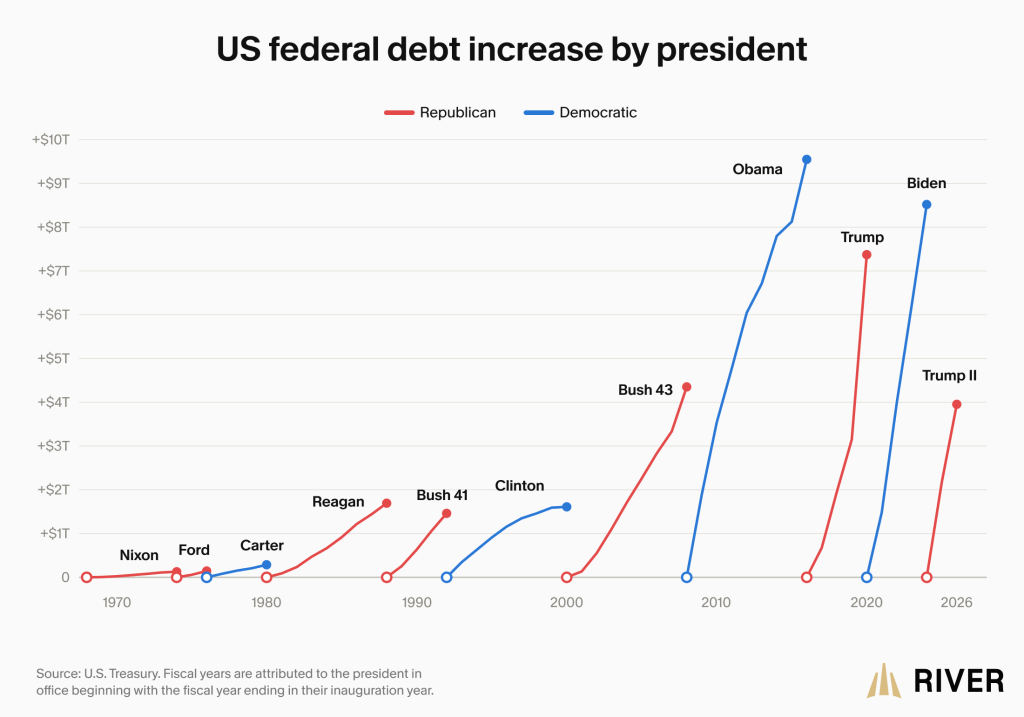
It was an eye-popping $40 trillion dollar number that grabbed many of the top mainstream headlines this week, as the US officially crossed the threshold of doubling its outstanding federal debt in just a single decade, but it was a measly $4 billion figure that really got markets moving. With long-end Treasury yields pushing into uncomfortable territory once again, Scott Bessent’s Coupon Cleanup Crew announced plans to increase the size of the US Treasury’s ongoing bond repurchase program from $2 billion per month to at least $4 billion per month beginning in September. The financial press made much hay over the fact that this announcement’s positive impact on long-end yields was short-lived and fully reversed within 24 hours, and many were quick to jump to the conclusion that that means the printer (now helmed by a Trump ally and former Bessent colleague) must be right around the corner, or else that the US debt death spiral has officially begun and the collapse of the dollar is just around the corner. All this helped push the debasement trade out of de basement (I’m sorry, I’ll show myself out) as gold and bitcoin both had banner weeks.
As bitcoiners, we won’t look a gift horse in the mouth — particularly when he comes bearing a $16,000 weekly candle, good for 1 whole bitcoin market cap at this time four years ago — but we’d posit that some commentators may be jumping the gun on the implications and transmission mechanisms here. If you think the current administration is intent on a “global economic reordering” (a prospect about which its leading Bond Salesman has been quite explicit and which seems to be supported by virtually every policy decision of the past 18 months), then what you need is not to solve America’s long-run debt burden tomorrow, but just to keep the fiscal picture manageable long enough to claw back the strategic industrial capacity needed to reestablish hegemony (and maybe to re-shore the eurodollar system that is now bigger than the officially recognized dollar market while you’re at it). In that case, the operative question is not whether Bessent can buyback his way back to ZIRP, but rather how big the buybacks need to be to keep the largest marginal source of long-end buying (not the Fed, but US investment funds) at the table so volatility doesn’t get too far out of hand (and once again, we’d note that the MOVE Index remained pretty calm all week). That number may be higher than $4 billion per month, but our sense is it’s not $100 billion, so we wouldn’t bet on the administration getting shaken out of its main existential trade just because of long-end rates.
To be clear, the US no doubt has an unavoidable long run fiscal math issue (which we’ve addressed extensively in this newsletter), and sudden nonlinear changes in the strategic picture could force Washington’s hand back into its century-long failure mode of printing the difference. But we think it’s worth readers considering that there may be more than one way to skin the cat of fiscal dominance, and it may involve structural changes to the dollar system that sit outside the familiar toolkit of a new Federal Reserve alphabet soup facility. Fortunately, we’d argue hard assets ultimately have a central role to play in either scenario, which makes the timing of revived Presidential allusions to the US buying more bitcoin particularly noteworthy this week.
As the world’s largest investor focused on the convergence of bitcoin, energy, and AI, Ten31 has deployed over $200 million across two funds into more than 30 of the most promising and innovative companies in the ecosystem. Visit ten31.xyz to learn more and get in touch about participating.
Media
AnchorWatch Co-Founder and CEO Rob Hamilton joined the Galaxy Brains podcast to discuss the latest developments in the Bitcoin Red Team cybersecurity initiative.
Market Updates
After a steady climb in the long end throughout the summer, the US Treasury decided enough was enough this week, announcing a doubling of the maximum size of its buybacks of 10-year and 30-year bonds, from $2 billion to at least $4 billion per monthly operation beginning in September. The all-caps DOUBLING headline splashed across many Twitter feeds was no doubt eyebrow-raising, but we’d flag that the amounts at play here are still a drop in the bucket relative to Treasury’s ultimate headroom if it really wants to get frisky.
Yields kneejerked down for approximately one session, with the 30-year giving back more than 10 basis points on Wednesday before rates edged back higher on Thursday as traders finished doing the arithmetic and came to the conclusion that some of that extra headroom may need to get used sooner than later.
Secretary Scott Bessent evidently agreed, taking to CNBC the following morning to emphasize the operation could run much higher than $4 billion per issue and that Treasury has “a big toolkit” for dealing with the long end, a reassurance the 10-year rather pointedly ignored by erasing all of its gains from the prior day while he was speaking.
Poetically, total public debt outstanding crossed $40 trillion within the same 24 hour period, having roughly doubled since January 2017 across two administrations united in the bipartisan view that the other guy should be stuck with the tab.
Bessent’s view is that there’s nothing magic about that $40 trillion number and that “we can grow our way out of this,” which might have triggered some longtime Timestamp readers into the Leonardo DiCaprio pose.
He went even further on Thursday, telling CNBC there’s a “very good chance” the deficit has already peaked under this administration, a bold top-tick call against last week’s record July deficit of $432 billion.
Whatever the trajectory of the deficit, President Trump was once again clear about where he’d like the vig on it to be, reiterating that the US “should be paying much less” in interest expense and that the Fed’s board is overly political — while taking care to note, again, that his Number One Boy Kevin Warsh is doing a great job.
As Treasuries looked to recover from their latest bout of queasiness, the already challenged private credit backdrop got even murkier with the news of a federal probe of Dodgers owner and insurance magnate Mark Walter, whose TWG Global agreed to swap out as much as $6.5 billion of related-party private credit investments held at Delaware Life amid SEC and SDNY scrutiny of potential self-dealing.
The ultimate blast radius here remains uncertain but is already spreading, with bonds issued by Sammons Financial Group — a $135 billion life insurer whose parent holds a non-controlling minority stake in Guggenheim — blowing out some fifty basis points in a week on the back of a short seller’s report.
Away from the credit complex and despite some solid recent data on inflecting wage growth at the lower end, Walmart’s latest earnings release pointed to a more cautious American consumer, with US comps up just 2.6% (the softest rate in over six years) even as the company raised full-year guidance.
In a similar vein, July single-family housing starts fell nearly 10% to 808,000, the lowest level since November 2022, with mortgage rates parked near a still-restrictive 6.8%.
On the Iran front, the President took to Truth Social to promise an “ECONOMIC D-DAY” (with particular focus on the third countries, exchange houses, ship registries and front companies that make Tehran’s oil trade function) days after the UAE suspended trade with Iran outright.
Secretary Bessent once again popped his head out to suggest that this new round of economic pressure means “likely there will not be a large-scale kinetic restart” and that we’ll get more details on Monday. Reasonable readers could interpret this as laying the groundwork for a graceful de-escalation where the US gets to claim an economic win without scoring a decisive military victory, but we’d still bet that the last chapter of how this episode plays into the global economic reordering has not yet been written.
Energy markets remained fragile but took the escalation in stride, with commercial crude stockpiles posting an above consensus weekly build of 4.4 million barrels (vs expectations for a 1.6 million barrel drain), landing right in line with the five-year seasonal average.
That marginally better inventory picture may owe something to the midnight runs the US has apparently been operating in the Strait of Hormuz, where Axios reports a US task force has been using the secret weapon of checks notes the dark to shepherd 15-20 tankers per night down the Omani coast, good for roughly 10 million barrels a day or about half of prewar output.
Elsewhere in US gambits for rearranging the security map, the President ordered Defense Secretary Pete Hegseth to substantially reduce the US’s annual joint exercises with South Korea, calling them “totally inappropriate and hostile” toward North Korea, which is after all a swell neighbor and paragon of good faith diplomacy.
Some relevant context for the superficially baffling decision came a couple days later in the form of Chinese Foreign Minister Wang Yi visiting Seoul for the first time since 2021 to meet with the relatively new Lee government, which has signaled more warmth toward Xi than the White House may like.
And speaking of China, Mexico is reportedly weighing tougher anti-dumping measures on Chinese steel and vehicles as President Claudia Sheinbaum works toward a multi-year USMCA extension, a US leverage point we’ve been flagging for much of this year.
To the north, the US enacted a three-day pause of its 50% tariffs on some $20 billion of Canadian exports minutes before the deadline, with Trump linking the reprieve to a Keystone XL pipeline that “may be awoken from the grave.”
But as often happens on the rocky road to achieving an Artful Deal, negotiations fell apart at the eleventh hour, and the US moved forward with its planned tariffs starting Saturday morning.
As the world awaits the IPO of arguably the two most important companies in the US later this year, new reporting this week suggested Anthropic’s annualized run rate reached $65 billion at the end of July, a number almost nobody would have believed 9 months ago when the company was hovering under $10 billion of ARR, yet one that still landed short of the buyside whisper and drove some renewed consternation across the AI-levered complex.
Bitcoin, meanwhile, did bitcoin things, breaking back above $70,000 for the first time since early June in one of the largest short squeezes in the asset’s history. The corn even made a run at $80,000 on Friday morning.
Regulatory Update
The OCC granted preliminary conditional approval to World Liberty Financial, the Trump-affiliated “DeFi” entity behind the USD1 stablecoin, to operate as a national trust bank issuing and custodying digital assets (though the charter is conditional and the bank can’t yet open its doors).
Meanwhile, the US Comptroller of the Currency indicated that over half of new OCC bank charter applications now include some digital assets component, up eightfold from the Biden administration.
Having punted the closely-watched CLARITY Act vote past the August recess, the Senate now has cloture on the calendar for September 15, and White House digital assets adviser Patrick Witt says he remains “optimistic and bullish” on the bill clearing this year.
When asked about the US acquiring a “sizable amount of bitcoin” at a White House digital assets summit this week, President Trump said that “[he] would certainly listen” to recommendations, adding that bitcoin has “been very, very good for the dollar.”
Noteworthy
A new Blockstream Research report showed that hash-based signatures that could offer future quantum resistance for bitcoin transactions can be reasonably produced on at least four of the most popular bitcoin hardware wallet models, which is notably positive given that the potential unwieldiness of these signatures has been a point of concern among industry observers.