

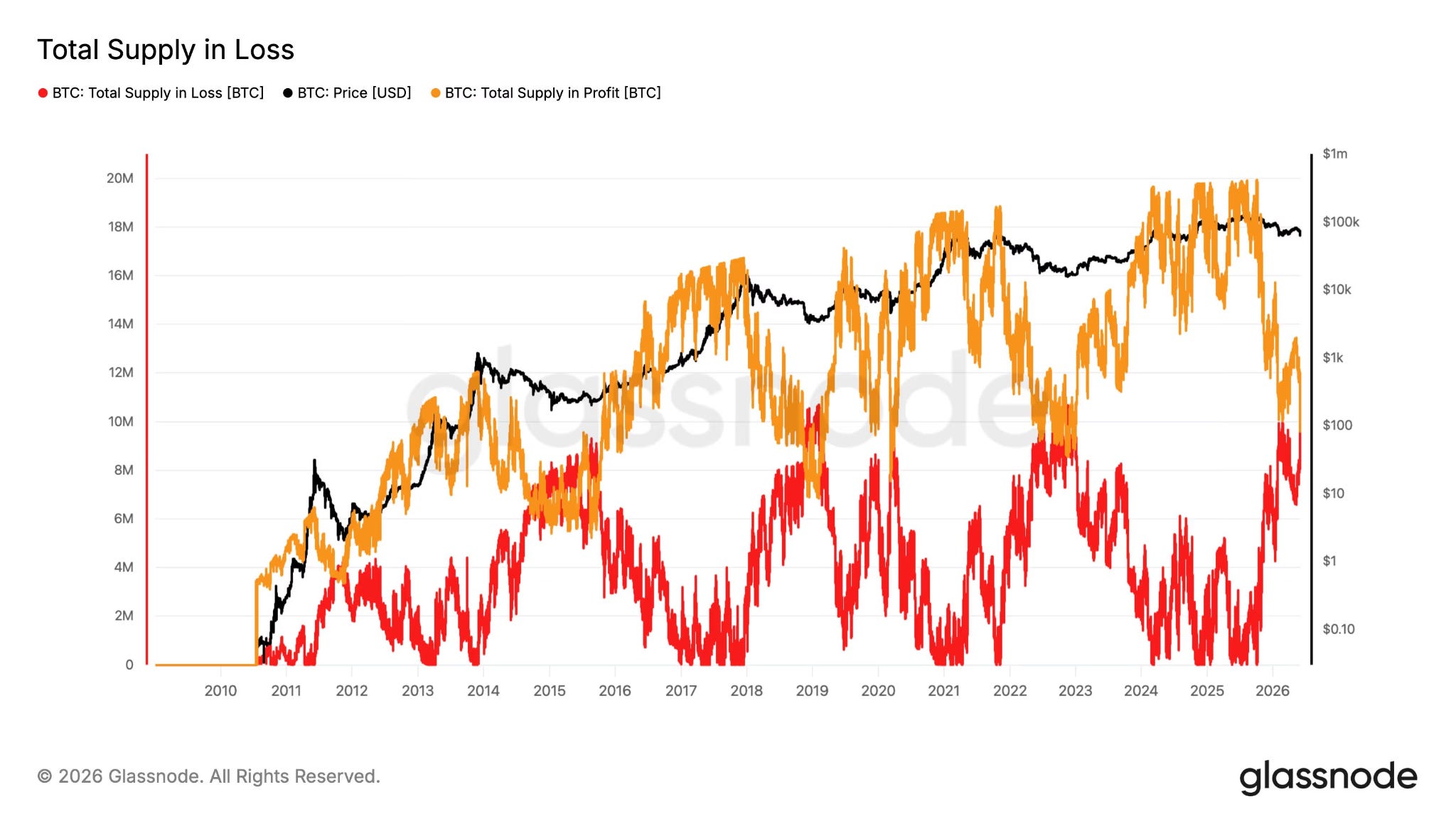
It was a tough week to own – checks notes – anything, as stocks violently gave back a few weeks of gains, gold broke its 200 day moving average, and bitcoin did, well, bitcoin things. With a divided and potentially net-hawkish Fed making its debut next week, a generational reworking of who wears the pants in the dollar system coming into view, and fund managers pre-positioning for allocations into the three largest IPOs of all time, the road ahead will no doubt be bumpy, even as many technical and onchain indicators seem to point to bottom formation sometime in the near future. But at the risk of repeating ourselves, on weeks like this, we like to assess what’s actually going on in the world, and what we see is an administration that’s not shy about spending at historically aggressive levels on top of historically high public debt to reignite the traditional business cycle (a dynamic that has historically been quite positive for bitcoin) and shore up long-term US hegemony; a phase shift in technological capabilities paralleled by only a few moments in history, which will dramatically disrupt legacy capital markets in either the bull or bear case; an ongoing, radical shift away from an international trade system that assumed open capital markets and trusted sovereign partners; gradual, persistent improvements in the base protocol and user tooling needed to make bitcoin robust and extend its utility; and legacy institutions like Charles Schwab and Fannie Mae increasingly incorporating bitcoin offerings even in the face of terrible price action while the US Treasury Secretary frames a strategic bitcoin reserve as a matter of national security. I don’t know what to tell you, man; seems bullish.
As the world’s largest investor focused on the convergence of bitcoin, energy, and AI, Ten31 has deployed over $200 million across two funds into more than 30 of the most promising and innovative companies in the ecosystem. Visit ten31.xyz/invest to learn more and get in touch about participating.
Selected Portfolio News
Strike launched new anti-phishing tools to prevent fraud and social engineering:


Media
Unchained published a guide on moves bitcoin holders can make to maximize opportunity during a bear market.
Market Updates
After a monthslong soap opera that jumped the shark long ago, Iran decided to take its toys and go home on Monday, declaring negotiations over and promising to “completely block” the Strait of Hormuz.
When asked about how he’d respond, President Trump shrugged it off, suggesting he doesn’t care and that the whole thing has become “very boring.” Interestingly, the oil market seemed to agree, with both WTI and Brent flattish on the week.
While negotiations in the Gulf continue to stall out, fundamental US economic data – at least at the macro level – continued to look better, as the US Manufacturing PMI increased M/M again to the highest level in four years.
Meanwhile, JOLTS job openings data ripped to a multi-year high, and Non-Farm Payrolls also came in much stronger than expected to close out the week (though once again, the decomposition under the hood is less exciting).
This last data point, however, sent markets into a tailspin as investors began to panic about the prospect of a stronger labor market potentially justifying rate hikes at the upcoming FOMC meeting next week, pushing the Nasdaq to its worst single day performance in a year as anything related to semiconductors or AI got shellacked.
Worries about AI being cancelled may be somewhat premature, though, as Anthropic published an article this week suggesting they are now seeing the beginnings of “recursive self-improvement,” a long-awaited milestone among AGI Truthers that describes the state at which frontier models are capable enough to train and improve their own next iterations. Scientists accordingly set the Paperclip Maximizer doomsday clock to 11:59pm.
In response to the rapid progress in AI, Senator Bernie Sanders previewed an upcoming bill that would have “the public” (a classic abstraction that somehow never actually includes your average American) take a 50% ownership stake in key frontier AI labs.
At the same time, new reports indicated that prominent Sanders ally Donald Trump – hey, wait a minute – and OpenAI have already discussed the federal government taking a stake in the company.
While AI continues to eat more of the economy, the traditional private markets backdrop has remained rough, with Blackstone once again gating redemptions out of its flagship BCRED fund as withdrawal requests jumped to a new high of ~10%. Across the pond, Partners Group reported similar redemption pressures and was also forced to limit withdrawals.
The global liquidity backdrop has remained mixed and has not been getting any help out of China, where the PBOC cut its daily liquidity injection operations to zero for the first time in two years.
The road may not be getting any easier for the domestic Chinese economy, as the European Union officially prepares new restrictions on Chinese imports amid what policymakers have acknowledged is an unsustainable trade deficit between the two parties.
As the world weighs its dependence on Chinese supply chains, the Wall Street Journal ran a feature this week on various recent engineering developments that may pave a path to reduced reliance on Chinese rare earth minerals and critical materials.
In what may be a sign of growing stress brought on by the trade recalibrations of the past couple years – as well as a deep and ongoing decline in the local real estate market – Chinese authorities have begun cracking down on offshore trading and ownership of US equities.
Elsewhere in the rapidly shifting geopolitical landscape, notably pro-Tump Colombian candidate Abelardo de la Espriella surprisingly took the lead in the first round of Presidential voting this week. The next round of elections to replace outgoing anti-Trump incumbent Gustavo Petro will take place later this month.
To the north, reports surfaced this week that the USMCA (the North American trade agreement that replaced NAFTA) will miss its July 1 renewal deadline, a potential headline we’ve previewed in prior issues and a development that will throw the already-strained trade relationship between the US and Canada further into limbo.
The CEO of Payments Canada gave a noteworthy speech this week in which she acknowledged that payments are tools of “economic statecraft,” and flagged that 80% of Canada’s cross-border payments are routed through US correspondent banks. We suspect the USMCA situation may be setting up a scenario that makes the implications of this reality more concrete.
On the bitcoin front, Schwab officially launched 24/7 bitcoin futures trading on its Thinkorswim platform as the $13 trillion stalwart continues to ramp up its bitcoin offerings (as an aside, it may be worth noting that turning on persistent trading did not require a blockchain).
Just under a year after the FHFA initiated its exploration into bitcoin as an element of mortgage collateral packages, the first Fannie Mae-conforming bitcoin-backed mortgage was officially issued in the wild.
Despite the ongoing drumbeat of positive real-world developments, bitcoin’s price took it on the chin again this week, falling back to the ~$60,000 level and fighting for its life to hold onto some key technical levels (though breaching these levels has historically marked roughly the bottom of prior bear markets).
Regulatory Update
Treasury Secretary Scott Bessent confirmed the Treasury Department is continuing to take steps to build out the strategic bitcoin reserve, framing the topic as an element of national security.
The Treasury, meanwhile, enacted new sanctions of Iran’s largest crypto exchange, which processed over half of Iran’s digital assets flows last year.
Six Senators sent a letter to the Fed, FDIC, and OCC calling for a reconsideration of the Basel framework’s overly punitive risk-weighting of bitcoin.
Noteworthy
Bitcoin treasury giant Strategy sold 32 bitcoin this week, marking the company’s first small sale since 2022. The sale was previewed on the company’s last earnings call as an “inoculation” of the market to the possibility that Strategy could sell bitcoin from time to time; if so, the patient appears to currently be coding.
Bitcoin open source funding organization Brink announced a new grant for developer Conduition, who will focus on post-quantum security upgrades for bitcoin.
Zcash, a privacy-focused altcoin whose advocates have long criticized bitcoin for insufficient privacy guarantees, took a drawdown of nearly 50% this week as developers revealed a hidden inflation bug that, thanks to Zcash’s privacy-maximizing design, was both undetectable for years and has effectively made the total circulating supply of Zcash unknowable. The bug appears to have been discovered by a simple Claude prompt.