

The market decided to party like it’s 1999 this week, all the way down to a new all-time high for *checks notes* Intel. We may have less clarity than ever on how much oil will be allowed to flow through the Strait of Hormuz by this time next year, but investors have largely shrugged off that pesky question, as all major indices have moved aggressively higher while bond volatility compresses and the 10-year yield stays rangebound. We have no crystal ball on whether these trends can sustain themselves in the coming weeks, but this sequence of events is admittedly fairly problematic if your main heuristic for analyzing the Trump administration’s constraints revolved around the President’s sensitivity to financial market turbulence, which was supposed to be unavoidable and cataclysmic in any bout of extended volatility in the Middle East. Some may object that US financial markets are increasingly manipulated to absorb and offset the downside that should be prevailing right now, and we’d probably agree to a large extent, but that’s also the point: the name of the game is whether the US can use its exorbitant privilege of dollar supremacy (while it still lasts) to facilitate a realignment of the global chessboard in its favor. Time will tell whether the airplane can be repaired mid-flight (particularly given downstream commodity impacts that are piling up every day), but one team clearly has the right to yell “scoreboard” at this point in the action.
We’ve been beating the drum on this theme for the better part of a year, but this week was especially loaded with more signposts in this direction, including a move toward more standing dollar swap lines for key Gulf and Asian allies, a US-financed takeover of a major Brazilian rare earths asset (complete with price floors and long-duration offtake agreements), explicit international coordination with Western vassals allies to ramp up production of critical materials (at the expense of anyone not in the club), and wide-ranging executive orders authorizing aggressive reshoring and decoupling actions in the energy and power markets. As always, none of this is guaranteed to succeed, but it’s hard not to see the direction of travel, and with the President now closer than ever to getting his Number One Boy in the big chair at the Eccles Building, we don’t expect the financial backdrop necessary for this transition to get any less accommodative. To paraphrase renowned American philosopher Randall Savage: you may not like it, but accept it (and allocate accordingly).

Selected Portfolio News
Fold launched its new Fold Business platform:


Mempool.space shipped v3.3 of its industry-leading dashboard and analytics suite:


As the world’s largest investor focused on the convergence of bitcoin, energy, and AI, Ten31 has deployed over $200 million across two funds into more than 30 of the most promising and innovative companies in the ecosystem. Visit ten31.xyz/invest to learn more and get in touch about participating.
Media
AnchorWatch Co-Founders Rob Hamilton and Becca Rubenfeld appeared on the Bitcoin Archive podcast to discuss AI’s intersection with their business and startups more generally.
Rob also appeared on What Bitcoin Did to discuss how to handle quantum-vulnerable bitcoin over time.
Market Updates
The nation continued to sit gripped by one of history’s great will they / won’t they dramas this week, as tensions between the US and Iran once again flared up, with intermittent skirmishes initiated by both sides throughout the week.
On Tuesday, after going deep on the important issues like how NIL is ruining college sports (co-signed, FWIW), Trump assured his Squawk Box audience that “we’re going to make a great deal” before the end of the two-week ceasefire on Wednesday.
Though just before the expiration of one of the more hostile ceasefires in history, the President extended the window for talks indefinitely, ostensibly due to Iran’s failure to present a unified proposal due to its “seriously fractured” leadership. That said, the US is continuing its blockade of Iranian ports while talks are ongoing.
Shortly thereafter, Iran announced it had seized two container ships in the Strait of Hormuz, while the US Navy boarded and commandeered a sanctioned oil tanker in the Indian Ocean, allegedly “without incident.”
On Friday afternoon, the White House announced that Steve Witkoff and Jared Kushner (notably sans the Vice President this time) were en route to Pakistan for direct talks with Iran, or at least some faction thereof. But even with those two in the air, Iran publicly insisted no meeting is set to take place.
We can only hope a deal is signed imminently, otherwise there’s no telling how many more oil tankers will fall prey to crypto scammers impersonating the IRGC.
The revived uncertainty pushed oil prices higher on the week, though key benchmarks remain well below recent highs. The market broadly seems to have become numb to all the maritime whiplash, as the US 10-year yield was flattish on the week (with the MOVE Index basically back to pre-war levels) while the S&P500 again made new all-time highs.
With Middle East oil revenues in flux and growing Fintwit chatter about the emergence of the “petroyuan,” the Wall Street Journal reported this week that the UAE has initiated talks about establishing a swap line with the US, a relationship that only five central banks have on a standing basis.
During Congressional testimony this week, Treasury Secretary Scott Bessent confirmed that swap line talks with both Gulf countries and Asian allies are ongoing, framing these discussions as an opportunity to extend dollar dominance and further entrench the dollar’s network effect.
Interestingly, the UAE is reportedly also moving to bucket its China investments into a segregated arm of its sovereign wealth holdings. We have our suspicions on what this indicates, but people will see what they want to see in that headline.
Arguably the more important headlines from the week came on the domestic side, as the US continued to ramp up its overt shift toward wartime industrial policy by facilitating USA Rare Earths’ acquisition of Serra Verde, a major Brazilian rare earth miner, for $2.8 billion.
The miner represents the only scaled producer of all four magnetic rare earths outside of Asia, and in a bright red signpost, the deal includes $565 of Development Finance Corporation (read: Pentagon) funding and a 15-year, 100% offtake agreement with defined price floors backed by the US government.
That same day, US Trade Representative Jamieson Greer called for shared price floors and trade barriers on critical minerals among a club of Western allies in opposition to China. Greer noted that the West needs to be ready to pay a “national security premium” for production of these critical materials.
Despite some immediate grumbling and pushback among the likely members of that club, the EU later announced a new MOU on critical minerals cooperation with the US, explicitly pointing to the potential for “border-adjusted price floors, standards-based markets, price gap subsidies and offtake agreements” (following, of course, the consummately European “exploration of a broad range of trade policies and instruments to reinforce coordinated international action”).
On an even wider scale, President Trump signed a flurry of Executive Orders declaring states of emergency on US electrical infrastructure and domestic production of oil, natural gas, and coal. The orders authorize the Department of Energy to make purchases and financing commitments as necessary to address supply chain vulnerabilities and over-reliance on foreign imports across these industries.
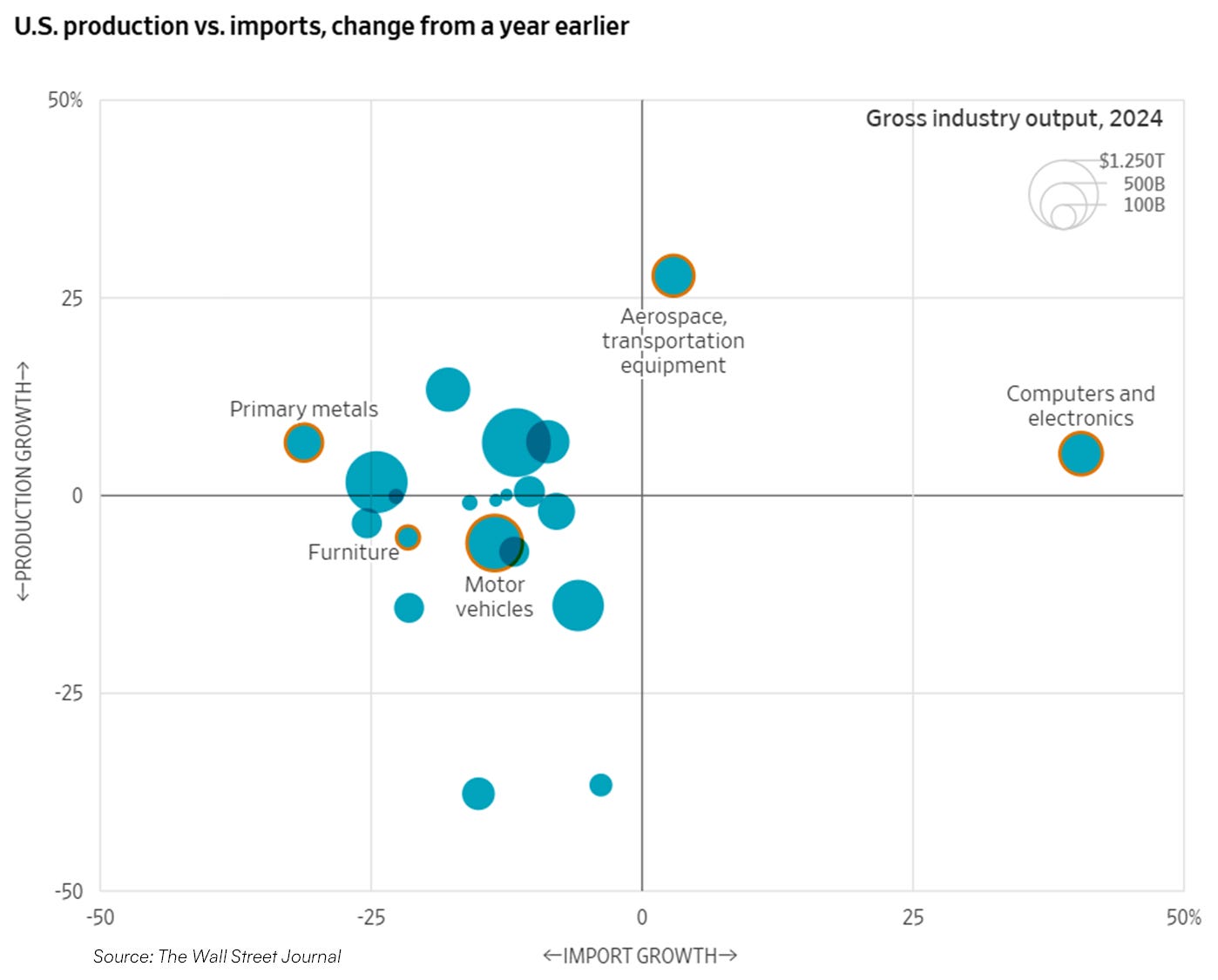
Amid all these aggressive industrial maneuvers, the Wall Street Journal published a timely article on America’s “stealth manufacturing boom.” To be sure, it’s very early days; semiconductors (arguably the most pivotal industry in the world at the moment) remain skewed toward foreign reliance; and nothing about this strategy guarantees that US citizens will necessarily get richer in real terms even if it works, but the playbook looks increasingly clear by the week.
On this same theme, Japan lifted its multi-decade export ban on defense technologies for a select group of countries including the US, UK, NATO members, and a few Asian neighbors (readers might hazard a guess as to who was excluded). On the other side of the world, the Wall Street Journal ran a feature on Germany “reinventing itself as a weapons factory.”
While the US continues to shore up its circle of friendlies, it’s also ramping up efforts to punish defectors, as a leaked internal Pentagon memo reportedly floated various punitive measures for Spain and other NATO members that have not supported US actions in Iran.
Regime change has been the term du jour on the war in Iran, but it got a different twist this week as Kevin Warsh, President Trump’s nominee to succeed Jerome Powell as head of the Federal Reserve, went to Capitol Hill for the customary Congressional kayfabe. Warsh reiterated his desire for structural shifts in Fed operations, noting he’ll push the institution to move past outdated academic models and quarterly “forward guidance” jawboning.
Mr. Warsh also reemphasized his view that the Fed can both lower benchmark interest rates and meaningfully reduce the size of the Fed’s balance sheet over time in coordination with the Treasury. We’ll just say we remain skeptical on this point (and we’re in good company here).
Much of Warsh’s framework seems to be based on an expectation for an oncoming deflationary AI productivity boom that will give the Fed more headroom to cut rates. Perhaps, but this week gave us another headline pointing to a different wrinkle the Fed may need to address if Warsh’s view plays out, as large-scale layoffs at Meta and Microsoft sparked renewed fears about AI disruptions to employment.
Finally, the nominee emphasized that President Trump never demanded that he lower interest rates upon taking the job. Apropos of nothing, Trump said on the same day that the next Fed chair should cut rates right away and that the US should have the lowest rates in the world.

In any case, the nomination now appears more likely to move forward, as the Department of Justice dropped its investigation into current Fed Chair Powell, theoretically clearing the way for full Republican support of confirming Warsh (though Press Secretary Karoline Leavitt suggested the investigation is “not necessarily dropped” just yet).
The Trump administration began doling out tariff refund payments that will eclipse $160 billion to various businesses over the next several months. This may have some near-term stimulative impact, though we strongly suspect that tailwind may be offset by replacement measures under a different regulatory framework.
A US Admiral touted the national security implications of bitcoin in his Congressional testimony this week, and doubled down in a separate hearing with the claim that bitcoin is a tool for power projection while noting the military is running its own bitcoin node. The admiral was quick to deemphasize bitcoin’s monetary properties, so we’ll admit this all sounds like the military version of “blockchain, not bitcoin,” but it’s no doubt noteworthy to see this conversation playing out on a stage like this.
Strategy announced the purchase of over 34,000 bitcoin, almost all of which came from issuance of the company’s STRC preferred stock. STRC has now cumulatively driven the purchase of nearly 100,000 bitcoin, and the company holds over 815,000 bitcoin, officially surpassing IBIT.
Wealth management bellwether Charles Schwab released a suit-friendly educational video on bitcoin for its 40 million clients as it launches bitcoin trading on its platform.
Regulatory Update
New York sued Coinbase and Gemini over their launches of prediction markets, calling these products “quintessentially gambling.”
After several weeks of apparent momentum, the long-awaited CLARITY Act market structure bill appears to be delayed once again.
Noteworthy
Bitcoin on-chain metrics analyst James Check – for our money, one of the most consistently sober and high signal voices in bitcoin – published a report assessing the potential price impact of a sudden theft and sale of Satoshi’s quantum-vulnerable bitcoin. Check concludes that such an event would be well within the bounds of what investors already absorb during bear market capitulation events.
Project 11, a startup focused on quantum-proofing digital asset infrastructure, awarded a 1 bitcoin bounty to a hacker who claimed to have used a quantum computer to break a 15-bit ECC key, ostensibly the largest successful quantum cryptographic attack in history. Underlying details of the attack may suggest there’s more than meets the eye here.
In more legitimate hacking news, DeFi protocol KelpDAO (the exact name of something you’d expect to be a pillar of the future of finance) was hacked for nearly $300 million, driving widespread contagion across various crypto ecosystems and once again highlighting the fragility of the broader “crypto” universe. In response, Arbitrum, one of the most popular (and ostensibly decentralized) Ethereum L2s, unilaterally froze $90 million of assets.
Meanwhile, leading stablecoin issuer Tether froze $344 million of its tokens on the Tron blockchain in coordination with OFAC. Treasury Secretary Scott Bessent later indicated these funds were allegedly linked to Iran.
Travel
Bitcoin 2026, Las Vegas, April 27-29
Ohhhhhh Yeahhhhh, Dig It!!!!