

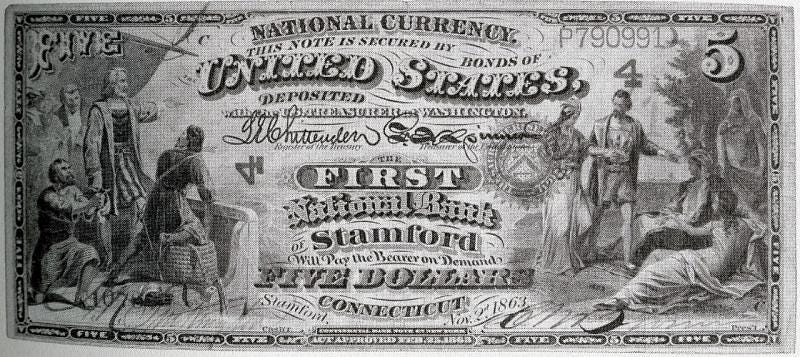
More traders became Aware of the Situation this week as the rout in the AI complex accelerated, with neoclouds continuing to face credit concerns and investors getting increasingly queasy that AI-pilled Mag7 CEOs may actually be willing to gulp dilute shareholders to fund their prophesied Age of AI-quarius. There’s plenty to be discussed there, but the headline that stuck with us most came from a decidedly drier corner of the financial world in the form of final OCC rules implementing the GENIUS Act and, most notably, Treasury Secretary Scott Bessent’s celebratory tweet (Xeet?) that marked the occasion by invoking the National Currency Act of 1863. We’ve been arguing for most of the past year that the real ballgame here is moving the world toward a redefinition of the dollar as effectively a spendable T-bill, and Bessent’s reference to an obscure 19th century piece of monetary legislation strikes us as the clearest validation of that thesis we’ve seen yet: the 1863 Act (which, fittingly, is the same law that created the OCC in the first place) provided a framework for private banks to issue a uniform national currency that would be collateralized by government bonds held at the Treasury, effectively making every new banknote in the country a unit of captive demand for Union issuance. It was also, not coincidentally, a wartime measure, which should tell us something about how this administration views the stakes of the game right now, in a week when the White House invoked the Defense Production Act (again) for petroleum products, the Pentagon originated new loans to move pharmaceutical supply chains out of China, Elon Musk’s new chip fab reportedly swore off Chinese vendors entirely, and Beijing extended its export controls beyond critical metals to some finished industrial equipment.
But wait, there’s more! The war-finance machinery that the 1863 Act was part of also went on to fuel a financing boom for the high-tech railroad industry, the most capital-intensive buildout the country had ever attempted to that point. As is generally the case with booms, it was all fun and games until various factors, including a fundamental overbuild of duplicative, uneconomic, and debt-financed capacity, ended the music violently in the Panic of 1873. Intrepid readers who exert themselves may be able to just barely make out some interesting parallels to the present moment in this (admittedly reductive) summary, though of course many key differences may yet emerge (e.g. you didn’t immediately 2x your freight volume or cross-country trips just because the price of rail transit fell 50%; it remains to be seen how that elasticity will play out with on-demand superintelligence). But if this is going to be a meaningful historical analog, we think it signals that paving the way for more credit creation and liquidity to fund strategically important industrial initiatives is going to be a top priority in the near term regardless of buyside consternation about slowing lab ARR, and it shows once again that Treasury policy and industrial policy are increasingly joined at the hip as instruments of American hegemony. Finally, it may be interesting to consider that this rhyming historical episode ended up in the Specie Resumption Act of 1875, in which the US returned its paper money to gold convertibility to help stabilize American credit markets, a feat that required the Treasury Secretary of the day to spend years selling bonds to build up its gold reserve. We therefore imagine that the utility of a stockpile of hard assets during a monetary phase shift like this is not lost on the Treasury Secretary, and we’d also flag once again that his view of hard assets may be more expansive than the market appreciates.
Selected Portfolio News
AnchorWatch announced it is now a Qualified Custodian alongside the launch of its trust company, making it the only multi-institution bitcoin platform offering Qualified Custody:

As the world’s largest investor focused on the convergence of bitcoin, energy, and AI, Ten31 has deployed over $200 million across two funds into more than 30 of the most promising and innovative companies in the ecosystem. Visit ten31.xyz to learn more and get in touch about participating.
Media
Giga Energy published a practical guide to building the business case for a first data center site, covering business model selection, the costs teams commonly undercount, and equipment lead times and partner selection.
Giga also published a piece on building scalable, future-proof data centers out of repeatable modular blocks of power, cooling, and compute.
Market Updates
The Bond Vigilantes’ European revival tour rolled on this week, as France’s 10-year pushed through 5% to its highest since 2002 with the spread to Bunds pushing toward levels last seen in the 2011 euro crisis, with weekend protests and a looming Moody’s decision piling on top of a strained budget nobody in Paris seems interested in addressing ahead of next year’s elections.
Harley Bassman – originator of the MOVE Index that we’ve frequently cited over the years – identified an emerging source of fragility in the US rates complex, warning that the negative convexity of Treasury futures has climbed to levels not seen since 2007, a quirk of delivery mechanics that could force hedgers to shed long bonds into a falling market and turn the selloff into what he called a self-reinforcing “nightmare scenario” if the 20-year crosses 6%.
Duration did get some relief this week, as the 10-year yield posted its largest single-day decline since Silicon Valley Bank’s implosion in March 2023, closing back below 5% for the first time in a month.
The source of that relief was less welcome, though, as the carnage in the AI complex continued all week on mounting investor queasiness about long-term ROI and rising leverage, culminating Thursday in the semiconductor index’s worst day since June.
Meta led the way down after posting its first negative free cash flow quarter in over a decade and unveiling a new class of non-voting shares to raise capital, acknowledging an “increasingly challenging environment for raising capital” as fellow hyperscalers and AI labs all line up for the same dollars.
Despite the stock carnage, on-demand GPU rental prices continued to rip to record highs across the board, with even the six-year-old A100 starting to move higher again after a recent soft patch.
The buildout’s footprint on the real economy also got a little more tangible, with a slew of big company layoffs this week from American Express and Barclays to eBay and Netflix, most of which cited some variant of AI productivity as a driver (whether AI is the cause or just the most investor-friendly explanation is left as an exercise for the reader).
The equity market weakness was a global affair, as China’s CSI 300 entered a bear market on Thursday, down 20% from its recent June peak with chip and AI names leading the way lower.
Seoul also faced its own version of the problem, as South Korean President Lee Jae-myung said his government was weighing additional measures to “normalize” a stock market that has tripped marketwide circuit breakers 10 times this year amid worries about excessive AI investment.
Not helping global risk vibes was price action in oil, which spent the week grinding higher as Houthi attacks on Saudi Arabia escalated to the point that Aramco ordered the evacuation of its Dhahran headquarters, pushing Brent uncomfortably above $100, its highest level since early May.
That’s all despite more oil now coming out of the Persian Gulf than before the Iran war, with Iraq’s exports back near pre-war levels and Saudi and Emirati pipelines, shuttle tankers, and dark transits picking up the slack, though diesel remains below pre-war trend and, crucially, the cost of all those workarounds is doing plenty to keep end prices elevated regardless of progress on total flows.
Washington’s appetite for underwriting all of that may be thinning, as Trump envoy Tom Barrack told nervous Gulf allies in Doha that the old oil-for-security arrangement no longer fits America’s needs and that the US can’t guarantee their security forever, an echo of the President’s message to Europe in Davos early this year that the bill for the security umbrella will move steadily onto allies’ tabs.
Zooming out, the FT made the case that this ongoing disruption is tilting the balance of global oil and gas power toward the Americas, with western hemisphere output on track to rise 10% over two years, while Bloomberg noted that the US now enjoys some of the cheapest crude imports in the world as the global market fragments by geography.
The gap is even starker in gas, where Asian LNG broke above $30 for a four-year high while North American prices sit around $3, arguably a meaningful industrial advantage that should compound over time (which may be relevant if you’ve decided the only way forward is reshoring).
And in perhaps the clearest sign of the times, Qatar, until recently the undisputed LNG export juggernaut, signed a deal to buy 4 million tons of US LNG every year through 2054 with part of its own Ras Laffan capacity still knocked offline.
Up north, Alberta voted to remain in Canada by roughly a three-to-one margin after separatists spent months feinting toward secession, keeping the hemisphere’s other energy heavyweight in one piece for the moment.
Closer to home, President Trump invoked the Defense Production Act once again for petroleum production, refining, pipelines, and storage, declaring the whole chain essential to national defense and citing “constrained financing” and “long lead times” among the bottlenecks to fix.
Diesel also seems to be greasing the wheels of diplomacy further east, as Vladimir Putin proposed a meeting with President Trump and Xi Jinping to hash out an end to the Ukraine war, floated on the same October 9 call that produced the US deal to buy Russian diesel.
Things looked like they were moving quickly from there, with a new Trump peace plan reportedly including a demilitarized zone in the Donbas, sanctions relief, and resumed Russian gas flows to Europe via Nord Stream, while the Kremlin said Russian and Ukrainian militaries were working out ceasefire dates for a local evacuation. If any of it sticks, it would carry real implications for the diesel and broader energy picture, though given how last week’s “energy truce” went, we’d probably keep the champagne on ice for now.
Beijing, for its part, kept turning the screws on Western supply chains, extending its export controls beyond refined critical metals to specialized industrial equipment like tunnel boring machines, a market in which Chinese manufacturers have gone from zero to 60-70% share over two decades.
Washington is working the other side of that ledger, as the Department of War made a conditional $80 million loan to onshore production of key pharmaceutical ingredients, part of a broader push to reduce dependence on a Chinese supply chain that accounts for over 40% of the starting materials reaching American patients.
Elon Musk’s Terafab is apparently taking the same memo seriously, reportedly excluding Chinese suppliers entirely in favor of Korean vendors as American semicap juggernauts Lam Research and Applied Materials stand up dedicated Terafab teams for a facility targeting 100,000 wafers per month before 2030.
Elsewhere in what Washington hopes will be a resurgent domestic chip industry, Intel CEO Lip-Bu Tan said it’s “always very important” to have strong government involvement supporting the foundry business to make it viable long term, noting it took TSMC 10 to 20 years to get where it is today (with no shortage of government help along the way).
The administration’s appetite for wiring Americans into the capital markets keeps growing as well, as Brad Gerstner is reportedly pushing to expand Trump Accounts to anyone under 40, which would add roughly 100 million people to the program (and, not for nothing, some incremental price-insensitive bids for US equities).
Against an increasingly volatile backdrop, bitcoin has been fairly rangebound over the past month, but IBIT nonetheless pulled in $665 million on Monday for its largest single-day inflow in over a year – though the ETF complex gave back a similar ~$636 million on Thursday, its largest daily outflow since June.
Meanwhile, BlackRock filed for a “buffer” bitcoin ETF that trades away some upside for downside protection, the latest product in the asset management giant’s growing portfolio of bitcoin-linked offerings.
Prospective buyers of this ETF may want to check out JPMorgan’s latest long-term capital market assumptions, which have bitcoin as the highest expected return asset on the table, though also with much higher expected vol, even as new Grayscale research showed the orange coin’s one-year realized volatility has fallen to 43%, lower than roughly a fifth of S&P 500 constituents.
Regulatory Update
The OCC finalized its GENIUS Act rules, notably dropping its proposed restrictions on stablecoin rewards and leaving the yield fight between banks and digital asset firms unresolved for now (the agency will review arrangements case by case; billable hours remain the undefeated champion of the world).
Treasury Secretary Bessent celebrated by explicitly invoking Lincoln’s National Currency Act of 1863 as the precedent, arguing that the GENIUS Act does for payment stablecoins what that law did for bank-issued currency.
New York and Wyoming, two states not often mentioned in the same breath on digital asset policy, agreed to link up on oversight with an MOU to share supervisory information, coordinate exams, and fast-track licensing for firms with a clean track record; however, this will not include automatic reciprocity, so a Wyoming license still isn’t a free pass in Manhattan.
Noteworthy
The internet faced a massive set of newly disclosed vulnerabilities – unearthed by, you guessed it, the latest AI models – in core PHP, the language behind roughly 70% of the world’s websites, with unauthenticated remote code execution possible across every PHP version of the last decade.
Shortly thereafter, new reporting indicated US banks are detecting unauthorized third-party AI agents operating inside customer accounts, with some taking actions that appear to be independent of user instructions (though it’s not totally clear how accurate this characterization is).
And just for good measure, Quest Diagnostics, which serves roughly half of US hospitals and physicians, was also hacked, exposing patient data.
To close on a more uplifting note (for everyone but goldbugs), strides are being made in the alchemy game, as Marathon Fusion said it transmuted mercury into stable gold using fusion neutrons at 10x the record CERN set last year, though the real prize is scarce medical isotopes. We will keep readers posted should any reactor figure out how to transmute anything into more bitcoin.