

The memetic power of the Two Week Pause remains undefeated, as President Trump sent SPY shorts scrambling with his mid-week announcement of a 14-day ceasefire between the US, Israel, and Iran. Despite calling for the destruction of Iran’s entire civilization over the weekend, the President suggested mid-week that he sees a long-term path to peace, which may or may not include the US administering the Strait of Hormuz in a JV with Iran (never mind all the bilateral attacks that continued even after the announcement). Much could be said about what the President called the “world’s most powerful reset” on Friday, and we continue to think that the legacy press has largely missed the mark on thinking through the implications of what it would mean if there is actually some kind of intentional reset going on – maybe something like a global economic reordering? – but for our purposes, the most noteworthy development in the week’s flurry of headlines was the report that officials in Iran are requesting tolls from ships through the Strait paid in bitcoin.
To be clear, it remains uncertain how accurate this report was, and we think it’s fair to fade the notion of Iran durably extracting any kind of tax from waters that are technically the territory of another sovereign nation – unless by “Iran” you mean a subfaction of the increasingly divided Iranian government that may be more willing to cut a deal with the US and GCC. But the fact that such a headline could even seriously make the rounds in major financial media outlets and be treated as broadly plausible by generalists speaks to a growing understanding of bitcoin’s viability as “money for enemies” – that is, a neutral monetary network that does not depend on trust or revocable permission – that would have been basically unthinkable even five years ago. We expect this steady diffusion of knowledge about bitcoin’s properties to become increasingly valuable as key pillars of the Bretton Woods framework (e.g. the “special relationship” between the US and Europe) continue to break down and supply chains for key resources get more fractured along US / China fault lines. With those megatrends accelerating in the same week that the US Treasury and Federal Reserve called major bank CEOs to Washington for an urgent meeting – ostensibly about…cybersecurity? – it may make more sense than ever to get some just in case it catches on.
Selected Portfolio News
Strike’s line of credit product now supports interest rollovers:


And Strike opened up term loans and BLOC access to South Dakota:

As the world’s largest investor focused on the convergence of bitcoin, energy, and AI, Ten31 has deployed over $200 million across two funds into more than 30 of the most promising and innovative companies in the ecosystem. Visit ten31.xyz/invest to learn more and get in touch about participating.
Media
Ten31 Principal John Arnold published an extensive research piece arguing that, contrary to the consensus framework, the growth of stablecoins is unlikely to depend on or drive value accrual to public blockchains in the long run.
Ten31 Managing Partner Matt Odell appeared on the Blockspace podcast for an update on OpenSats and the broader market.
AnchorWatch Founder and CEO Rob Hamilton joined the Build with Bitcoin podcast to discuss the early days of insurance markets in bitcoin.
Start9 Founder and CEO Matt Hill appeared on the Guy Swann podcast to discuss the company’s impressive new router, the latest advances in its product stack, and the state of decentralized AI.
Market Updates
President Trump wished everyone a lovely and totally normal Easter morning with a colorfully worded missive to his Iranian counterparts, then kicked off Tuesday morning with a message that “a whole civilization will die tonight” if Iran did not come to the table.
While the market waited with bated breath to see just how hyperbolic these latest Truths were, the US and Israel launched another strike on Kharg Island, a critical waypoint in the Strait of Hormuz.
But on Tuesday night, just about an hour before the ostensible 8pm deadline, Trump announced a two week ceasefire, claiming Iran has agreed to open the Strait and that he sees a long-term path to peace. Notably, several sources reported that the tipping point was increased pressure from China on the IRGC.
As part of the announcement, the President echoed his comments from several weeks ago that the Strait will be run by “me and the Ayatollah,” noting that the US will help with traffic through the waterway and that “big money will be made” as part of this new “joint venture.”
But the latest Artful Deal almost immediately hit several apparent snags the next day, as the Saudi East-West pipeline (the main alternative artery for shipping oil out of the region) was attacked, Iran suggested the US has already violated the ceasefire agreement on several points, and the UAE’s chief oil executive said that the Strait was effectively still not open as of Thursday.
Vice President JD Vance flew to Pakistan to hammer out more details of the ceasefire (or detente, or TV timeout, or whatever we’re calling this), though notably, there appears to be some confusion around which set of leaders and representatives will actually be speaking for “Iran” in these discussions, as internecine conflicts between the IRGC and other factions of the country’s government have become more visible. These divides may help make some sense of Trump’s frequent claims that “regime change has already happened,” and may be an important fault line worth watching as talks progress.
Early reports from the Iranian side suggested that the weekend’s discussions have already led to the US agreeing to release frozen Iranian assets held in Qatar, though the US quickly denied this was the case (an exclusive first look at the Iranian source of this information is available here). Even if something like this ends up in a final deal, it will be important to see which factions of Iran’s leadership might actually benefit.
Unfortunately, the hopes for a kumbaya session may be complicated by reports suggesting that Iran is having trouble actually increasing the flow through the Strait because it can’t remember where it left its mines. It probably also won’t help that, per US intelligence reports (which are of course famously reliable and trustworthy), China is preparing to supply Iran with new anti-aircraft weaponry.
Whatever the actual details and durability of the ceasefire – a question that Polymarket degens are once again grappling with as they discover the Oracle Problem from first principles – the announcement sent oil prices tumbling, with WTI and Brent both down nearly 20% on the news, while equities and the VIX moved back to basically pre-war levels. Crucially, volatility in Treasuries has also retreated to approximately pre-war levels.
Very notably, the Financial Times quoted an Iranian exports minister as saying that ships trying to traverse the Strait (at least, those that make it past the mines) are being asked to pay tolls in bitcoin.
It remains to be seen if this is true – and live reporting from Citrini’s Analyst #3 suggested payments are being made in diplomatic favors and handshakes rather than bitcoin, stablecoins, yuan, or anything else – but that it’s even a reasonable possibility highlights one of bitcoin’s key value propositions as money for enemies.
Amid all the ongoing Gulf disruption, three major US-aligned Gulf state sovereign wealth funds reaffirmed $24 billion in commitments to backstop Paramount’s takeover of Warner Brothers. This is an interesting signpost about the GCC’s financial position – and willingness to continue supporting Western capital markets – given reports from last month which suggested that the significant financial strains of the war have led these countries to reconsider their massive capital commitments to the US.
The week also gave us some noteworthy headlines about the ripple effects of the war on the global balance of power, as Asian and European economies are now seeing severe shortages in jet fuel and have begun imposing export controls.
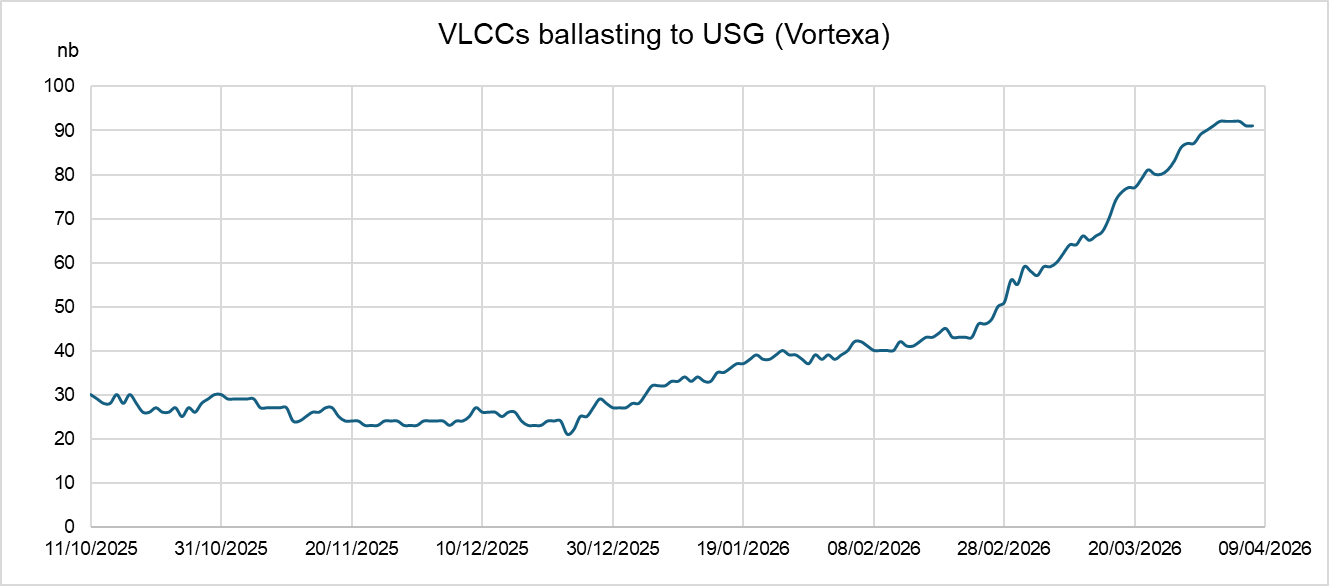
Meanwhile, China is ramping up oil and LNG imports from the US for the first time in a year. On a somewhat related note, there appears to be a notable and atypical uptick in empty oil tankers transiting to the US to load up.
At the same time, The Hill ran a feature on China progressively losing influence in a variety of Latin American countries as the Trump administration looks to project a more, uh, “protective” posture in the Southern Hemisphere. On this point, those with their tinfoil hats at the ready may be interested to note a large explosion at the Bridge of the Americas this week that came close to blocking access through the Panama Canal.
That said, China also responded to global disruptions by announcing a ban on sulfuric acid exports beginning next month, a move that could send more shockwaves through an already weaker fertilizer market.
The Trump administration is reportedly exploring “punishments” for NATO allies that have failed to support US operations in Iran, the latest signal of the US’s willingness to shake up the chessboard of the old global economic order.
Perhaps having finally learned the lessons of 1971, France pulled its remaining sovereign gold reserves out of New York vaults. Interestingly, it apparently did so by selling in New York and buying with the proceeds domestically – if only there were some type of, say, digital gold that could be transferred in arbitrary size around the world and instantly verified in minutes.
The US trade deficit increased M/M in February, though was down 14% vs February 2024 (the last February comp before substantial tariff frontrunning skewed the figures). However, gold exports once again drove a sizable chunk of the normalized period over period improvement.
Domestically, the macro picture was mixed on the week, as the latest Services PMI declined more than expected M/M, though still remained firmly in expansion territory. The Logistics Manager’s Index, however, came in very hot with a large M/M jump and its best print since early 2022.
GDP growth for Q4 was revised down to just +0.5% from an already disappointing +1.4% initial read. Headline CPI of +3.3% was in line with consensus, though core inflation (ex-energy) rose only 2.6%, slightly below expectations, potentially giving a little more air cover to a Fed that – per the latest minutes, which still suggest another rate cut this year – seems reluctant to hike into an energy shock.
Carlyle became the latest asset management platform to limit redemptions from a multi-billion dollar private credit fund, as it reported requests to redeem almost 16% of its $7 billion CTAC fund. As part of this update, Carlyle noted that investors’ inability to get out of other funds over the past month contributed to its own redemption pressures (the textbooks have a word for that phenomenon, I think it rhymes with “fun”).
A new report by insurance rating agency giant AM Best suggested portfolios across the annuity-selling space are “significantly worse off” than they were on the eve of the Great Financial Crisis thanks to recent growth in private credit exposure.
In response to the ongoing stream of questionable private credit headlines, the Treasury Department scheduled a meeting with state insurance regulators to review ratings assigned to over $400 billion in private credit instruments that may have been too generous or insufficiently supported.
Elsewhere in eyebrow-raising government meetings, Treasury Secretary Scott Bessent and Fed Chairman Jerome Powell “urgently summoned” every major bank CEO (except, notably, Jamie Dimon) to Washington this week, ostensibly to discuss potential new cybersecurity threats posed by Anthropic’s much-discussed but still mostly unreleased Mythos model. Once again, our tinfoil-clad readers may fairly ask if such an emergency meeting of the most powerful regulators and financiers in the world during the most geopolitically turbulent moment in the last 50 years might actually have been about something else.
Morgan Stanley’s MSBT ETF officially went live this week and got off to an extremely strong start, with volume and inflows putting it in the top 1% of ETF launches historically. The firm’s head of digital assets indicated that MSBT posted the best first day volume of any ETF they’ve launched.
BlackRock also quietly filed for a new income-oriented bitcoin ETF.
Regulatory Update
Treasury Secretary Bessent penned an editorial in the Wall Street Journal about the importance of passing the CLARITY Act as soon as possible. Coinbase CEO Brian Armstrong tweeted this piece out in agreement, suggesting that Coinbase – which, per reports, has been at odds with the administration about recent drafts of the bill – is now aligned and ready to move the legislation forward.
That said, the bill’s protections for developers of noncustodial software apparently remain a sticking point with some law enforcement and regulatory groups.
The OCC granted conditional approval for Coinbase’s national trust charter.
Noteworthy
Potential mitigation measures for the possible eventual emergence of a quantum computer continued to roll in this week, as Starkware CPO Avihu Levy published a proposal to for quantum-resistant bitcoin transactions without a soft fork (though the idea comes with some notable current drawbacks including cost to execute and relaying the resulting non-standard transactions).
Meanwhile, bitcoin and lightning developer Olaoluwa Osuntokun published his own proposal to better protect vulnerable coins in the case of an emergency soft fork. And just for good measure, Daniel Buchner posted a framework for post-quantum signatures that would also not require an immediate soft fork.
Osuntokun also released a helpful comprehensive technical tracker of the extensive and multifaceted work already in progress to develop various quantum-resistant solutions.
For the first time in history, the UK’s welfare spending by itself now exceeds the country’s total tax receipts. Some leading mathematics experts have suggested the situation may be unsustainable.
Apple complied with an order from the Chinese government to remove BitChat – a decentralized messaging app developed by Jack Dorsey that leverages Bluetooth and mesh networks – from the local app store.
Travel
OPNext, New York, April 16
Bitcoin 2026, Las Vegas, April 27-29
the ceasefire/escalation framing is perfect tbh. every time there's a deescalation headline the underlying infrastructure question doesn't go away.