

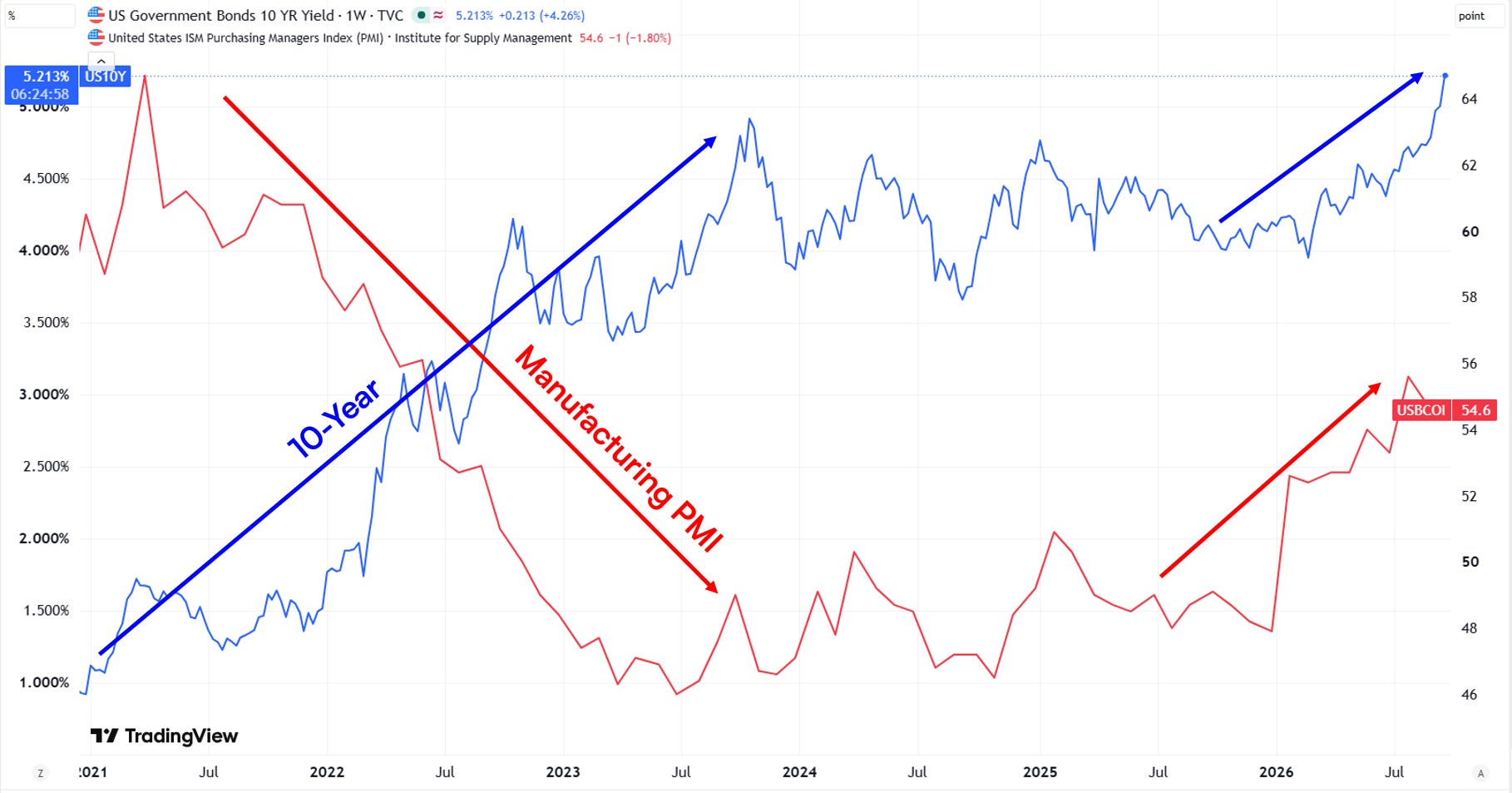
The bond market had a terrible, horrible, no good, very bad week, though the culprit in this case looks a bit different than in prior versions of this story. The last time the 10-year Treasury yield was sitting where it closed out this week (north of 5.2%, a three-year high), the American industrial economy had a decidedly worse complexion. Back in October 2023 (those halcyon days when almost no one had ever heard of recursive self-improvement), PMIs had spent the better part of two years in a sharp downtrend and were in the middle of one of the longest runs of contractionary readings in the history of the data series. This time around, they’re heading in the opposite direction, with this week’s S&P composite print ripping to its highest level since July 2021. Oil and inflation have gotten most of the focus as drivers of the yields story, and they’re no doubt important; however, rates are generally procyclical (absent explicit Yield Curve Control – bookmark this for later), so it’s not entirely shocking to see the long end moving higher just as the US embarks on a new Manhattan Project whose staunchest advocates believe it will deliver double-digit GDP growth (especially since that project is making demands on physical-world resources the likes of which we haven’t seen since World War II). There’s one obvious, though far from cost-free, bailout mechanism for this upward pressure, but so far the folks holding that lever have shown little interest in acting as a release valve against the procyclical uptrend, with Fed Governor Michael Barr and New York Fed President John Williams both lining up behind more hikes this week.
As we’ve argued elsewhere, this is the essential conflict facing the administration: whether GDP growth and its attendant tax receipts can outrun higher debt servicing costs by enough to keep nondiscretionary outlays flowing without recourse to Ye Olde Money Printer. This week’s renewed bond volatility didn’t do them any favors there, with the MOVE Index finally breaking out of the fairly stable range it had held for months, though what looks like an easing oil situation out of the Middle East may be a partial offset in the coming weeks. At the risk of repeating ourselves, this looks like it sets up two live paths from here: In the first, the growth leg is for real, receipts rise fast enough to keep the interest bill in a workable spot, and the buildout more or less pays for itself (with a little help from a new digital dollar to sop up short-end Treasury issuance). In the second, a Fed unwilling to lean on the long end runs into a Treasury that can’t afford blended yields much higher than this, and we get another classic step-function change that has characterized so much of recent American financial market history. But whether Bessent et al. ultimately get to run a victory lap or not, we’re clearly facing a major phase shift, and we think either way this breaks will entail a clear role for scarce, programmable money as a base collateral asset.
As the world’s largest investor focused on the convergence of bitcoin, energy, and AI, Ten31 has deployed over $200 million across two funds into more than 30 of the most promising and innovative companies in the ecosystem. Visit ten31.xyz/invest to learn more and get in touch about participating.
Market Updates
It appears rumors of Saudi Arabia’s oil standstill were greatly exaggerated, as the Kingdom aggressively ramped Gulf exports back up early this week in the wake of the East-West pipeline attack, loading ~14 million barrels onto 7 VLCCs at once, while also telling Asian refiners they’ll soon be able to pick up cargoes from the key Red Sea port of Yanbu (and per satellite imagery, they were apparently doing so by mid-week).
The Kingdom has now sold roughly 100 million barrels to Asian buyers since last week despite the disruptions, helping push total Saudi oil exports to their highest level since the start of the war.
France, meanwhile, said it will deploy forces to defend Yanbu from Houthi attacks, a notable shift in kinetic posture from one of the states most impacted by Middle East energy disruptions, and one that sets up an interesting new front in what looks like a metastasizing proxy war, per the Wall Street Journal’s reporting that Yemen’s Houthis are increasingly supplied by China.
More broadly, Hormuz flows appear to be continuing in the right direction, with 13.5 million barrels per day clearing the waterway toward the end of the week, the highest since early July (though likely at a higher than optimal cost given the need for dark transits and other workarounds).
Those barrels can’t arrive soon enough for China, where fuel inventories have fallen to decade-plus lows.
Late in the week, Tehran offered to reopen the Strait within seven days if the US eases its blockade and lifts oil sanctions, which may strike some readers as a curious bargaining chip given the aforementioned oil flows out of Hormuz.
Predictably, President Trump rejected the proposal (though, ever the gentleman, only after Friday’s market close) and is reportedly planning to ramp up the bombing again after the midterms.
Treasury Secretary Scott Bessent, for his part, promised to shut down all Iranian airlines worldwide starting Wednesday and threatened secondary sanctions on anyone who fuels, services, or tickets them.
Back on the home front, trucking spot rates net of fuel are up 27% Y/Y, one offset for carriers staring down much higher diesel prices.
But given the ongoing strain of high diesel prices, Bessent said the Treasury is examining a diesel export ban (with Trump chiming in that he’s called for one too), even as Energy Secretary Chris Wright said it wouldn’t work and instead hinted at a “voluntary cap” on exports.
Reporting out of Politico noted a decision on a ban would be coming by the end of the week (though as of this writing it’s still crickets), and while there are reasons to think a ban may not actually lower diesel prices domestically, there are also reasons to think that isn’t the primary motive.
Whatever the actual goal might be, the White House chose to take a victory lap on the industrial economy this week, with Bessent going out of his way to praise US manufacturing growth alongside PMIs that ripped way above expectations (albeit with the highest prices-paid reading since October 2022).
In response to that growth, Fed Governor Michael Barr said the Fed was previously “out of position” and that more hikes are likely needed, while New York Fed President John Williams agreed (though he was largely just reiterating the FOMC’s own commentary).
That combination of scorching growth and hawkish Fedspeak sent the 10-year back above 5% in a massive one-day move on Wednesday, and it kept going to finish the week north of 5.2%, the highest level since October 2023.
Perhaps more importantly, the MOVE Index finally broke out of its recent range, rising above 100 for the first time since the spring, which as we’ve noted is probably the bigger short-term constraint than the absolute level of yields.
The rates action also pushed the average 30-year fixed mortgage close to 7.5%, once again knocking on the door of multi-decade highs, which we imagine is not a welcome sight for many Congressmen seeking reelection in ~6 weeks.
Nor will it help multifamily landlords, who per the Wall Street Journal are sitting on a $2 trillion debt problem that is only getting worse and bears monitoring as one of many sources that could disrupt Trump and Bessent’s ongoing high-wire act.
Speaking of midterms, the Supreme Court ruled that the administration’s SAVE voter registration system is legal and can be used for the elections in just over a month, though the White House can’t force states to use it (we’ll let readers decide whether such a database could have any material impact on election outcomes).
The engine behind much of this week’s growth story is also shaping up to be one of the more contentious issues heading into November, but President Trump doubled down on his anti-pacing stance from last week, saying he’s not going to stifle the AI industry and noting for good measure that President Xi Jinping agrees with that view.
The White House was even reportedly considering Treasury Secretary Bessent for a new “AI Czar” position – a merging of responsibilities that would tell you a lot about the key drivers for making this whole gambit work – though Trump later said that’s not happening.
OpenAI has reportedly almost reached the long-theorized milestone of recursive self-improvement, with its internal models now handling much of the work of building and training new ones, while announcing that a new model it started training just three weeks ago has already solved 100 open problems in math.
Even with all those advances, insiders said this week that the AI labs have largely oversold the cybersecurity threat from their models.
On the hardware side, HBM export prices dropped for the first time in 5 months as Acer declared the structural memory shortage to be coming to an end, which may be welcome news for the hyperscalers and neoclouds tasked with making compute great again (even if it’s less positive for the memory bros).
But the permitting office remains perhaps the most significant bump in the road for this whole story, as Texas Governor Greg Abbott once again put a moratorium on new data center builds until his ERCOT audit is completed, while Oracle sent a force majeure notice on its stalled New Mexico data center, citing regulatory and permitting delays.
Those headlines notwithstanding, data center timelines remain broadly intact across the US, with Oracle’s New Mexico project accounting for only ~1% of capacity under construction.
Away from the compute complex, Mexico’s President Claudia Sheinbaum said Mexico and the US have reached agreements as Washington races toward a new trade deal to replace USMCA, likely putting more pressure on Canada.
The US also pushed the Donroe Doctrine further this week with a joint statement on “defending hemispheric sovereignty” published alongside various South American states, while President Trump again hinted at more influence operations in Cuba, telling the UN that “freedom will be coming to Cuba.”
Further north, the text of the Greenland deal looks pretty favorable to the US, while the US, Japan, and South Korea established a Trilateral Arctic Pacific Partnership at their meeting in New York.
All those global realignment headlines set the table for a characteristically chummy Trump-Xi meeting this week, which didn’t break a ton of new ground but did result in some mutual cuts to select tariffs.
In a less friendly signal for Beijing, new reports this week showed that Saudi Arabia has withdrawn from mBridge, China’s cross-border payments platform intended to serve as an alternative to the traditional and US-centric SWIFT system (though the exit technically happened last year and is only being announced now).
Washington is continuing to build out its own new rails in the meantime, with Bloomberg reporting that Treasury, the State Department, and the Development Finance Corporation are all working on initiatives to promote the use of USD stablecoins abroad, as the US keeps making preparations for the eurodollar to meet the same fate as Joe Pesci at the end of Goodfellas (less cinematically inclined readers may infer this was not a happy ending).
As the administration continues to play footsy with stablecoins, bitcoin had a strong week of its own, with spot ETFs taking in their largest daily inflows all year while the corn broke $87,000 before consolidating around $84,000 to close out the week.
That haul pushed ETF flows positive YTD for the first time since April, a pretty notable turnaround after the abysmal price action earlier this year.
Bitwise also published a review of its conversations with 15 large asset managers and found that none reduced their bitcoin allocation during this past year’s drawdown, while many even added on the weakness. Meanwhile, BlackRock published an overview of the ways AI may drive more adoption of “digital assets.”
Regulatory Update
The CFTC released new guidance on how digital assets can be used as collateral in derivatives markets, potentially another incremental step in plugging bitcoin into the plumbing of traditional finance.
Secretary of War Pete Hegseth’s latest investment disclosure included some exposure to bitcoin.
Noteworthy
Halcyon Energy released a new forecast calling for 100GW of new gas-fired generation in the US from just 2027 through 2029 based on officially filed plans alone (even if many of these end up subject to the kinds of permitting delays discussed earlier, this is still a staggering figure).
Block joined the x402 Foundation to bring bitcoin Lightning payments to the x402 open standard for agentic commerce, an encouraging step toward the machines using money that actually works natively on the internet.
A new white paper lays out a design for “shielded bitcoin,” enabling more private transfers on bitcoin’s base layer.
The US seized the assets of an offshore bank holding a small amount of USDT collateral, a reminder of just how much of the stablecoin stack still runs through the traditional banking system.