

You’re probably already tired of hearing about it even a few days after the fact, but the story of the week was undoubtedly the midterm Blue Wave that upended the balance of power in Washington, and for more downstream reasons than consensus may fully appreciate. Most directly, a Congress dominated by outspoken adversaries of the White House potentially stands to throw many wrenches into the machinations of an administration trying to accomplish the high-wire act of simultaneous decoupling, reindustrialization, and preservation of dollar hegemony. Readers will have to draw their own conclusions on whether any of those are worthy goals (though even their supporters should probably be able to concede their execution has been uneven thus far), but it’s clearly going to be slightly more difficult to balance all of those priorities if everyone in President Trump’s circle down to the junior staffers is fighting off special counsels and impeachment proceedings for the next two years (change the channel, I think I’ve seen this one before). The caveat there is that the Treasury and Fed are still arguably more important to this agenda than any member of Congress and remain helmed by two figures who seem clearly aligned with the administration’s direction of travel – plus, as we flagged a few weeks back, some senior Democrats are now publicly echoing many distinctly Trumpian talking points on several key issues – but the next moves in an already complex game have no doubt gotten even more complicated.
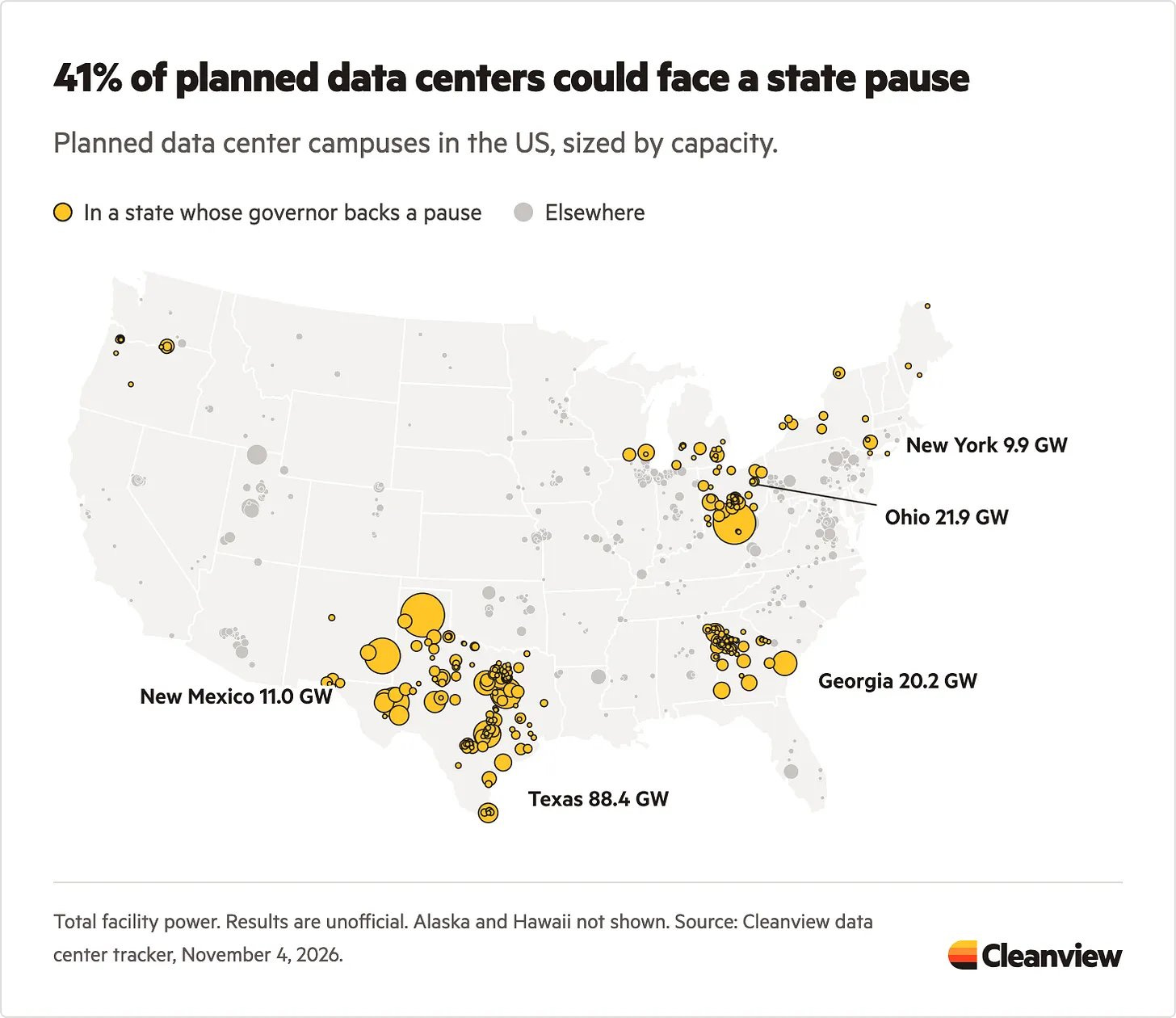
The other major and immediately relevant effect of the GOP shellacking was the wave of successful anti-data center candidates and ballot measures, most notably Democrat Gina Hinojosa’s surprise victory as the next Governor of Texas, which sent shares of basically every company in an already beaten-down AI complex plummeting to lows that in many cases almost totally erased their YTD gains. We would tend to fade some of the hysteria on this point specifically, given data centers are likely responsible (directly or indirectly) for a good chunk of the industrial impulse that has kept the US out of a recession over the past several years and are a key bulwark of the tacit geopolitical great game playing out between the US and China. Perhaps more importantly for the newly empowered Blue Crew, data centers also represent a golden opportunity for the more Machiavellian elements of the Democratic establishment to rebrand the whole buildout as a boon for American labor unions while using their newfound political weight to lean on hyperscalers and other large supply chain players for a bigger cut of the action (to this point, it’s worth noting that a major data center permitting bill is already seeing a bipartisan push for passage during the lame duck session that will close out this year).
But step back and consider what it might mean if the more radical elements of the party really do get their way here. The bond market perhaps offered an early hint on Thursday, when the Nasdaq posted its worst day since March 2020 and the 10-year could only muster a 5 basis point rally, all with crude having just given back a big chunk of its war premium, which also should have been a gift to the long end. This kind of action raises a series of questions we’ve been pointing out for more than a year: what does a truly stalled buildout do to the “run it hot” strategy? What does that in turn do to debt to GDP, and to nondiscretionary spending as a share of tax receipts? Where does that leave a Treasury complex that is already leaning harder on bills every quarter to fund the deficit, while exhibiting a growing reliance on levered and highly price-sensitive hedge fund buying? Finally, in a world where the Treasury’s reworking of the dollar system has not yet played out, what’s the net impact on rates from all of that, and what would be the reaction function from the Fed and policymakers? With avowed anti-capitalists now in charge of the two most important cities in America, we claim no special insight into which wing of the new majority wins this internal tug-of-war, but we suspect longtime readers can infer why we think hard assets keep a pretty central role in this story, even if (especially if) the Democratic hardliners get everything they think they want.
Selected Portfolio News
Maple AI added Kimi K3.1 Pro to its platform, offering users access to a cheap, private, near-frontier model for agentic coding:


As the world’s largest investor focused on the convergence of bitcoin, energy, and AI, Ten31 has deployed over $200 million across two funds into more than 30 of the most promising and innovative companies in the ecosystem. Visit ten31.xyz to learn more and get in touch about participating.
Media
Giga Energy’s modular approach to data center infrastructure was featured in both TechCrunch and Grit Daily.
Market Updates
Tuesday’s midterms dealt a massive blow to Republicans and the Trump administration’s agenda, with the GOP losing both chambers by a wide margin as Democrats picked up roughly 40 seats in the House and seven in the Senate.
The blue wave ran well down the ballot too, as “democratic socialist” Nithya Raman won the Los Angeles mayor’s race, putting the two most important cities in the US under the control of the DSA.
Markets counterintuitively ripped on the result for one of your classic “bad news out of the way” trades, before totally reversing course on Thursday, when the S&P 500 erased about $2 trillion of market cap in roughly 40 minutes to wipe out the entire post-election rally.
That sent the VIX up more than 70% on the day, its biggest single-session jump since February 2018 (and bigger than anything we saw in March 2020).
The selloff landed on a buyside still licking its wounds from October, with what looks like one of the worst hedge fund wipeouts in years across a variety of strategies, as stock pickers posted their largest active position cuts in over a decade and Lone Pine round-tripped a 40% first half all the way to negative on the year.
Among the many rough results for the GOP, the Texas governorship flipped blue for the first time in over 30 years behind a campaign from Democrat Gina Hinojosa that railed against data centers, driving investor anxiety that the state’s ~90 GW data center backlog (a key pillar of the US’s AI buildout) could be meaningfully impaired over the next few years.
We wouldn’t be surprised if much of this fear proves relatively unfounded, given Hinojosa has explicitly said that all currently permitted data centers will be allowed to finish construction (likely covering most deliveries well into 2028). New projects will have to pay taxes, use union labor, and not raise consumers’ power bills, which seems manageable enough given the political incentives likely skew toward letting the buildout proceed.
But regardless of those nuances, the market is increasingly a shoot-first game, and the battered AI complex consequently closed out the week deep in the red, with the semiconductor index logging its worst day in over six years on Thursday.
And it’s not just Texas, as local ballot measures across the US voted overwhelmingly to restrict data center development, with restrictions passing in every case except one.
Just for good measure, Bernie Sanders piled on by calling for a national moratorium on data centers, though realistically this is never getting past President Trump’s desk.
As a potentially countervailing force, the Senate seems primed to make a bipartisan push during the lame duck session for a sweeping bill to fast-track grid and data center development, a package with the rare distinction of being cheered on by climate groups and the US Oil & Gas Association alike.
But some lenders aren’t waiting around to see how it shakes out, as ING is reportedly shopping a $500 million portfolio of data center loans that includes exposure to Vantage, CyrusOne, and Stargate’s New Mexico site.
Over at the labs – whose economics were already in doubt against the backdrop of decelerating revenue growth and eye-watering valuation expectations – Anthropic’s run rate topped $80 billion at the end of October, a decent monthly step-up, but apparently not strong enough for some major prospective IPO investors to swallow a $1.5 trillion valuation, which now looks very likely unattainable in the near future given this week’s election results.
Buyers now appear to be floating something more like $1.2 to $1.3 trillion ahead of next week’s roadshow, with some weighing as low as $1.1 trillion.
As American capital markets have started to look queasier, OpenAI spent the week deepening its ties to Abu Dhabi, inking four deals spanning government, energy, and sovereign wealth (with UAE investors set to co-lead its new round), the latest evidence of the US AI complex cozying up to non-Iran GCC members.
The first close of that round landed at $11 billion at a $1.25 trillion valuation (down from the $1.4 trillion floated a few weeks back), with OpenAI reportedly still looking to raise another $9 billion and investors likely reluctant to give OpenAI much at that level until they see whether Anthropic can hold that range after its upcoming IPO.
The underlying technology continued to make clear strides regardless of market gyrations, with Anthropic telling prospective IPO investors that its 15-person chip team is already using Claude to speed up chip design, one more data point for the lab verticalization thesis we flagged last week.
Perhaps more consequentially, a new METR report estimated that AI is now making development roughly 2x faster at Anthropic, suggesting recursive self-improvement may be very close.
On a related note, MIT researchers showed a frontier model directly editing another model’s weights to fix its reasoning loops and boost its math scores up to 6x without any gradients or training, which theoretically has implications for frontier economics (though those implications may be positive or negative, depending on your lens).
Amid the carnage, GPU rental rates have continued to moon, with Silicon Data noting that prices are still rising across the board and that whatever the market is fretting about has more to do with the next couple of years than anything happening on the ground right now.
Not everyone is in a hurry for more compute, though, as Goldman Sachs restricted Claude Code and GitHub’s coding tools to engineers only, much to the chagrin of traders who’d been happily vibe coding with the CIO’s blessing as recently as July.
The market doom and gloom was juxtaposed with a much-better-than-expected jobs report showing 165,000 new payrolls in October, though that arguably piles on another headwind if it helps lock in a more hawkish Fed stance.
Interestingly, the 10-year rallied only about 5 basis points amid Thursday’s rout, a pretty tepid bid for the Nasdaq’s worst day since the COVID shock (even if this came on the back of a decent rally over the past month that arguably anticipated some of this chop).
Treasury, for its part, still doesn’t plan to increase coupon sizes for the next several quarters, so it will be relying even more on bills to fund the deficit, an unsurprising extension of the “Activist Treasury Issuance” strategy Scott Bessent criticized prior to his assumption of the big seat.
Oil also sold off hard on the week, with WTI falling below $90 and other key benchmarks declining partly because of a JD Vance Xeet conceding that the unpopularity of the Iran War was the primary cause of the midterm drubbing. Meanwhile, the physical premium in the Middle East all but evaporated after running as high as $30 per barrel for much of the year, as traders positioned for a wind-down of the conflict in the Gulf following the GOP’s electoral rebuke.
While Vance is correct that voters clearly responded negatively to the war, we tend to believe for a variety of reasons that we’re still far from a durable de-escalation in the Gulf – if nothing else, it’s tough to see President Trump (who is, of course, famously conciliatory and humble) conceding defeat with only two years left to define his legacy before he rides off into the sunset (or is dragged there in handcuffs by Democrats).
In any case, China reiterated in coordination with Oman that it wants to see the Strait of Hormuz return to normal as soon as possible, arguably its latest rhetorical hardening against Iran.
The Western hemisphere continues to shape up a bit differently, as Washington and Caracas are reportedly negotiating a long-term American military presence in Venezuela, the latest step in a regional consolidation we’ve been tracking for most of this year.
Tuesday’s results notwithstanding, we don’t see frictions with China abating near term, as the country’s chemical industry has been aggressively ramping exports despite roughly 30% of local producers now in lossmaking territory, with the involution model continuing to spread to industries worldwide, to the growing discontent of countries beyond the US.
American automakers are pushing back on that model, as the industry’s main lobbying group urged Congress to pass a permanent ban on Chinese vehicles before the session ends in December.
German automakers did the same in Berlin, helping drive a sudden reversal from a government that had long been one of the loudest opponents of EU tariffs on Chinese EVs.
Elsewhere in Europe, Poland’s long-running constitutional crisis has spilled over into a fight for control of its central bank. Izabella Kaminska laid out how this whole complicated saga could leave rival claims over the bank and its gold reserves, and in an extreme case even push an EU member state toward dollar rails and stablecoins if euro channels became unreliable, making this a scenario worth tracking as global financial rails continue to get reshuffled.
Bitcoin struggled just like everything else on the week, though all things considered continued to hang in well despite the Binance hack and the massive AI selloff, closing above the 50-week moving average on Thursday (and hovering right around there as of this writing).
Strategy’s STRC preferred also hit par again for the first time since May, ending a 165-day stretch below $100 and potentially clearing the way for the company to restart issuance that could fund more bitcoin buying.

Regulatory Update
House Democrats are apparently looking to advance an amended version of the CLARITY Act next Congress, including a bigger role for the SEC and ethics provisions aimed squarely at President Trump’s digital asset activities.
But don’t get your hopes up, as Elizabeth Warren (Colonel of the Anti-Crypto Army) is set to assume control of the Senate Banking Committee in January.
Lest you think Treasury Secretary Scott Bessent was going to be cowed by this week’s election results, OFAC announced a new round of sanctions on eight Canadian money service businesses with alleged ties to the IRGC after market hours on Friday.
Noteworthy
Paraguayan digital lender ueno suspended the accounts of some 3 million users amid a solvency crisis, with the central bank seizing ueno after regulators found a capital hole tied to insider lending and the fallout now threatening President Santiago Peña with impeachment. As tech trades blow up and political infighting gains ever more attention, events like this are an instructive reminder of the importance of bitcoin’s enduring properties regardless of which way the political winds are blowing.